


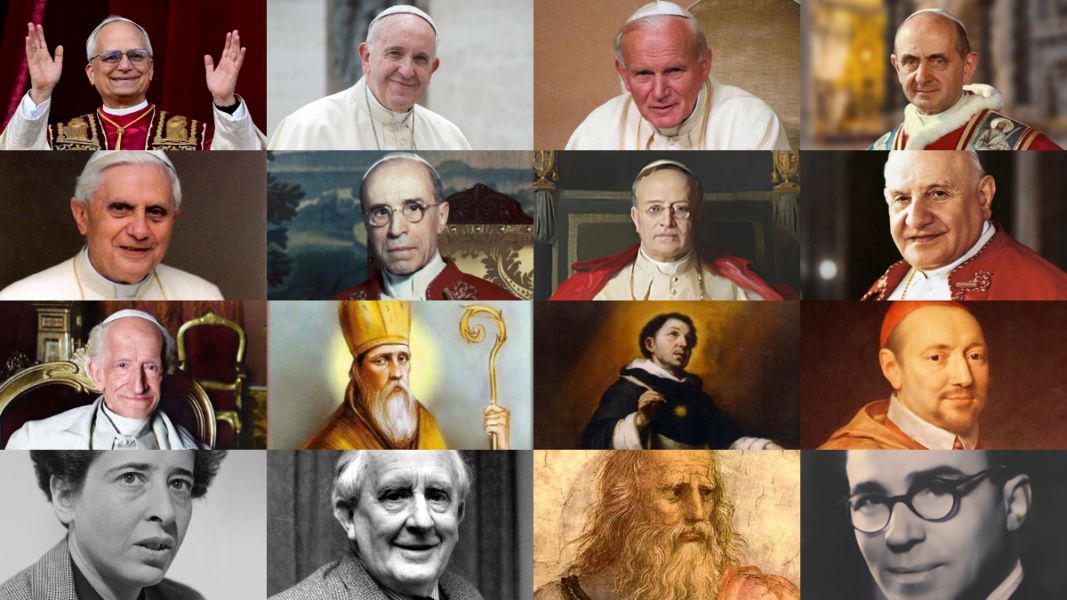
One of the most revealing ways to read a magisterial document is to examine its critical apparatus. The footnotes of an encyclical are not mere scholarly ornament: they indicate the tradition in which the Pontiff situates himself, which authors he recognizes as authorities, which prior magisterium he assumes as his own, and which cultural references he considers worthy of inclusion in a text meant to establish doctrine. We have reviewed the 224 notes of Magnifica Humanitas to offer the reader an ordered tally of the authors cited, from most to least frequent.
The result allows us to draw some conclusions about the intellectual profile of the first encyclical of Leo XIV: a clear continuity with the magisterium of Francis, a smaller-than-expected presence of his namesake predecessor Leo XIII—whose 135th anniversary of Rerum novarum frames the document—and a set of non-ecclesiastical cultural references that includes such diverse names as Hannah Arendt, J.R.R. Tolkien, and Plato.
Pontifical Magisterium
- Francis — about 35 citations. By far the most cited. Evangelii Gaudium, Laudato si’, Fratelli tutti, Dilexit nos, Laudate Deum, and numerous speeches and messages appear.
- John Paul II — about 25 citations. Centesimus annus, Sollicitudo rei socialis, Laborem exercens, Veritatis splendor, Redemptor hominis, Evangelium vitae, addresses to the UN, among others.
- Benedict XVI — about 12 citations. Chiefly Caritas in veritate, also Deus caritas est, Sacramentum caritatis, and catecheses.
- Paul VI — about 10 citations. Populorum progressio, Octogesima adveniens, addresses to the UN and the FAO.
- Leo XIII — 3 citations. Rerum novarum and In plurimis.
- Pius XII — 3 citations. Menti Nostrae and Christmas radio messages.
- Pius XI — 2 citations. Quadragesimo anno.
- John XXIII — 2 citations. Mater et magistra and Pacem in terris.
- Leo XIV himself — several self-citations from his own 2025 speeches.
Fathers, Doctors, and Theologians
- St. Augustine — 5 citations. Confessions, The City of God, Commentaries on the Psalms, Sermons.
- St. Thomas Aquinas — 3 citations. Summa Theologiae and Super Boetium De Trinitate.
- Pierre de Bérulle — 1 citation. Discourses on Jesus.
Non-Ecclesiastical Authors
- Hannah Arendt — 1 citation. The Origins of Totalitarianism.
- Viktor Frankl — 1 citation. Man’s Search for Meaning.
The Twilight of the Modern Age.
- J.R.R. Tolkien — 1 citation. The Lord of the Rings.
- Plato — 1 citation. Letter VII.
- Giorgio La Pira — 1 citation. 1962 address.
Recent Curial Documents
- Dicastery for the Doctrine of the Faith / Dicastery for Culture and Education — several citations of Antiqua et Nova (2025, on AI) and Dignitas infinita (2024).
- International Theological Commission — Quo vadis, humanitas? (2026) and Memory and Reconciliation.
Some Observations
Francis dominates by a wide margin: he is cited more than John Paul II and Benedict XVI combined. Magnifica Humanitas, in this sense, presents itself as an explicit continuation of the magisterium of his immediate predecessor, particularly in matters of social doctrine, integral ecology, and critique of the technocratic paradigm.
It is striking that Leo XIII, despite being the inspiration for the anniversary that frames the encyclical, is cited only three times. The presence of the founder of the Church’s modern Social Doctrine is, therefore, more symbolic than substantive in the critical apparatus.
The most singular element of the document is the presence of non-ecclesiastical authors. Tolkien, Arendt, Frankl, Guardini, and Plato share footnotes with the great Fathers and Doctors of the Church. This represents a broad cultural nod that places the text in dialogue with very diverse intellectual traditions.
Finally, the near-total absence of twentieth-century theologians is noteworthy. Beyond Romano Guardini, neither Joseph Ratzinger-theologian—only Ratzinger-Pope, as Benedict XVI—nor Hans Urs von Balthasar, Henri de Lubac, Yves Congar, or Karl Rahner appear in the critical apparatus. The encyclical prefers to rest its doctrinal framework on recent pontifical magisterium and on the great classics—Augustine, Thomas—without relying on the great twentieth-century theology that preceded or extended the Council.