


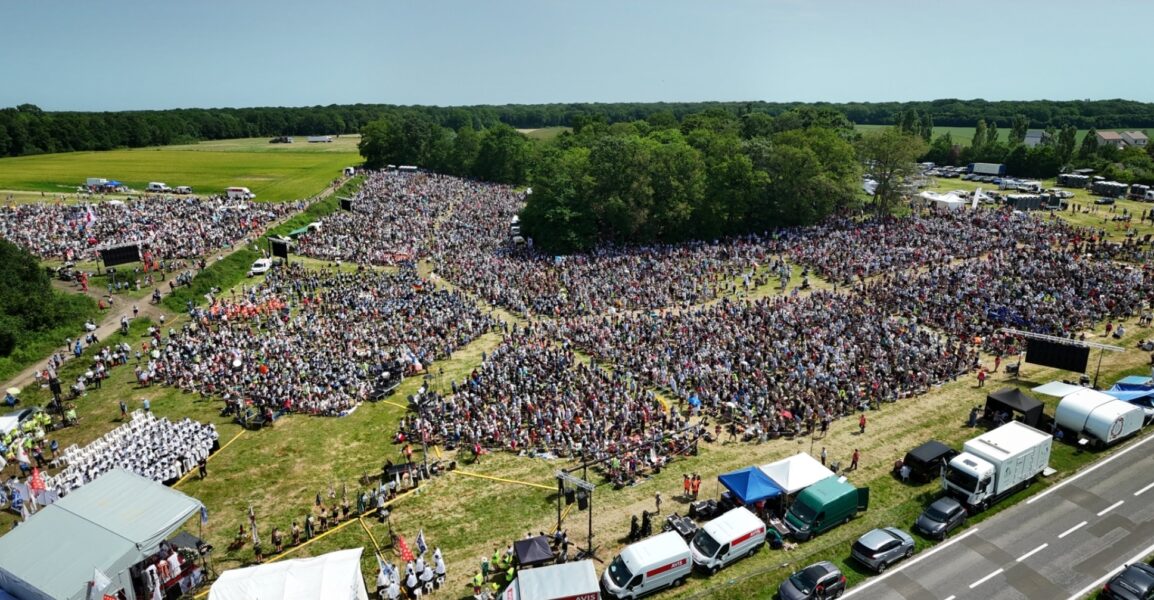
The Pentecost pilgrimage to Notre-Dame Cathedral in Chartres, a stronghold of the traditional liturgy in France, has once again broken records with nearly 20,000 participants. While Rome maintains restrictions on the ancient rite, the phenomenon continues to grow and increasingly attracts young people who had drifted away from the Church.
Forty-four years after its founding by a handful of Catholics faithful to the Tridentine Mass, the pilgrimage organized by Notre-Dame de Chrétienté has changed in scale. This Pentecost weekend, nearly 20,000 faithful walked the hundred kilometers separating the church of Saint-Sulpice in Paris from Chartres Cathedral. Registrations, which opened on Palm Sunday, sold out at an unprecedented pace: 14,000 registered on that date, compared to 6,000 the previous year.
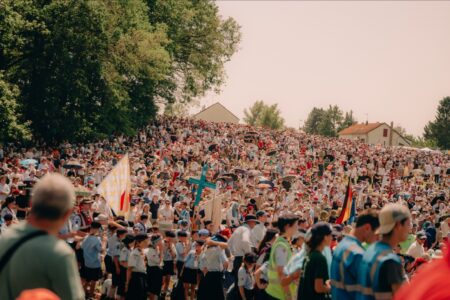
The origins of this march date back to 1983, three years after John Paul II’s famous appeal in Le Bourget: “France, eldest daughter of the Church, are you faithful to the promises of your baptism?”. A group of laypeople, also marked by the witness of Polish Catholics in Częstochowa, decided to respond on foot. The French hierarchy at the time regarded them with open hostility. Today, the episcopate maintains an uneasy silence in the face of a phenomenon that surpasses its empty parishes.
The liturgy as an entry point
Philippe Darantière, president of Notre-Dame de Chrétienté, places the project beyond the mere ritual question: “It is about transmitting the Catholic faith and contributing to the awakening of a faltering Christendom in the context of the Church’s crisis.” But it is precisely the traditional liturgy—liberalized by Benedict XVI in 2007 and restricted again by Francis in 2021—that serves as the main vector of attraction.
“In the seventies, many thought that the rites had to be simplified, Latin abandoned, or the sacred toned down in order to bring people closer to the Church. Today we see that there are people who discover the faith precisely through this liturgy. Its transcendent character, its demands, its orientation toward the divine respond to something very deep in the human heart.”
These are the words of Abbé Jean de Massia, chaplain of the pilgrimage. His diagnosis coincides with that of Abbé Matthieu Raffray, a priest widely followed on social media who leads specific chapters for people discovering the event for the first time. This year he will lead two, given the demand. According to the organizers, 5% of the pilgrims are young people very distant from the Church, “in search of truth, of the absolute, and of roots.”.
Converts from Islam:
Among the most striking testimonies is that of Nabil, a convert of Algerian origin and chapter leader since last year. A practicing Muslim, he recounts having asked for baptism after an intimate spiritual experience. But when he first pushed open the door of a church, he was advised to remain Muslim. It was upon discovering the traditional Mass that he found a Catholicism capable of answering his search.
“The sense of the sacred, reverence toward God, doctrinal and liturgical rigor… All of that speaks strongly to Muslims. When you come from a world where tradition occupies a central place, you are sensitive to a faith that dares to be transmitted and lived fully.”
Nabil regrets not having found Catholics earlier who could speak to him simply about their faith. In his eyes, Chartres responds precisely to that lack: three days of walking, meditation, teaching, and prayer that allow some to discover Christianity and others to recover the impetus to make it radiate.
The shadow of Traditionis Custodes
The success of Chartres poses an uncomfortable paradox for Rome. According to a survey by the organization itself, 63% of the pilgrims attend the Tridentine rite preferentially, a figure they consider underestimated due to the lack of access to this liturgy in many dioceses since the restrictions imposed by the 2021 motu proprio Traditionis Custodes. The document, which largely revoked Benedict XVI’s liberalization, aimed to redirect the faithful toward the ordinary form of the Roman rite. The numbers from Chartres suggest the opposite effect: a growing demand that finds no outlet in diocesan structures.
With Leo XIV newly elected, many pilgrims are scrutinizing the directions the new pontiff will give on this sensitive dossier. Pressures are mounting in both directions: those hoping for a gesture of appeasement and those demanding that Francis’s restrictive line be maintained. Meanwhile, on the roads of the Beauce, the faithful have already given their answer.
This year’s pilgrimage has placed mission at the center of its program, with the distribution of materials to help participants answer questions about the faith and support evangelization initiatives in parishes and communities. A bet that contrasts with the dominant pastoral approach in the post-conciliar Church, more concerned with not causing discomfort than with proposing.