


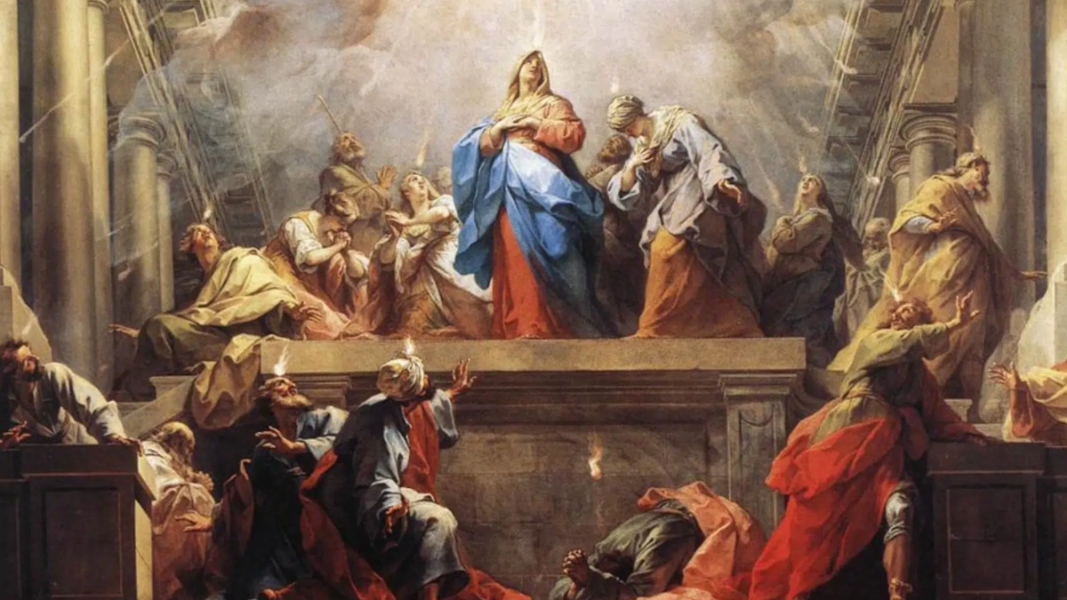
Pentecost Sunday, one of the principal solemnities of the Christian calendar, was for centuries preceded by a liturgical vigil of great spiritual richness, similar in some respects to the Easter Vigil. However, this ancient practice was suppressed in the liturgical reforms of the mid-twentieth century and today survives only in circles connected with the traditional liturgy.
The vigil of Pentecost was for centuries a day of fasting and abstinence, intended to prepare the faithful for the coming of the Holy Spirit. Until the early 1960s, Catholics still observed this day with penance, prayer and recollection.
A vigil similar to the Easter Vigil
The ancient vigil of Pentecost included prophetic readings from the Old Testament, the blessing of the baptismal font, the litany of the saints and the celebration of Mass.
It was not merely the day before a solemnity, but a true liturgical preparation for one of the great feasts of the Christian year. As at Easter, Pentecost was linked from the earliest centuries to the solemn administration of Baptism.
Pentecost, the Easter of the Roses
Catholic tradition also linked Pentecost with roses, the symbol of the tongues of fire that descended upon the apostles and the Virgin Mary.
Dom Prosper Guéranger recalls that in the Middle Ages Pentecost was known as the “Easter of the Roses.” In Rome, rose petals were scattered from the oculus of the Pantheon, now the Basilica of Santa Maria of the Martyrs, to represent the coming of the Holy Spirit.
An octave suppressed after centuries of tradition
For centuries, Pentecost also had its own octave. Monday and Tuesday of Pentecost were even days of precept in the universal Church for a long time.
The article notes that these days gradually lost their liturgical rank until the octave was finally suppressed by Paul VI in 1969.
The disappearance of this octave is one of the most significant examples of how the later liturgical reforms eliminated practices rooted for centuries in the life of the Church.
Joyful fasting and prayer for vocations
The week of Pentecost also included the Ember Days, days of fasting, abstinence and prayer. Unlike other Ember Days of the year, those of Pentecost had an especially joyful character, marked by the celebration of the Holy Spirit.
Traditionally, these days were also linked to priestly ordinations, so the faithful were invited to pray in a particular way for vocations and for the newly ordained priests.
Recovering what should not have been forgotten
Although the vigil and octave of Pentecost no longer occupy in the reformed calendar the place they held for centuries, many Catholics attached to the traditional liturgy continue to preserve these practices.
The rediscovery of these ancient customs shows that the liturgical tradition of the Church is not a dead relic, but a school of faith, penance and adoration.
Pentecost is not merely the close of the Easter season. It is the feast of the Holy Spirit, the visible birth of the Church and a call to renew the Christian life with prayer, fasting and fidelity to the tradition received.
Source: One Peter Five