


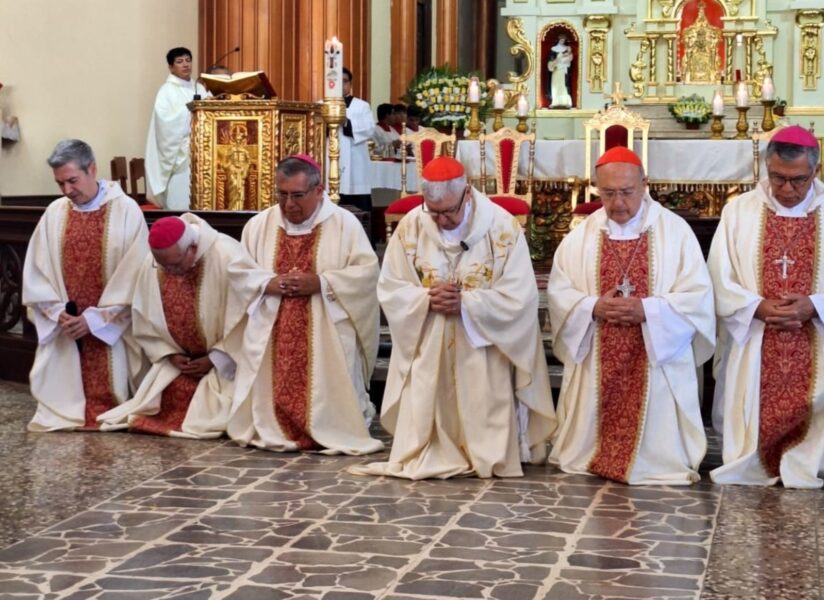
“We should have come twenty years ago. Today we ask your forgiveness.” With those words, Msgr. Jordi Bertomeu Farnós, official of the Dicastery for the Doctrine of the Faith and apostolic commissioner for the liquidation of the now-defunct Sodalicio de Vida Cristiana, addressed the families of the comuneros allegedly murdered for opposing the land dispossession linked to Sodalicio companies this Saturday at the parish of San Juan Bautista in Catacaos (Piura). The main point must be stated up front: asking forgiveness is good, and asking it of these specific families, after more than a decade of dispossessions, criminalization and deaths, is particularly good.
What happened in Catacaos
The ceremony, held at ten in the morning, was presided over by Cardinals Carlos Castillo, Archbishop of Lima, and Pedro Barreto, president of the CEAMA, with the concelebration of Archbishops Luciano Maza of Piura, Alfredo Vizcarra of Trujillo, and Bertomeu himself. The Mass took the form of a funeral rite for Guadalupe Zapata Sosa, shot dead on 8 December 2011 during a violent eviction, and Cristino Melchor Flores, who died defending communal lands. Representatives of the diplomatic corps and of the United Nations High Commissioner for Human Rights were present.
The Comunidad Campesina San Juan Bautista, of the Tallán indigenous people, denounces the seizure of some ten thousand hectares by companies linked to the Sodalicio, allegedly with the cover of the then Archbishop of Piura, Msgr. José Antonio Eguren, whose resignation Pope Francis accepted in 2024. According to Peru’s Coordinadora Nacional de Derechos Humanos, the conflict has also left seven wounded, thirty-nine people charged—some for terrorism, in cases archived in 2022—and ten families at risk of eviction. In 2017, comunero Luis Pasache Zapata was also murdered. Bertomeu acknowledged at the event that the ceremony is “a symbolic reparation that comes very late and is insufficient.”
What is right
That two cardinals, two archbishops and an apostolic commissioner should come for the first time to this forgotten corner of Piura is no small thing. Nor is it that the Vatican publicly admits that “it should have come twenty years ago.” Asking forgiveness in a public setting, before those who have lost their dead without either civil or canonical justice, is an act that binds the one who utters it and the institution he represents.
InfoVaticana has documented in detail—and will continue to document—actions by Bertomeu himself which, in this medium’s view, should long ago have led to his removal from office: the excommunication of journalists Caccia and Blanco, personally revoked by Francis; the intimidations involving the FBI; the procedural opacity outside Book VII of the CIC; the lack of patrimonial transparency in the liquidation; or the description of Peru—in a recording accessed by this medium—as “a forest, a jungle, where you fend for yourself.” None of that disappears because a just word was spoken yesterday.
What is wrong
The gesture was made inside the church, vested for celebration, during the liturgical action. That disorders the sign. The Sacred Liturgy, Sacrosanctum Concilium reminds us, is the action of Christ and of his Church, not a stage. The chasuble is not emotional stage-dressing: it signifies that the one wearing it does not act in his own name, but in persona Christi. When a vested minister kneels, he does so before the Blessed Sacrament. When he prostrates himself, he does so in the Good Friday rite or at an ordination. The knee bent by the priest in liturgical function has a precise recipient, and that is God.
Redemptionis Sacramentum expressly forbids adding or removing elements in the eucharistic celebration and warns against turning the Liturgy into a platform for messages foreign to the rite. Everything is aggravated when, moreover, it was a funeral: a rite with its own content, upon which extra-liturgical gestures were superimposed whose recipient is not God, but the faithful present and the cameras.
The misunderstood Francis-style echo
The inspiration is not hard to guess. Pope Francis kissed the feet of the leaders of South Sudan in April 2019; but that did not happen during Mass, nor vested for celebration. It was a gesture outside the liturgical action, during a spiritual retreat at Santa Marta. Debatable or moving, but not a liturgical abuse.
Bertomeu’s problem is precisely that: confusing the pastoral gesture with liturgical theatricalization, immediate emotion with sacramental meaning. There is in all this a superficial understanding of the Liturgy, treated not as an objective order received by the Church, but as an expressive support adaptable to the moral intention of the moment.
Repeating the gesture without understanding the framework is the difference between the icon and the caricature: in Francis it was a plea outside the altar; repeated by an apostolic commissioner vested in the middle of the eucharistic celebration, it becomes imitative Francis-ism, sentimental in form and poor in doctrinal substance. For the issue is not merely aesthetic or disciplinary. It is theological. Whoever understands what the Liturgy is knows that the priest does not dispose of it as a private language to stage personal messages, however noble his intentions may be. The chasuble does not amplify emotions: it sacramentally configures a function. And precisely for that reason it is striking that someone invested with doctrinal responsibilities in Rome should seem to ignore something as elementary as the difference between a personal penitential act and the public worship of the Church.
If Bertomeu and those accompanying him wish to kneel before the victims of Catacaos—and they are right to do so—let them do it in clergyman polo shirts, in street shirts, in the civilian clothes in which, for years, ecclesiastical authorities met, negotiated, remained silent or looked the other way. Those are the clothes in which the peasants of Piura were offended, and those are the clothes that should be bent at their feet. Not the chasuble, which bears no blame and does not mean what is being forced upon it at that moment. Let them kneel. Let them kiss their feet, if necessary. But outside the altar.
Processes, not photographs
Asking forgiveness is good. Asking it in canonically regular processes, with transparency, investigation and sentence, is better. The risk of the foot-kissing in a chasuble, before cameras and international observers, is precisely that it substitutes for the process.
The families of Catacaos do not need only a postcard: they need to know who bought what lands, with what money, through what companies, with what episcopal protections. They need the material restitution they themselves are demanding. The victims deserve forgiveness; the altar deserves respect. Christ is not to be instrumentalized, not even for good causes.