


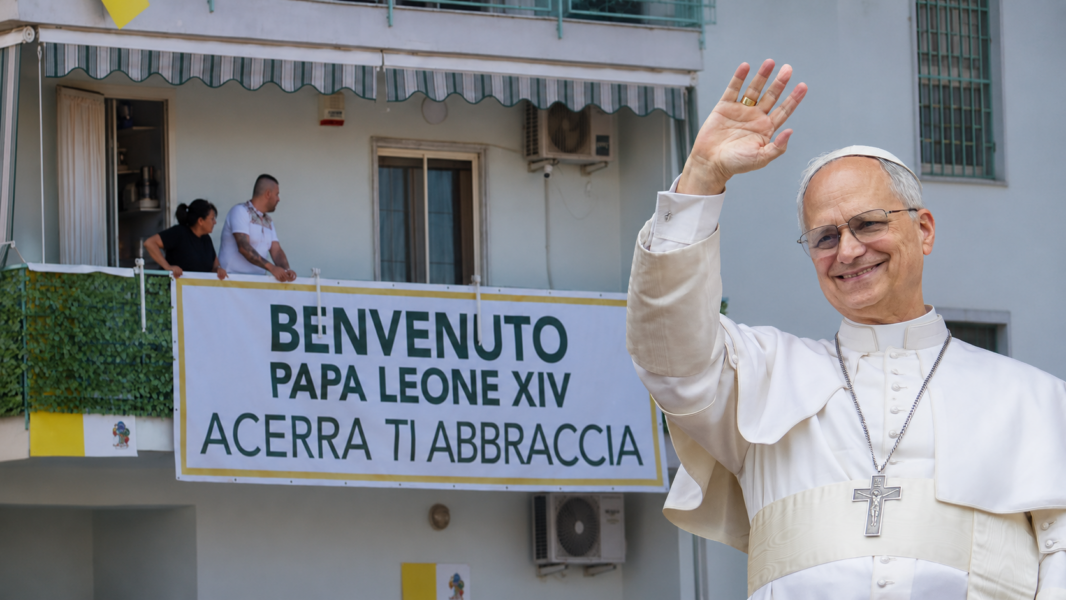
Pope Leo XIV will return to Campania on May 23 with a visit charged with symbolism and continuity with the previous pontificate: he will travel to Acerra, one of the epicenters of the so-called “Land of Fires,” to close the Laudato si’ Week and once again place the call for “integral ecology” promoted by Francis at the forefront.
The visit also resumes a trip that the Argentine pontiff had planned but was unable to make, having intended to go to Acerra six years ago before the pandemic canceled the journey. Now it will be Leo XIV who takes up the baton in one of his first outings within Italy, just weeks after his visits to Pompeii and Naples.
“We are positively surprised by Leo XIV’s attention to Campania. These are his first trips in Italy, and the visit to Acerra is a gift for us,” declared Bishop Antonio Di Donna of Acerra and president of the Campanian Episcopal Conference to Vatican News.
The Pope’s schedule will begin at 8:45 a.m. with his arrival by helicopter at the Arcoleo sports field. He will then proceed to the cathedral, where he will meet with the ecclesial community and with families of those who died due to environmental contamination. Later, in Calipari Square, he will hold an encounter with mayors and the faithful from municipalities affected by the “Land of Fires.”
The “Laudato si’,” more celebrated outside the Church than within
One of the most striking aspects of Bishop Di Donna’s interview with Vatican media is his explicit acknowledgment that the encyclical Laudato si’ seems to resonate more in secular circles than within ecclesial life itself.
“It is an encyclical more cited than known, even in the ecclesial environment. Perhaps it is more appreciated in secular circles than in our ecclesial world,” lamented the prelate.
Di Donna strongly defended the idea that care for the environment must be fully integrated into the Church’s ordinary preaching, catechesis, and parish pastoral work, rather than being limited to initiatives by small, sensitized groups.
“The Laudato si’ is not a green or environmentalist document; it is a document of the Church’s social magisterium, comparable to the Rerum novarum,” asserted the Campanian bishop.
However, Di Donna himself acknowledged that many priests still view these issues as “extra-ecclesial” matters, more linked to politics and social activism than to the core of Christian life.
The “Land of Fires,” symbol of Italian political failure
The papal visit will take place in one of Italy’s most environmentally degraded areas. The so-called “Land of Fires,” between Naples and Caserta, has for decades been marked by illegal dumping, the burning of toxic waste, and activities linked to organized crime.
The contamination of soil, water, and air has caused serious health consequences for the local population over the years, while Italian institutions responded slowly to the problem.
The bishop of Acerra himself admitted that the political response was initially “very weak” and called for continuity in control, surveillance, and decontamination efforts.
“The spotlight on our land must not be turned off,” stated Di Donna, who urged the Italian government to provide more financial resources for environmental cleanup and greater oversight of public health.
Ecology, immigration, and social doctrine
Di Donna affirmed that Campania “has never been hostile to foreigners” and defended the integration of immigrants in the region, while acknowledging the persistence of illegal labor and worker exploitation.
“The cry of the earth is also the cry of the poor,” the bishop declared, echoing one of the central ideas of Laudato si’.
He also insisted on linking environmental protection with education for legality, justice, and peace, in a pastoral approach increasingly present in certain sectors of the Italian episcopate.
Leo XIV maintains Francis’s social line
The visit to Acerra confirms that Leo XIV, at least in this early stage of his pontificate, does not appear inclined to break with some of the pastoral and social priorities promoted by Francis.
The emphasis on “integral ecology,” the link between the environment and poverty, and the denunciation of consumerist culture thus return to the center of papal discourse.
“We continue to be slaves to a mentality that uses, consumes, and discards,” lamented Di Donna, describing a society dominated—in his view—by the logic of consumption and waste.
Meanwhile, in Acerra and throughout the “Land of Fires,” the population continues to live amid social fatigue, persistent pollution, and a sense of institutional abandonment. A scenario that Leo XIV will now use to reinforce one of the major ideological and pastoral banners inherited from the pontificate of Francis.