


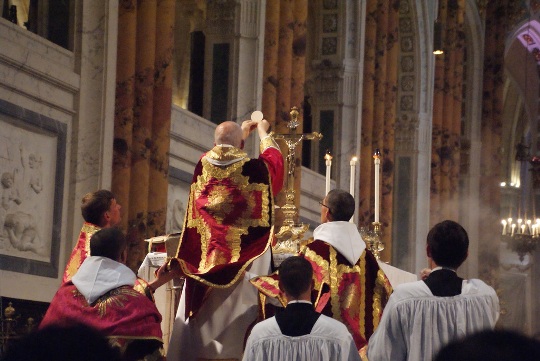
A few days before the start of the traditional Pentecost pilgrimage to Chartres, the president of Notre-Dame de Chrétienté, Philippe Darantière, has offered a reflection on the reasons behind the steady growth of one of the largest Catholic pilgrimages in Europe. In an op-ed published in La Croix, Darantière places at the center of the debate issues that are uncommon in certain contemporary ecclesial circles: the meaning of sacrifice, the sacred, transcendence, and the worship due to God.
Far from resorting to sociological analyses or discussions about new pastoral models, the French leader maintains that the appeal of the traditional liturgy responds above all to a deep spiritual need. This year, nearly 20,000 pilgrims are expected on the routes to Chartres, with an average age of just 22. In addition, as Darantière recalls, around 30% of participants are discovering the traditional liturgy for the first time.
Beyond Aesthetics
One of the most common arguments used to explain the growing interest for the traditional Mass often focuses on the aesthetic dimension: Latin, Gregorian chant, incense, or the beauty of the ceremony. Darantière acknowledges these elements, but considers it insufficient to reduce the phenomenon to a mere cultural sensitivity.
“If the traditional liturgy were nothing more than a cultural conservatory, it would be a museum; yet it is manifestly alive. It moves from the cultural to the cultic,” he states.
The appeal of this liturgy does not lie solely in its external beauty, but in the experience of transcendence it offers. According to his explanation, in an age marked by immediacy and the constant need for explanations, many young people discover in the ancient liturgy a space where man ceases to occupy the center.
“We Do Not Come First for Ourselves”
Darantière describes as one of the paradoxes of the traditional Mass the fact that, from the outside, it may appear to be a liturgy “that unfolds without us,” and yet it exercises a strong spiritual attraction.
“The priest is oriented toward Christ. He does not constantly animate or comment. The gestures are the same ones that have been performed for centuries,” he explains.
In contrast to liturgical models more centered on visible participation or adaptation to contemporary language, the president of Notre-Dame de Chrétienté insists that the Mass reminds us of an essential truth frequently forgotten: worship is directed above all to God.
“We do not come to Mass first for ourselves. We come because we have with God a debt that cannot be repaid,” he maintains.
For Darantière, precisely this decentering of man is what ultimately elevates ihn spiritually. “Man effaces himself before the rite. And far from humiliating him, this effacement elevates him,” he states.
The Permanent Appeal of the Sacred
Over the decades, numerous analyses have announced the progressive disappearance of this dimension in modern societies. However, the success of initiatives like Chartres seems to point in another direction.
“The sacred continues to attract. Not in spite of modernity, but perhaps because of it,” Darantière notes.
In a society saturated with screens, noise, and constant explanations, the traditional liturgy offers concrete signs that open to the mystery: silence, genuflections, Gregorian chant, or the use of Latin.
According to the organizer, many young people do not necessarily seek permanent novelty, but realities that precede them and transcend them. Here appears another of the key concepts of his reflection: permanence.
A Liturgy That Does Not Seek to Please the World
Darantière recalls that the Roman Canon dates back to the first centuries of the Church, and that Gregorian chant spans more than a millennium of Christian history. That continuity, far from driving away young people, seems to exercise a powerful attraction on many of them.
“Whoever discovers this Mass instinctively understands that they enter into something that surpasses them, that existed before them, and that will continue after them,” he writes.
The phrase that summarizes his entire reflection is probably the most cited in the op-ed:
“The liturgy does not seek to please the age. And therefore the age returns to it”.
The sustained growth of the Chartres pilgrimage raises uncomfortable questions for certain dominant ecclesial discourses in France. Why does a liturgy so often presented as anchored in the past continue to attract thousands of young people? Why does it generate conversions, vocations, and families deeply rooted in the faith?
“A Lived Catechism”
Finally, Darantière defines the traditional liturgy as “a lived catechism.” The Mass would not be simply a symbolic remembrance of Christ’s Passion, but the sacramental renewal of the redemptive sacrifice.
“The Mass, treasure of the faith, is not the remembrance of the Lord’s Passion, but its unbloody renewal on the altar,” he states.
And he concludes with a reflection that summarizes the core of his entire argument: “The ancient liturgy teaches not only who God is, but who man is before God.”
The growing success of the Chartres pilgrimage thus brings back to the table a question that many in the Church preferred to consider marginal. While numerous pastoral initiatives face difficulties to mobilize the faithful, thousands of young people each year walk the paths of France drawn precisely by what some, for decades, considered surpassed: the sense of the sacred, the continuity of tradition, and the centrality of God in the liturgy.