


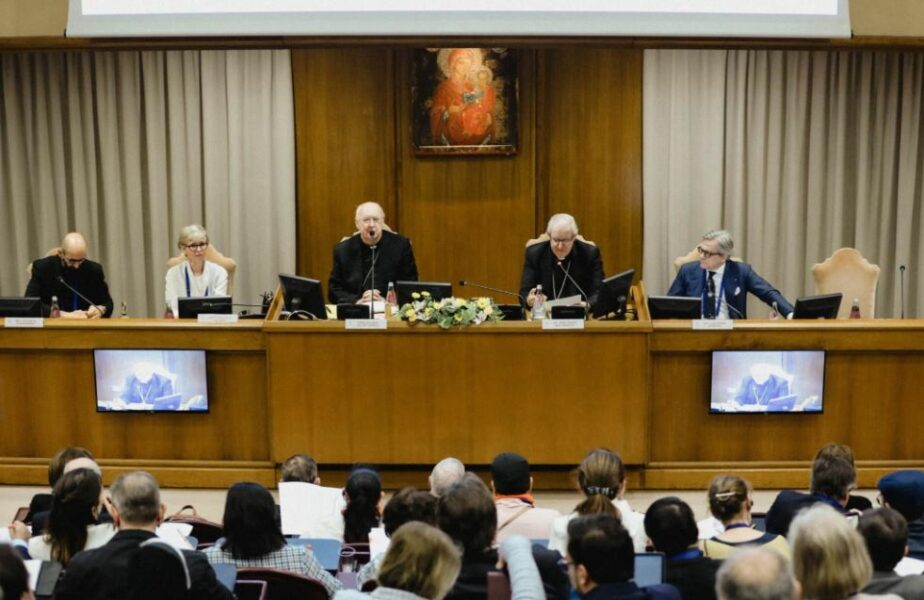
The Archbishop of Seville has spoken at the annual meeting of the Dicasterio for the Laity, Family and Life with a presentation on the relationship between bishops and moderators of associations of the faithful, in which he defended that the prelate “is not the owner of the Spirit in his diocese,” but rather “his first servant.”
Monsignor José Ángel Saiz Meneses participated this week in Rome in the days organized by the Dicasterio for the Laity, Family and Life, of which he is a member, dedicated to the leaders of international associations of the faithful, ecclesial movements and new communities. The Archbishop of Seville delivered the main presentation this Friday, titled Relationship between Moderators and Bishops. Conciliation as a Style of Government.
The prelate, who joined the Cursillos de Cristiandad Movement at the age of 17 and is currently its spiritual advisor to its World Organism, drew on his personal experience to articulate a reflection on the place of charisms in the diocesan Church. He defined movements, associations and communities as “a privileged way through which the Holy Spirit renews, again and again, the life of the Church.”
“The bishop must view movements not with the suspicion of the administrator before something he does not control, but with the gratitude of the pastor before what the Spirit brings forth”
Saiz Meneses drew on the famous 1998 intervention of Cardinal Ratzinger before associations and movements, in which the then Prefect of the Congregation for the Doctrine of the Faith presented the institutional and charismatic dimensions of the Church “not as poles in tension, but as two co-essential dimensions of a single mystery.” Ratzinger had already warned then that every authentic charism “needs to be purified” through ecclesial discernment, an integration that “does not always prove easy.”
Three tasks of the bishop: discernment, integration and mission
The Archbishop of Seville pointed out that the difficulties in the relationship between bishops and movements may be due to the diversity of spiritualities, to the temptation of the movement to “close in on itself” or to the “incapacity of the diocesan structure to accommodate a new reality that overwhelms it.” But “in overcoming these difficulties, the ecclesial maturity of both moderators and bishops is tested,” he emphasized.
Saiz Meneses identified three fundamental tasks of the bishop in his relationship with these realities: discernment, integration and mission. And he specified that the relationship the pastor is called to maintain with the leaders of movements “has a precise theological name: communion,” which is not “the result of a negotiation process between different instances,” but rather “a way of perceiving reality.”
“The bishop is not the owner of the Spirit in his diocese; on the contrary, he is its first servant and first guarantor of discernment”
Evoking Romano Guardini and his intuition that “the Church awakens in souls,” the prelate defended the validity of this perspective for understanding the current movements. The conciliation between bishop and movements, he affirmed, is not “an exercise of diplomatic skill nor a balance of forces in tension,” but “the mutual recognition, anchored in faith, that both are servants of the same Spirit that precedes them.”
Synodality and the Magisterium of Leo XIV
The Archbishop of Seville connected this communion with the concept of synodality, citing both Francis and the current pontiff. “The very encounter of the bishop with the leaders of movements is a synodal act,” he said. He recalled that Leo XIV, since his election, has insisted that “synodality is a spiritual and missionary category.”
This new dimension requires, according to Saiz Meneses, that bishops and movements “it is not enough for them to coexist in peace, nor even to collaborate in common projects”: it is necessary that “they be able to mutually generate one another in faith, to correct one another with charity, to challenge one another with the truth.” The “grammar of listening” that the Pope proposes implies “the disposition to be surprised, to discover that the Spirit speaks through voices we had not anticipated.”
Saiz Meneses concluded with a look at his own diocese, where “associations, movements and communities of very diverse origins and spiritualities coexist alongside the brotherhoods and confraternities,” a fabric that “also requires constant pastoral discernment.” His task as archbishop, he said, is to welcome and discern, recognizing the gifts and integrating them “in a common project of evangelization, without fearing diversity.”
“The bishop who welcomes associations, movements and communities in his diocese is not managing pastoral resources. He is recognizing that the gift of the Spirit is greater than any diocesan program”
The Dicasterio’s days, held under the motto Serve, Accompany, Guide. Foundation and Praxis of Governance in Associations, were attended by the Holy Father last Thursday and concluded this Friday.