


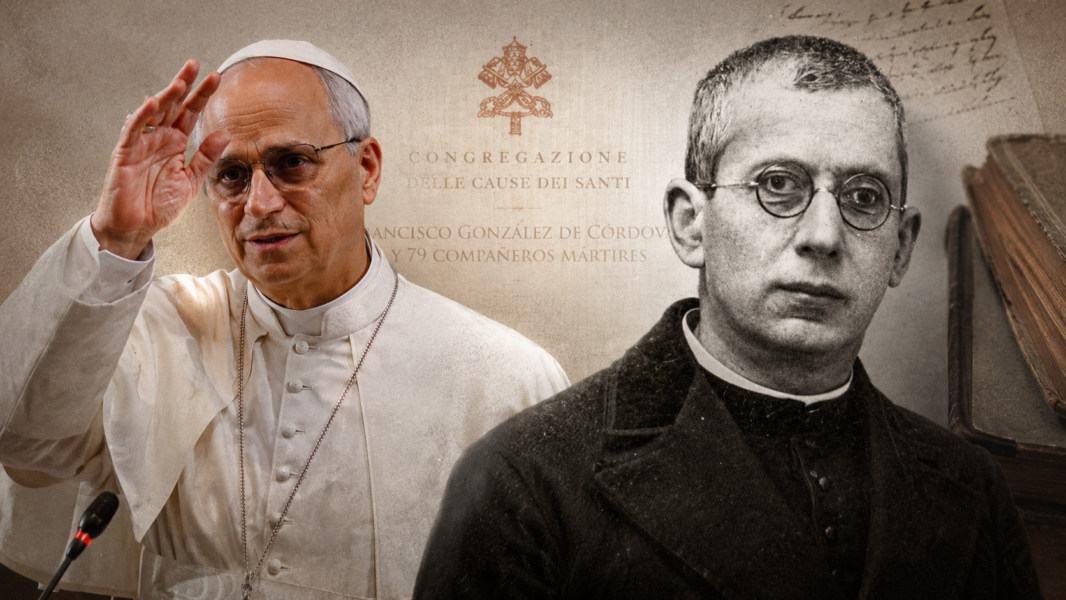
The Pope has authorized today the decree recognizing the martyrdom of Francisco González de Córdova and 79 companions —67 priests, 3 Carmelites, 3 seminarians and 7 laypeople— murdered during the religious persecution of the thirties in northern Spain. The recognition comes just weeks before the papal visit and opens an uncomfortable scenario for La Moncloa, which maintains in force the Law of Democratic Memory while Rome elevates to the altars the victims of revolutionary terror in the republican rearguard.
In the audience this Friday, May 22, with Cardinal Marcello Semeraro, prefect of the Dicastery for the Causes of Saints, Leo XIV gave the green light to the decree recognizing the martyrdom of the Servants of God Francisco González de Córdova and 79 companions,
victims of the religious persecution unleashed in the republican zone between 1936 and 1937. The decision, far from going unnoticed, comes preceded by a diplomatic agenda that gives it singular prominence: the Pontiff is finalizing preparations for his first apostolic journey to Spain, whose program includes an audience with the President of the Government, Pedro Sánchez.
The prison-ship Alfonso Pérez and the sea as a tomb
The documentation of the process, instructed by the Archdiocese of Burgos and the Diocese of Santander, records with forensic precision the circumstances of deaths that owe nothing to propaganda and everything to contemporary testimonies. Some were thrown into the Cantabrian Sea with hands and feet tied and a stone on their bodies. Others disappeared in the hold of the prison-ship Alfonso Pérez, transformed into a floating prison by the authorities of the Popular Front in the port of Santander. Several were executed and subsequently burned. The remaining ones perished in makeshift concentration camps, overcrowded, without medical or religious assistance.
The group is composed of 67 diocesan priests, 3 Discalced Carmelite religious, 3 seminarians and 7 laypeople. Men and women to whom apostasy was offered as the price of life, and who rejected it.
«Let me be the last, so I can absolve them all»
The postulator of the cause presents the figure of the blessed at whose head the process is titled: Francisco González de Córdova, parish priest of Santa María del Puerto in Santoña. Forty-eight years. Once the arrest order for the clergy was known, he was urged to flee. He refused. The prohibition to celebrate the mass and administer the sacraments did not make him desist: he continued doing it clandestinely until he was arrested and confined in the hold of the Alfonso Pérez.
There, between the stench, the darkness and the terror of the companions who knew the fate that awaited them, he organized the spiritual life of captivity: he confessed those who approached him, prayed the rosary every day, encouraged those who had fallen into despair. When the night of the executions came, he made the firing squad a single request.
«Allow me to be the last, so I can absolve and bless my companions».
It was granted. He died absolving. It is probably the highest priestly scene produced in 20th-century Spain, and the universal Church has just recognized it.
The context: a visit and a law
The signing of the decree takes place in a politically delicate moment. Leo XIV is scheduled to visit Spain in the next months —the itinerary has not yet been officially finalized by the Holy See Press Office, but Vatican sources confirm that the visit will include a meeting with the President of the Government—. Sánchez will receive the Pontiff while his Executive maintains in force the Law 20/2022 of Democratic Memory, whose provisions, as the Spanish Episcopal Conference and various jurists have repeatedly warned, present tensions with the historical symmetry required by both documentary truth and the principle of non-discrimination by religious reasons.
The elevation to the altars of 80 martyrs murdered in the republican rearguard —not by belonging to a side, but by being priests, religious or Christians who refused to apostatize— reminds, without needing underlines, that the religious persecution of the thirties was a historical fact of primary order, with more than 6,800 clerics murdered only in territory under control of the Popular Front. Rome does not enter the German political debate, but by canonizing its victims it configures.
A pontifical gesture that is read from Madrid
Those who know the praxis of the Dicastery for the Causes of Saints know that the promulgation schedule of decrees is never casual. The files can be accelerated or rest for years in function of pastoral, geopolitical and ecclesial criteria that the Pontiff weighs personally in the audience with the prefect. That Leo XIV has signed this decree in this May, weeks before his journey to Spain, admits a single reasonable reading: the Pope wants to arrive to Madrid with the martyrs ahead.
It is not a gesture of confrontation; it is a gesture of truth. And a gesture, especially, of continuity with its predecessors —John Paul II beatified 233 Spanish martyrs in 2001; Benedict XVI beatified 498 in 2007; Francis beatified 522 in various ceremonies—. The beatification of the martyrs of Santander adds thus to a process that already exceeds the 2,100 blessed and saints recognized by the Church among the victims of the Spanish religious persecution of the 20th century.
The meeting between the Pontiff and the President of the Government will have, therefore, a difficult-to-ignore background: the one of eighty men of Santander who, before being thrown into the Cantabrian Sea, chose to die forgiving.