


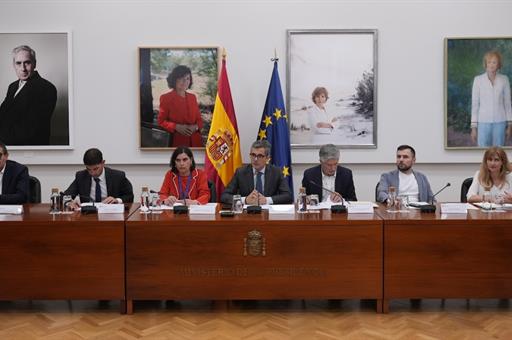
The Government of Pedro Sánchez took advantage of this Wednesday’s official coordination meeting for Pope Leo XIV’s visit to Spain to publicly highlight the agreements reached with the Catholic Church in recent years, including the resignification of the Valley of Cuelgamuros, the issue of property registrations, and the removal of certain tax benefits.
The meeting, chaired by the Minister of the Presidency, Félix Bolaños, was attended by representatives of the Spanish Episcopal Conference, the Apostolic Nunciature, several ministries, the Royal Household, and government delegations from Madrid, Catalonia, and the Canary Islands—the territories the Pontiff will visit between June 6 and 12.
Moncloa links the Pope’s visit to its pacts with the Church
In the statement released by the Ministry of the Presidency, the Government explicitly emphasized that Pope Leo XIV’s visit comes “after the culmination of historic agreements between the Government and the Catholic Church.”
Among those agreements, the communiqué specifically mentions the resignification of the Valley of the Fallen—“Cuelgamuros”—the reparations plan for victims of abuse, the agreements on registered properties, and the elimination of some of the Church’s tax benefits.
Security, mobility, and institutional coordination
The meeting also addressed logistical issues related to Pope Leo XIV’s visit, particularly the special security and mobility arrangements that will accompany the large-scale events planned in Madrid, Catalonia, and the Canary Islands.
The Government noted that since the official confirmation of the trip, “dozens of coordination meetings” have been held between public administrations, the Spanish Episcopal Conference, and the Apostolic Nunciature.
Those in attendance also included the Minister of the Interior, Fernando Grande-Marlaska; the Apostolic Nuncio to Spain, Monsignor Piero Pioppo; and representatives from Congress, Foreign Affairs, Transport, and Territorial Policy.
The Government seeks to avoid uncomfortable interpretations of the visit
The political dimension of the visit has also been reflected in other reports that emerged in the last few hours. According to Confidencial Digital, the Government reportedly asked the Vatican to review in advance some of the speeches Pope Leo XIV will deliver during his stay in Spain, especially those related to immigration.
According to ecclesiastical sources, the Holy See reportedly refused to provide the Pope’s interventions in advance and is working to prevent his words from being interpreted as explicit support for specific government policies.
They also claim that the Government does not want the visit to include political meetings that could benefit the opposition, such as a possible meeting between Pope Leo XIV and the leader of the People’s Party, Alberto Núñez Feijóo.
A visit shaped by the political context
Although the trip is officially pastoral and spiritual in nature, various political sectors are already attempting to place it within their respective ideological frameworks.
While the Government continues to present its current relationship with the Church as a phase of “institutional normalization,” parts of the Catholic world are watching with concern some of the agreements reached in recent years, especially those related to the Valley of the Fallen and the growing secularization of the Spanish public sphere.
The Vatican maintains the pastoral profile of the visit
For its part, the Holy See continues to present Pope Leo XIV’s trip as a pastoral visit focused on youth, evangelization, ecclesial unity, and social issues such as immigration and secularization.
To date, the Vatican has avoided publicly entering into Spain’s internal political controversies linked to the visit, although the context surrounding the trip inevitably turns every gesture and every absence into an object of public interpretation.