


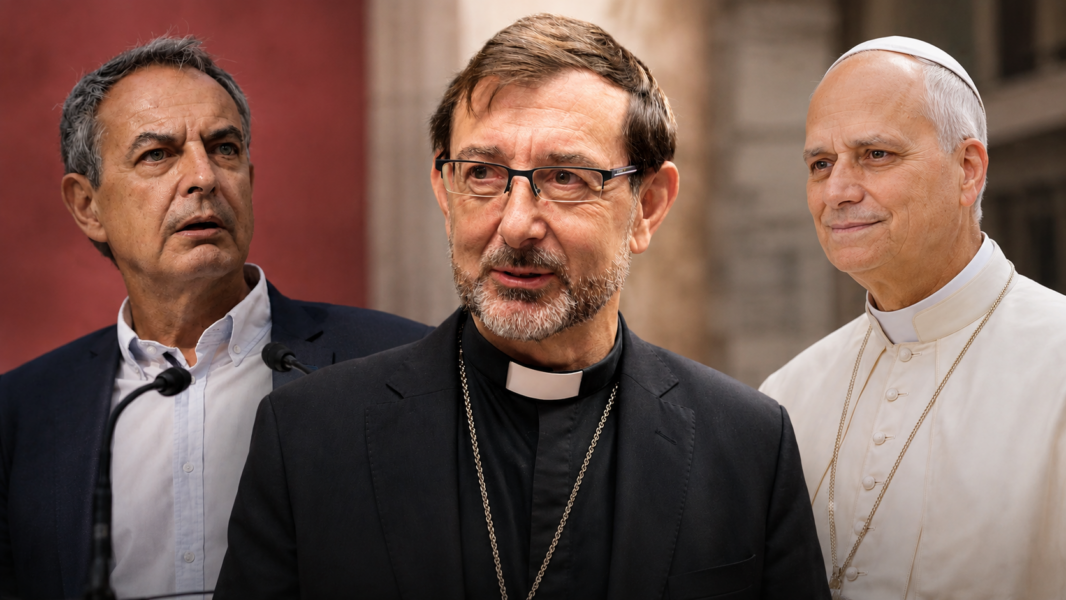
Cardinal José Cobo insists that the visit of Leo XIV to Spain “does not come to do politics” nor “to take votes away from anyone.” And he is surely right in the essential point: the mission of a Pope is not to intervene in electoral campaigns or to align himself with parties. The problem is different. In today’s Spain it is practically impossible to separate a papal visit from the political climate that envelops everything.
Leo XIV will arrive in our country from June 6 to 12 amid an explosive situation: permanent polarization, institutional wear and tear, constant ideological confrontation, and a government besieged by scandals. To pretend that all of this will not inevitably condition the papal trip is asking too much of reality.
The temporal coincidence is especially uncomfortable. Just four days before the Pontiff’s arrival, José Luis Rodríguez Zapatero will have to testify before the National Court, investigated for alleged crimes of money laundering, influence peddling, and membership in a criminal organization in the Plus Ultra case.
“Raising one’s gaze”… to look away?
In statements to Europa Press, Cobo was asked whether Zapatero’s indictment could overshadow the Pope’s visit. The Archbishop of Madrid replied that “raising one’s gaze” allows us to understand that “political contingency” is not the center of our life.
The phrase sounds good. It even has a certain spiritual appearance. The problem is that the “contingency” we are talking about is not a simple parliamentary dispute or a television talk-show spat. We are talking about a former president of the government who must appear before the National Court, investigated for extremely serious crimes.
It does not seem especially edifying to suggest that raising one’s gaze consists in ignoring possible cases of corruption of enormous institutional gravity. The Church’s social doctrine has never defended the idea that public life should remain outside moral judgment. Quite the contrary.
Political corruption destroys social trust, degrades institutions, and ultimately hits the weakest hardest. It is not a secondary distraction from which citizens should abstract themselves.
The CEE and the language of depoliticization
Cobo’s words quite well reflect the tone that the Spanish Episcopal Conference has been trying to impart to the visit for months: avoid conflicts, lower tensions, normalize relations and present the Pope as a figure above national political and social tensions.
The problem is that the trip’s own agenda makes that complete neutrality impossible. Leo XIV will speak in the Spanish Parliament —something Cobo himself has been involved in—, will meet with Pedro Sánchez, and will land in the middle of one of the most tense political atmospheres in recent years.
In addition, the episcopal insistence on concepts such as “encounter,” “dialogue,” or “depolarization” coincides with a strategy of clear institutional détente with the socialist government, even after years of laws deeply contrary to the Christian view on life, family, education, or historical memory.
It is no coincidence that Cobo now emphasizes the “fluid dialogue” with the Executive. The Spanish Episcopal Conference appears determined to avoid any clash with La Moncloa before the Pope’s arrival.
Immigration and the risk of instrumentalization
The migration issue has become one of Europe’s great political debates today. And to think that that discourse can be maintained in a kind of purely moral limbo, without political consequences, is increasingly less realistic.
In fact, the archbishop himself recognized the risk of political instrumentalization of the Pope’s messages. A risk that is evident in a country where any word spoken from a public platform is immediately turned into partisan ammunition.
A visit that will inevitably have a political reading
No one expects that Leo XIV will come to Spain to support specific party lines. That has never been the role of a Pontiff. But it also does not seem reasonable to pretend that a visit of these dimensions can develop in a bubble detached from national reality.
The true challenge will be precisely to avoid that the Pope’s message be absorbed by the political logic that today dominates practically all of Spanish public life.
Because politics does not disappear by repeating that it does not exist. And “raising one’s gaze” should not mean closing one’s eyes.