


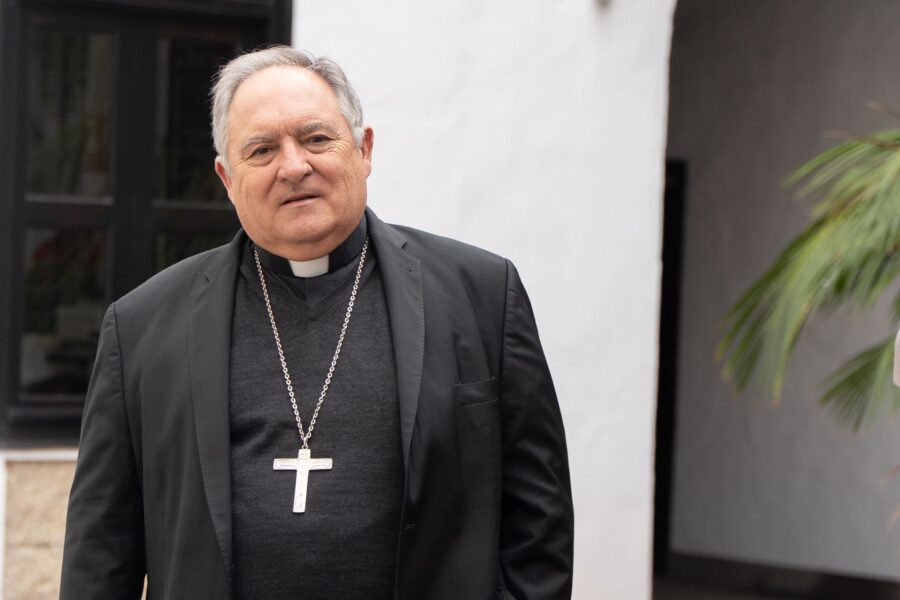
The visit of Leo XIV to the Canary Islands on June 11 will arrive in islands marked by two major crises that, for the local Church, are deeply connected: the growing migratory pressure and the spiritual weariness caused by decades of secularization and consumerism.
Thus explains the Bishop of the Canary Islands, Monsignor José Mazuelos, in an interview given to ACI Prensa in which he offers a diagnosis of the reality of the archipelago. Although the migratory issue will occupy a large part of the media attention during the Pontiff’s trip —which will include a visit to the Arguineguín dock and meetings with immigrants and volunteers—, the prelate insists that the underlying problem goes much further.
According to Mazuelos, the Canary Islands have been experiencing a profound cultural and spiritual transformation for years, leaving a large part of society caught between contemporary individualism and a growing sense of emptiness.
“The Canary Islands received all of Europe’s secularization at once”
The bishop recalls that the islands went in just a few decades from being a rural society, marked by a deeply rooted popular religiosity, to becoming one of the world’s major international tourist destinations.
“The Canary Islands were a rural population, and suddenly the entire focus of tourists and the secularization of all of Europe arrived,” he explains.
Mazuelos acknowledges that the economic and tourist boom found a large part of the population “ill-prepared” to face the cultural change coming from the European continent.
The consequence, according to his description, was a rapid erosion of traditional Christian life and the family and social structures that for generations had sustained popular faith in the archipelago, resulting in a superficial religiosity, often linked to a “first communion” culture, which was ultimately struck by materialism, consumerism, and contemporary individualism.
“People are tired of materialism”
However, Mazuelos also perceives a change in trend.
After years of accelerated secularization, he maintains that many people are beginning to experience a profound spiritual weariness.
“People are thirsty for God and for the love of God,” he affirms. And he adds: “There are so many wounds caused by this materialism, by this consumerism, and by this individualism.”
The bishop considers that this is precisely where the Church’s great pastoral challenge lies today: to be able to reach out to those who discover the emptiness of a life centered solely on material well-being.
For this reason, he insists on the need for a Church “capable of going to the one who is wounded,” returning to the Gospel image of the prodigal son and the man abandoned on the road to Jericho.
“People are tired of looking at the ground and need to look again at the soul,” summarizes the prelate.
Immigration, globalization and the common good
The other major issue that will mark the visit of Leo XIV will be immigration.
The Canary Islands have become one of the main points of entry for African immigrants into Europe, especially through the so-called Atlantic route. Caritas and numerous ecclesiastical institutions have been working for years with unaccompanied minors, newly arrived persons, and families in situations of extreme vulnerability.
Mazuelos insists that the migratory phenomenon cannot be understood without the context of globalization and calls for addressing the problem while avoiding both political demagoguery and simplistic discourses.
“The Church does not defend irregular immigration,” he states explicitly. “The Church would like all migration to be regular.”
At the same time, he underlines that the human drama of those who arrive on Spanish shores after fleeing extreme situations in their countries of origin cannot be ignored either.
The bishop thus defends a position that combines humanitarian welcome, regulation of migratory flows, and protection of the common good.
“A country cannot open its doors and destroy the common good,” he warns. But he adds that Europe cannot respond with indifference to people who risk their lives to reach the continent.
Leo XIV as a sign of hope
Mazuelos is especially hopeful about the arrival of Leo XIV, whom he describes as a serene, prudent man of deep Augustinian spirituality.
The bishop is convinced that the Pope’s visit will not be limited solely to the political debate over immigration, but will have a much deeper dimension.
“It will bring a focus and a light of spirituality,” he assures.