


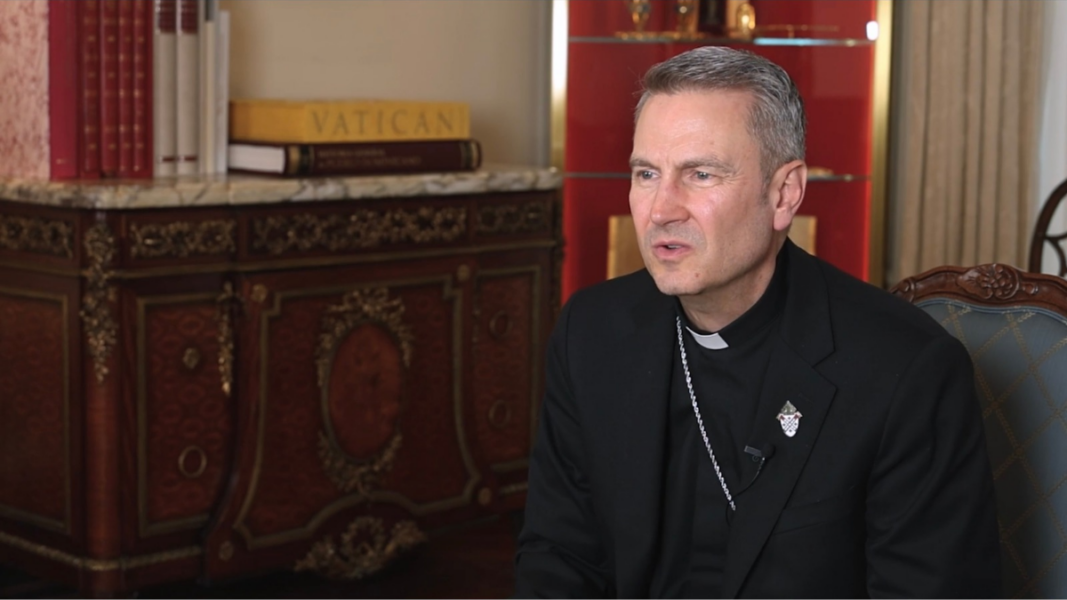
The Archbishop of New York, Ronald Hicks, has completed his first hundred days leading the archdiocese by strengthening a pastoral profile centered on accompaniment, closeness to the Hispanic community, and an ecclesial language focused on inclusion and mission.
On the occasion of this first review of his ministry in New York, Hicks granted an interview to The Good Newsroom —in Spanish— in which he insisted on the importance of walking alongside Latino faithful, defended a “missionary” Church, and once again highlighted some of the pastoral lines he had already outlined during his installation last February.
“I don’t like saying ‘me and them’ very much. It’s us, it’s a community,” the archbishop affirmed when referring to the Hispanic Catholics of New York, insisting that he feels “at home” with them.
The Hispanic community in his pastoral project
During the interview, Hicks repeatedly emphasized his closeness to the Latino community, underscoring that learning Spanish was not merely a practical tool, but part of his understanding of pastoral ministry.
“Not only do I speak Spanish. Part of my heart is with the Hispanic community,” he assured.
The archbishop also recalled that he currently celebrates a monthly Mass in Spanish at St. Patrick’s Cathedral and described walking alongside the Hispanic faithful of the archdiocese as “a joy.”
“The Church is not a club”
Hicks once again used language centered on mission and pastoral accompaniment, insisting that the Church must be oriented toward service and not limited to preserving internal structures.
“The Church is not a club,” he affirmed. “A club is for taking care of its members, but the Church is for serving others.”
The archbishop explained that one of his priorities for the coming months will be to continue forming pastoral teams made up of men and women committed to the Church’s mission, in addition to maintaining an intense life of prayer to “do the will of God.”
A pastoral style based on closeness
Hicks also recounted how he often walks through different places in New York and explained that he uses those walks to listen to conversations in Spanish and try to identify the country of origin of Spanish speakers by their accent.
“I try to listen and guess which country they come from,” he commented, presenting that experience as a way to approach the cultural diversity of the city.
This close and horizontal tone has marked much of his first public interventions since his arrival in New York, where in February he alternated English and Spanish during his first homily at St. Patrick’s and repeatedly appealed to unity and joint work within the Church.
An appointment received with reservations
Ronald Hicks’s arrival in New York was viewed with concern in numerous more conservative Catholic circles in the United States due to some episodes that occurred during his previous tenure as Bishop of Joliet.
Among them, the case of the former diocesan chancellor who left the priestly ministry and entered into a civil marriage with another man, an episode that resurfaced after his appointment to New York and fueled criticism of his episcopal administration.
Hicks’s appointment also represents a sign of the type of ecclesial leadership that has been consolidating in recent years: bishops with a strong pastoral emphasis, inclusive language, and priority on accompaniment over more doctrinal or disciplinary profiles.