


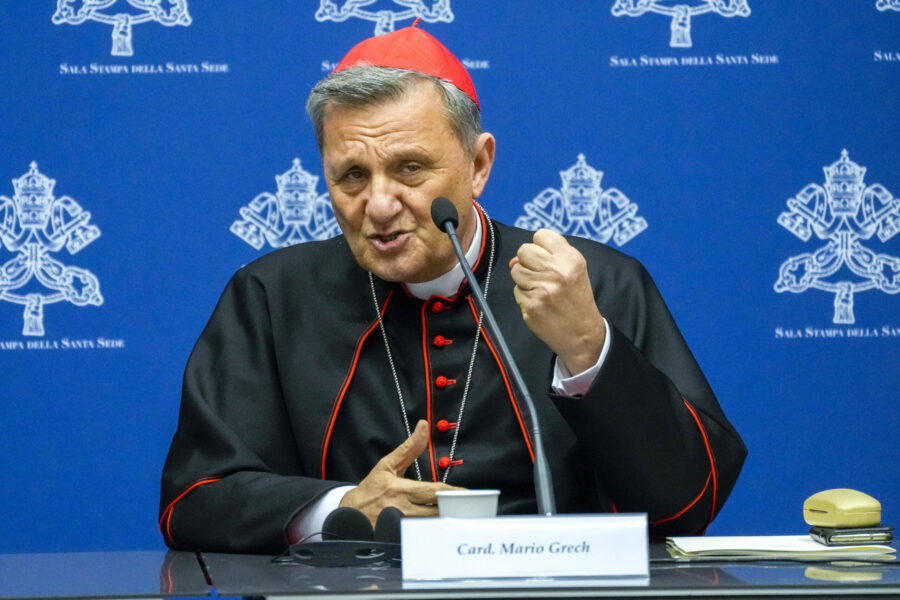
Cardinal Mario Grech, Secretary General of the Synod of Bishops, avoided distancing himself from the German Synodal Way and left open the possibility of future convergence between the process promoted in Germany and the worldwide Synod on Synodality promoted from Rome.
During the 104th German Catholic Congress held in Würzburg, Grech stated that both the German Synodal Way and the universal synodal process have “the same protagonist: the Holy Spirit,” according to Katholisch.de. When asked about a possible integration between the two processes, he replied: “We shall see.”
The statements come as the Church in Germany continues to await definitive Vatican approval for the creation of a permanent synodal body at the national level, one of the main proposals to emerge from the Synodal Way and one that has raised doctrinal and canonical objections from Rome.
“Synodality is not a power struggle”
In that context, Grech insisted on a vision of synodality removed from parliamentary models or simple voting dynamics. During a roundtable dedicated to synodality as a structural principle of the Church, the cardinal stressed that the synodal process cannot be reduced to internal power struggles or decisions taken solely by majority.
“Synodality must not be understood as a power struggle or as a simple decision according to the majority principle,” he said. He went on to insist that the center of the process must be “the common listening to the Holy Spirit.”
To explain this idea, Grech used the image of the Church as a “symphony of communion,” in which the Holy Spirit does not create “a sum of opinions,” but a true “harmony.” According to his explanation, the deepest meaning of synodal deliberation does not consist simply in voting, but in allowing the Spirit to act within the relationships between the members of the Church.
In the same line, the cardinal recalled that “there is no universal Church without local Churches, nor a local Church without the universal Church,” a statement interpreted by many observers as an indirect message against possible autonomous developments of the German process.
Grech defends different “paces” in the application of reforms
During the debate, the question of differences in speed between various local Churches in the application of synodal reforms also arose.
Grech acknowledged that some Churches advance more slowly and others need “an impetus,” but avoided presenting the German case as a particular problem.
“Unfortunately, we focus only on Germany, but the Church has a much broader vision,” he said.
The cardinal also added that the challenge consists in “walking together,” respecting “as far as possible the pace of all.”
The question of the role of women comes to the fore in the debate
During the interventions, theology student Finja Miriam Weber, a member of the German Synodal Assembly, questioned the “symphony” metaphor used by Grech and asked “what instruments each one can play” within the Church, adding that, as a woman, she knows that certain roles are barred to her solely because she is a woman.
Grech responded by saying that “Jesus is the composer” and that “the Holy Spirit is the conductor” of that ecclesial symphony. Later, the cardinal turned personally to Weber and told her: “We need people like you.”
Nemet acknowledges the “wounds” of the German Synodal Way
Also participating in the same meeting was the Cardinal of Belgrade, Ladislav Nemet, who stated that the German Church is a “strong Church” within the universal Church.
At the same time, he acknowledged that the Synodal Way has left “wounds” in other local Churches, especially in Eastern Europe, where some episcopal conferences have used the German case as an argument to distance themselves from synodality.
Nemet further called for avoiding interpretations in terms of “black and white” and urged that more emphasis be placed on the positive aspects of the synodal process than on the public conflicts between bishops.
The Vatican still has not responded on the Synodal Council
The Catholic Congress in Würzburg was held while uncertainty continues over the future of the so-called German Synodal Council, conceived as a permanent structure of participation of bishops and laity in the governance of the Church in Germany.
Although direct questions were asked during the event about Vatican approval of that body, the representatives of Rome avoided giving a concrete response.
The President of the German Bishops’ Conference, Bishop Heiner Wilmer, who was also present at the meeting, expressed his confidence that an agreement with the Vatican could eventually be reached.