


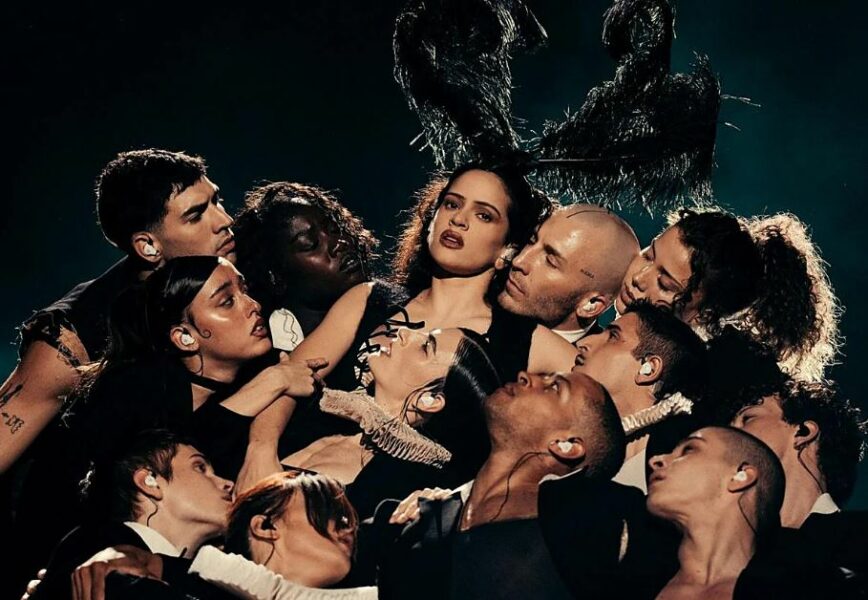
The Spanish Episcopal Conference will award the ¡Bravo! 2025 Prizes this Monday, May 18, the awards promoted by the Episcopal Commission for Social Communications (CECS) which, according to their own rules, seek to recognize “the meritorious work of all those communication professionals […] who have distinguished themselves by their service to the dignity of man, human rights or evangelical values.”
Precisely for this reason, the decision to award the ¡Bravo! Music Prize to Rosalía for Lux, after seeing the scale of her tour, is at least confusing. The criticism does not stem solely from the singer’s artistic style, but from the deep contrast between the symbolic content of her show and what the Church claims to want to reward.
A religious aesthetic turned into spectacle
The chronicles of the Lux Tour describe a tour filled from beginning to end with explicit references to Christianity: confessional, sin, redemption, holiness, the Virgin Mary, penance, angels, veils, crosses, processions and even a botafumeiro inspired by the one in Santiago de Compostela.
However, these references appear integrated into a stage proposal that mixes sensuality, eroticization, club culture, sexual provocation and “reinterpretations” of the Christian faith. In fact, one of the tour chronicles expressly states that Rosalía “appropriates the codes of faith to make them more free, ambiguous and carnal.”
That is the core of the issue.
The Catholic tradition has never considered the use of religious language or sacred symbols to be irrelevant. The Catechism of the Catholic Church teaches that blasphemy consists in uttering—internally or externally—words of hatred, reproach or defiance against God, as well as abusing the name of God and failing to respect sacred realities.
And although not every artistic use of religious elements constitutes formal blasphemy, it is difficult to ignore the trivialization involved in converting signs linked to repentance, holiness or liturgy into pop entertainment elements.
The confessional as a viral gimmick
One of the most discussed elements of the show is precisely the “confessional” that Rosalía incorporates in her concerts. According to various accounts, this space has become a viral section where celebrities and influencers recount sentimental, sexual or intimate experiences to the public.
The problem is not simply aesthetic. The confessional is not a decorative object or an empty symbol within the Catholic tradition. It is the sacramental place where the sinner reconciles with God.
Transforming it into a theatrical resource for romantic anecdotes or viral stories reflects precisely the contemporary drift that trivializes the sacred until it turns it into mere cultural scenery.
And, yet, it is precisely this proposal that the Episcopal Conference has decided to award in the name of “evangelical values.”
The incoherence of a Church that feels insecure
The underlying issue is not Rosalía. Rosalía does exactly what the world of entertainment has been doing for years: using religious symbols, reinterpreting them and mixing them with contemporary narratives where the spiritual is subordinated to the individual experience, aesthetics and provocation.
The true question is another: what leads an ecclesiastical institution to culturally bless this type of proposals?
Because the ¡Bravo! Prizes are not just any civil awards. They are awards granted “on behalf of the Church.” And that implies inevitably a moral and cultural judgment. When the Episcopal Conference distinguishes a particular work, it is sending a message about what it considers compatible with the Gospel and what it today understands by “evangelical values.”
The problem is that many faithful can hardly recognize those values in an artistic proposal where the religious appears constantly mixed with explicit sensuality, moral ambiguity and an aesthetic use of sacred symbols.
When relevance replaces Catholic criteria
It appears that certain ecclesiastical bodies have been trapped for years in the need to be culturally acceptable to the contemporary world. And in that attempt to appear modern, dialoguing and close to the dominant culture, they end up blurring specifically Catholic criteria.
Awarding Rosalía can generate headlines, media sympathy and social-network conversation. But also transmits another idea: that the institutional Church no longer considers problematic the ambiguous, frivolous or sensualized use of elements deeply linked to the Christian faith.
And that indeed has consequences.
While many Catholics see religious symbols being ridiculed in cultural and media spaces, they now discover that part of the own ecclesiastical structure not only avoids denouncing that trivialization, but publicly awards it.
The question, therefore, remains: if these awards exist to recognize the service to “evangelical values”, what exactly does the Episcopal Conference today understand by Gospel?