


By Randall Smith
I recently read that Cardinal Reinhard Marx says he will allow the blessing of same-sex unions, in defiance of Vatican directives. Fr. Davide Pagliarani, superior general of the Society of St. Pius X, says he intends to ordain new bishops without a papal mandate. And Luxembourg’s Cardinal Jean-Claude Hollerich says the ordination of women is essential for the future of the Church; “In the long run, I cannot imagine how a Church can survive if half of the people of God suffer because they have no access to the ordained ministry.”
Well, as a married layman who “has no access to the ordained ministry,” I can imagine it. I’ve always thought the priesthood is a special call to service, not a position of special prestige to which people deserve to have “access.” But Cardinal Hollerich seems to have a different view, perhaps because he is feted as a cardinal.
However, Cardinal Hollerich’s statement is not really a novelty. The late Cardinal Pell warned shortly before his death, in an article in The Spectator, that Hollerich had “publicly rejected the Church’s basic teachings on sexuality, abortion, contraception, the ordination of women to the priesthood, and homosexual activity, as well as polygamy, divorce, and remarriage.” So the ordination of women is not the only thing without which the cardinal thinks the Church cannot get by.
I am convinced that the Church can get by without those things—quite well, in fact—just as most of the people I know do. It may be that Cardinal Hollerich knows people with a different opinion, but there is an old saying that when a man becomes a bishop, he never again pays for dinner and never again hears the truth. People tell him what they think he wants to hear. People don’t do that with me.
And yet, the people I speak with do not seem to count in the same way as Hollerich or the “experts” of Synodal Group 9 who recently announced that the Church has been entirely wrong on sexual matters. I interact with young people every day and, from that perspective, I would have told them that the Church’s teaching is a gift from God, much wiser than anything else offered today. But that opinion does not seem to count as much, or at all.
Which makes me wonder how one becomes a person like Fr. James Martin, S.J., who flies to Rome to consult with the Pope and is regularly cited as an authority.
I suppose one of the reasons why Fr. Martin and others like him enjoy the “access” they enjoy is because he is clergy and I am not. But isn’t that clericalism? I thought clericalism was something bad, something the Church needs to put an end to. Many clerics say this. Some of them blame the entire pedophilia scandal on clericalism and not, as one might have thought, on the laxity of norms regarding sex among some members of the homosexual clergy.
So, if clericalism is to be resisted, why is what Jean-Claude Hollerich thinks about the ordination of women, the homosexual activity, or divorce and remarriage especially relevant? The answer, one must assume, is that he is a cardinal. Fair enough. But cardinals do not have the authority to dictate doctrine. They themselves are men under authority. And if they do not respect the authority under which they are, why should anyone respect their authority?
My students come to the Catholic university where I teach not because they want to listen to me. They come because they want to learn what the Church teaches. The only “authority” I have is the authority that derives from the Church’s teaching. The class is not “Randall Smith’s Theology.” Who would take that? The class is Catholic theology.
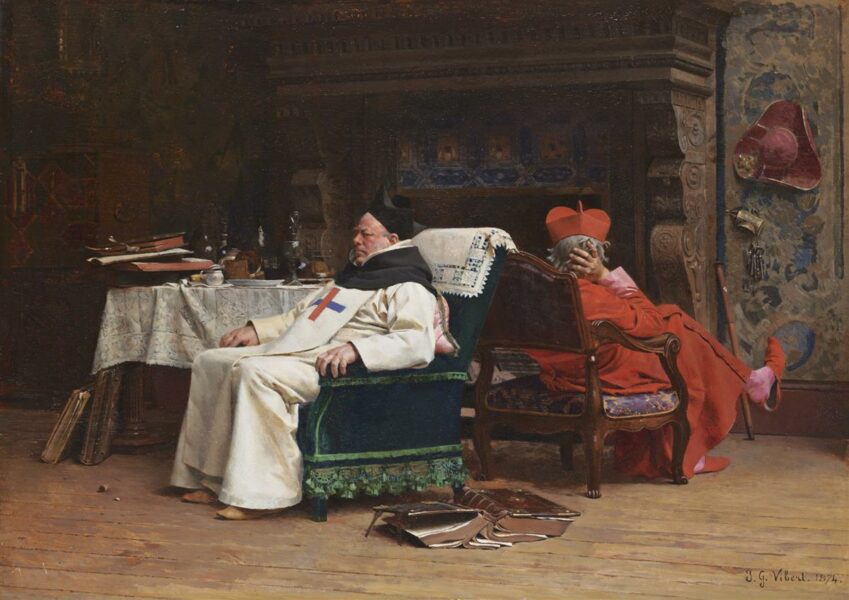
Therefore, when a bishop or cardinal proclaims something that is contrary to the Church’s authority, it is as if he is sawing off the branch on which he is sitting. The only reason anyone would listen to a bishop or cardinal is because that person accepts the authority of his ecclesiastical office based on Scripture, tradition, and the magisterium. Otherwise, a cardinal is just an eccentric old man with a curious red zucchetto.
I know that people on one side or the other will say that their man is “doing the best for the Church,” while the others are heretics who are leading people astray. I have no doubt that the people of the SSPX are horrified by Cardinals Marx and Hollerich and are convinced that they absolutely must ordain new bishops, just as Marx and Hollerich are likely to be dismayed by the SSPX and convinced that the Church absolutely must bless homosexual unions and ordain women.
The strange thing about all these men is their presumption that what they think should govern the entire Church. I do not assume that what I think should govern everything even in my own house. What delusion of grandeur gets into a man’s head to make him think: “The Church is me. I may cause a schism, but it will be better for everyone.”
Really? When has schism ever made things “better”? And when has a schism stopped at just one? Set aside Church authority, and what is there to prevent further divisions? Just ask the Protestants. Do they believe that leading people to a schism is good for the salvation of their souls? Setting a church on fire would be good for the building?
Some will say: “It is not heresy; it is schism.” But the schism is heresy. The term “heresy” comes from a Greek root (haiereo) that means “to choose.” When a group decides that it can choose a set of doctrines or councils of the Church that they want to obey and which they do not, that is heretical. Those people simply have become another group of Protestants.
Some of my best friends are Protestants. One thing I like about my Protestant friends is that they do not pretend to be Catholic. So, if certain people want to separate from the Catholic Church, it is fine. It has been done before. It is sad, but the Church always survives. But they cannot stay with the church buildings built by and for the Catholics. If they create their own church, they should build their own buildings.
They can come back for coffee.
About the author
Randall Smith holds the J. Michael Miller Chair of Theology at the University of St. Thomas in Houston. Among his books are Bonaventure’s Journey of the Soul into God: Context and Commentary, From Here to Eternity: Reflections on Death, Immortality, and the Resurrection of the Body, Aquinas, Bonaventure, and the Scholastic Culture of Medieval Paris: Preaching, Prologues, and Biblical Commentary, Reading the Sermons of Thomas Aquinas: A Beginner’s Guide. His upcoming book, Mapping Bonaventure’s Itinerarium: Context and Commentary, will be published in Emmaus Press this summer. His articles can be found here.