


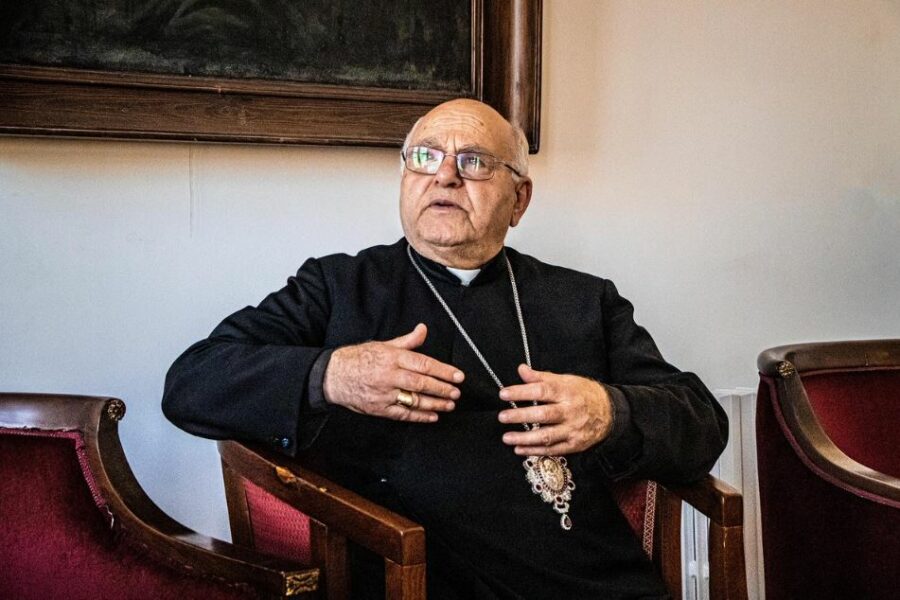
The Melkite Greek Catholic Archbishop Emeritus of Aleppo, Jean-Clément Jeanbart, passed away on Saturday, May 9, at the age of 83 during a trip to France, according to Aid to the Church in Need (ACN), a pontifical foundation that maintained close collaboration with him for many years.
Jeanbart was one of the strongest voices in defense of Syrian Christians during the civil war. Convinced that the ancient Christian communities of the Middle East were at risk of disappearing, he refused to leave Aleppo despite the constant danger of bombings and destruction.
“Without the providential protection” of God, the Christians of Syria “would have been annihilated long ago,” the archbishop once wrote to ACN during the hardest years of the conflict.
A Christian Voice Amid the War
Jean-Clément Jeanbart was born in Aleppo in 1943 into a Melkite Catholic family of twelve children. He first entered the seminary at just 11 years old, though he later left temporarily to continue his studies in his hometown. He returned permanently at the age of 19 and was ordained a priest in 1968.
From a young age, he showed a special dedication to working with young people, a concern he maintained throughout his priestly and episcopal life.
In 1995, he was appointed Melkite Greek Catholic Archbishop of Aleppo, a position he held until his retirement in 2021. During those years, he worked to strengthen the spiritual and material life of his faithful, convinced that helping Christians live with dignity was an indispensable condition for them to remain in their homeland.
He Refused to Leave Aleppo
When the war broke out in Syria, Jeanbart decided to remain in Aleppo with his people. This was not a symbolic decision. The city suffered years of bombings, the destruction of entire neighborhoods, mass exodus, and attacks on historic Christian communities.
In a letter sent to ACN in 2016, after a church building was hit by a missile, the archbishop thanked God that none of the young people or priests present had been injured.
The following day, he recounted, a crowd attended Sunday Mass. Jeanbart explained that he was “left speechless” and invited the faithful to join in a prayer of thanksgiving to the Lord, reminding them that Christians “are not alone” and that Christ, the Good Shepherd, remains close to them.
“This terrible and infernal war would have completely destroyed us or driven us to despair and madness, had it not been for His tender care,” he wrote at the time.
Defender of Christian Presence in Syria
During the Syrian civil war, Jeanbart repeatedly denounced the suffering of Christians and warned about the risk of disappearance of communities whose presence in the Middle East dates back to the first centuries of Christianity.
His pastoral priority was always to prevent persecution, poverty, and insecurity from forcing Christians to abandon their homeland permanently.
He also promoted ecumenical initiatives, including collaboration with the Greek Orthodox Church in Syria to build the so-called Church of Unity, shared by Melkites and Orthodox.