


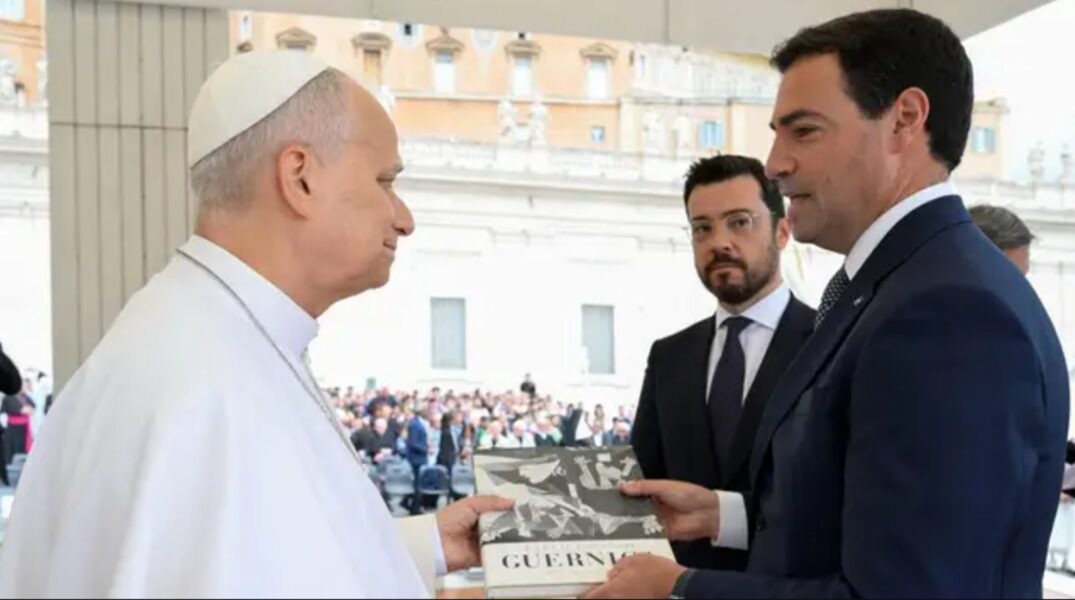
The lehendakari Imanol Pradales took advantage of his attendance at the General Audience of León XIV this Wednesday to present the Pontiff with three gifts loaded with political symbolism: two references to Picasso’s Guernica and a poem in Basque translated into Quechua, the Andean language that the Pope learned during his years as an Augustinian missionary in Peru.
The gesture by the head of the Basque Government is framed within the institutional outreach operation that the Basque Government has deployed around the first anniversary of the pontificate of Pope Robert Prevost, and it was accompanied by a formal invitation for the Pontiff to visit the Basque Country.
Two gifts on Guernica
The first gift presented to the Pontiff was the book Guernica, Pablo Picasso, by the Bilbao writer Juan Larrea (1885-1980), who maintained a close relationship with the Malaga painter during the execution of the commission for the Republic Pavilion at the 1937 International Exhibition in Paris.
The second present was a reproduction of the rereading of Guernica carried out in 1999 by the Gipuzkoan painter José Luis Zumeta (1939-2020), with burning farmhouses and mutilated figures in a composition of strong chromatic expressiveness.
From the Basque Government, the double pictorial reference has been presented as a nod to the «pacifist vocation» that the Basque Government attributes to the magisterium of León XIV, especially in his calls for the cessation of open conflicts in Ukraine and the Holy Land.
A poem in Basque… and in Quechua
The third gift was, without a doubt, the most imaginative in the repertoire: a poem by the bertsolari Jon Sarasua written in Basque and, in case the Pontiff did not fully grasp the message, opportunely translated into Quechua. The Basque Government has explained the gesture as a recognition of «the involvement and commitment» of the then Father Prevost «with indigenous languages» during his missionary stage in the Peruvian Andes, where he first served in Chulucanas and later as bishop of Chiclayo.
The choice of the Quechua language as a bridge between Rome and Vitoria—bypassing, in the process, the uncomfortable formality of Spanish, the native language of hundreds of millions of Catholics and, coincidentally, also the Pope’s language—allows the autonomous Executive to frame Basque within the category of «minoritized languages of the world,» on equal footing with those spoken by the Andean peoples evangelized by Spanish missionaries five centuries ago.
The translation into Spanish of the poem, finally provided by the Basque Government itself, reads: «From the childhood of humanity comes the aroma to us, the flour that they ground from generation to generation. Basque, community and task, longing, joy and pain of so many marginalized cultures, effort that we receive, dream that we offer, will to beautify a land, tenacity to maintain a we of the spirit, breath of the great background, created to open itself from the particular toward all and everyone.»
Invitation to the Pope and reference to the bombing
Pradales took advantage of the protocol greeting to formally invite León XIV to visit the Basque Country and to raise, as has transpired, a «gesture» from the Pontiff in relation to the 1937 bombing of Gernika, an episode whose commemoration Basque nationalism has been claiming for decades in terms of historical memory.
The Vatican, which maintains as a general criterion not to comment on commemorations of a political-national character in specific countries.