


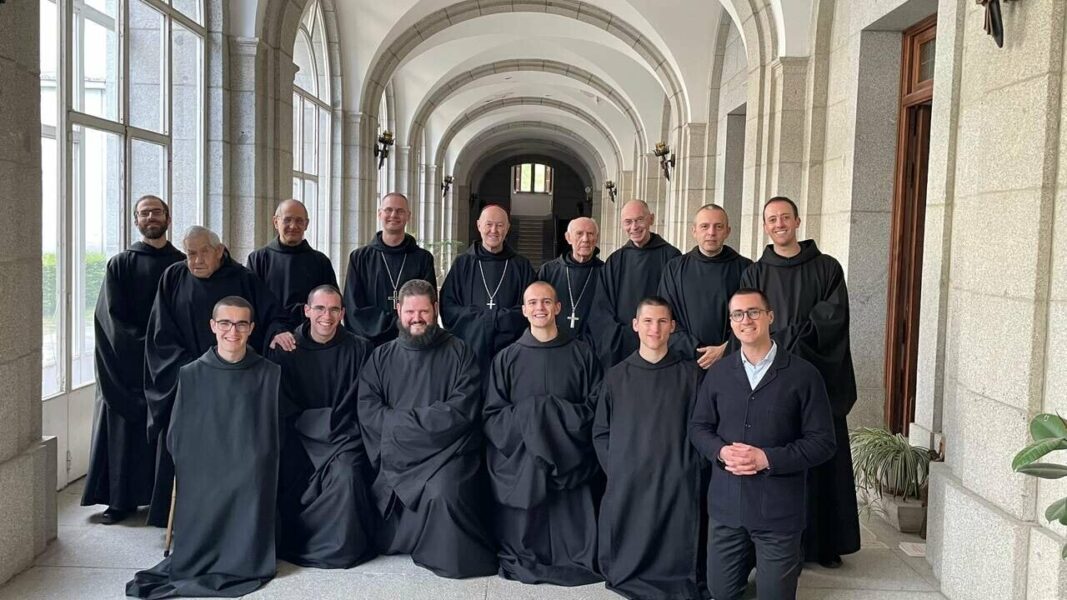
The Benedictine community of the Abbey of the Holy Cross of the Valley of the Fallen has elected Father Alfredo Maroto, OSB, as the new abbot of the monastery this Wednesday, putting an end to an exceptional situation that had been ongoing since 2014, when Father Anselmo Álvarez resigned from the position due to health reasons.
The election took place during a conventual chapter presided over by Dom Geoffroy Kemlin, abbot-president of the French Benedictine congregation of Solesmes, to which the Valley community is affiliated.
The abbey itself officially confirmed the election through a statement released on May 13, the feast of Our Lady of Fatima, in which the monks expressed their «profound joy» and presented the election as a sign of the community’s «unity, stability, and spiritual solidity.»
Maroto’s election comes at a particularly delicate moment for the Valley of the Fallen, amid ongoing conflict between the Benedictine community and Pedro Sánchez’s government over the process of resignifying the site, officially renamed the Valley of Cuelgamuros by the Democratic Memory Law.
Twelve years without an abbot amid strong political pressure
Since Anselmo Álvarez’s resignation in September 2014, the abbey had not had an abbot elected in accordance with Benedictine constitutions.
During these years, the community was governed by a prior administrator appointed from Solesmes. First it was Father Santiago Cantera, and since March 2025, Alfredo Maroto himself.
In these years, the Benedictine community has lived under intense political and institutional pressure stemming from the government’s successive attempts to transform the religious and reconciliatory meaning of the Valley of the Fallen.
The exhumation of Francisco Franco in 2019, the subsequent removal of José Antonio Primo de Rivera’s remains, and the current resignification project have constantly placed the abbey at the center of Spain’s political and cultural confrontation.
A community that claims its vitality and fidelity
Far from conveying an image of weariness, the abbey’s official statement insists on the continuity and strength of monastic life in the Valley.
The monks highlight that the community continues to develop «its life of prayer, work, and fidelity to the Benedictine tradition,» while also underscoring the «gradual growth of the community thanks to the arrival of new vocations to monastic life.»
The note adds that the election represents «a source of special consolation and confidence» for a community called to persevere in its mission as custodians of the basilica, the choir school, the guesthouse, and all the liturgical and spiritual life that takes place daily in the precinct.
The Benedictine community also reaffirms its willingness to continue this work «in full communion with the Church and in spiritual service to the faithful.»
The new interlocutor with the government
With the election of Alfredo Maroto, the abbey regains a figure with full monastic and canonical authority to officially represent the Benedictine community.
Since the abbey has sui iuris status, the abbot depends directly on the Pope and exercises functions equivalent to those of a major superior.
In practice, Maroto will now be the monks’ main interlocutor in the negotiations opened with the Executive on the future of the Valley and the preservation of the basilica’s sacred character against interventions promoted by the Ministry of Justice.
Currently, the community has filed an appeal against the agreement signed between the government and the Archdiocese of Madrid, considering that Cardinal José Cobo lacked authority to accept certain actions on spaces deemed sacred.
The role of Santiago Cantera
Maroto’s election comes just a few weeks after Father Santiago Cantera’s departure as prior administrator.
Some sectors interpreted his departure at the time as an ecclesial concession to government pressures. However, sources close to the community have defended the role played by Cantera during the most difficult years of the conflict.
According to those sources, his work allowed for «internal stability, community unity, and the continuity of liturgical and monastic life» amid a particularly tense situation.
During his tenure at the head of the monastery, Cantera also became one of the main figures of resistance against attempts to secularize and ideologically resignify the Valley.
A monk closely tied to the Valley
Alfredo Maroto was born in Segovia in 1958 and entered the Valley abbey as a priest in 1996.
He took his perpetual vows in 2001 and since then has held various positions within the community, including claustral prior, novice master, director of the choir school, and responsible for the monastic guesthouse.
During the closure of the basilica decreed by José Luis Rodríguez Zapatero’s government in 2010, Maroto also played a prominent role in defending the liturgical life of the Valley, celebrating Masses outdoors with the then-abbot while the temple remained closed.
The future of the Valley remains open
The election of the new abbot takes place while the standoff between the Benedictine community and the government over the future of the Valley of the Fallen continues.
In recent months, the president of the Spanish Episcopal Conference, Monsignor Luis Argüello, has publicly called for both parties to reach «a reasonable and satisfactory agreement.»
In the meantime, the monks continue to defend the maintenance of the site’s religious, liturgical, and spiritual character against the political projects promoted by the Executive.
The abbey’s official note concludes by entrusting this new stage «to the protection of the Most Holy Virgin of the Valley and our Father Saint Benedict,» requesting prayers for the new abbot and the entire Benedictine community.