


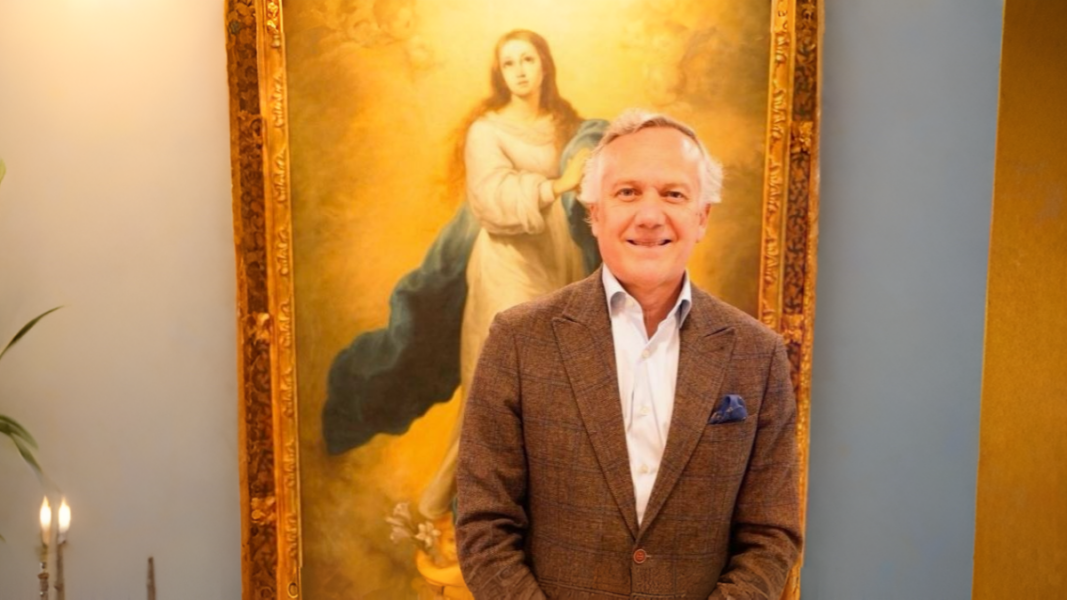
The battle for the succession of Alfonso Bullón de Mendoza in the Catholic Association of Propagandists is starting to leave papers behind. According to two documents from the candidacy of Raúl Mayoral Benito to which this medium has had access, the aspirant tries to present himself to the propagandists as a man of the house, with a long track record in the CEU and in the works of the ACdP, but with a programmatic discourse that, for now, moves more in the spiritual terrain than in concrete decisions about the institutional future of the Association.
The election is scheduled for July 18, 2026, at the V Extraordinary General Assembly of the ACdP, convened at the Colegio Mayor Universitario de San Pablo in Madrid. The deadline to submit candidacies ends on June 18 at 7:00 p.m., according to the call signed by Bullón de Mendoza.
Mayoral has begun circulating his candidacy with at least two documents: a personal and professional profile, and a programmatic text titled The Propagandists and the Supernatural Spirit. The first serves as an introduction letter. The second attempts to set the moral framework for his candidacy. However, neither of the two provides a concrete response to one of the major concerns of this succession: what will happen to El Debate and the model of public presence promoted during Bullón’s tenure.
The biographical document presents Mayoral as a lawyer and businessman, born in Talavera de la Reina on July 26, 1966, married and father of four children. He studied Law at the CEU and completed a master’s degree in Telecommunications Law at ICADE. The candidacy itself emphasizes that he has belonged to the ACdP since 1992, within the Madrid Center, a fact that seeks to reinforce his status as a long-standing propagandist and not a circumstantial candidate.
His track record within the organization is extensive. The profile recalls that he was deputy director and director of the association’s Bulletin, local councilor and secretary of the Madrid Center, as well as national councilor. It also lists relevant positions in the works of the ACdP: general secretary, deputy general director, director of CEU Media, general director of the Fundación Universitaria San Pablo CEU, and deputy to the presidency of the same foundation. Additionally, he was managing director of the Fundación Cultural Ángel Herrera Oria and trustee of the Colegio Mayor de San Pablo.
That review is not innocent. Mayoral needs to present himself as someone with direct knowledge of the inner workings of the Association and its works, especially the CEU, at a time when Bullón’s succession will not only decide who presides over the ACdP, but also who will have the capacity to influence its educational, cultural, and media network. Against José Masip, seen as the continuity option, and Rafael Rodríguez-Ponga, interpreted in internal sectors as a profile closer to the PP, Mayoral attempts to build a candidacy based on associative roots, management experience, and a discourse of spiritual regeneration.
The profile also includes a stage in the public sector: advisor on Telecommunications and parliamentary advisor to the Minister of Science and Technology during the 2000-2004 legislature. To that, it adds a trajectory in media and public opinion, with articles in ABC, La Razón, El Mundo, Religión en Libertad, and El Imparcial, as well as programs or collaborations on Radio María, Gestiona Radio, Popular TV, and 13 TV. The candidacy also highlights his two recent works: the essay Pregón de combate para jóvenes de espíritu, published in 2024, and the novel Perder para ganar. Una paz para un siglo, from 2025.
More revealing is the second document. In The Propagandists and the Supernatural Spirit, Mayoral addresses the members as “dear brother propagandists” and places his candidacy in a key of interior life, associative unity, and fidelity to the founding charism. The text thanks the endorsements received, greets the other candidates, and acknowledges that all are touring the Association’s centers to present their proposals. But after that introduction, the content shifts to a religious reflection on the supernatural spirit, internal concord, and the need for interior renewal.
Mayoral cites the call to be faithful to the founding charism, “centered on a Christocentric, Marian, and ecclesial spirituality, with Ignatian roots,” and relies on a recent letter from the national chaplain to insist on the unity of associative life. The candidate speaks of “deep interior renewal,” transformation of the heart and mind, service to the Church, to Spain, and to the neighbor, and achieving “the most difficult of victories: the victory over ourselves.”
The tone of the text is deliberately elevated. Mayoral states that the propagandist must be “a new man,” with intense interior life, primacy of the spiritual over the worldly, and the capacity to “illuminate a new world.” He also contrasts a “Catholicism of conviction” with a “Catholicism of convention,” a formula that can be read as an appeal to recover identity, but also as a veiled criticism of an ACdP too settled in its structures.
The political problem of the candidacy lies precisely there. The document speaks of holiness, unity, prayer, conversion, and moral renewal, but does not specify what Mayoral would do with the Association’s major works, what model he proposes for the CEU, how he would reorganize internal balances, or what role he would reserve for El Debate. In elections marked by the continuity or not of the media project launched during Bullón’s presidency, that omission is not minor.
Internal sources from the ACdP interpret Mayoral’s candidacy more as a positioning operation than as a candidacy with real chances of winning. The reading circulating in some sectors is that Mayoral seeks to gauge support, demonstrate mobilization capacity, and position himself to negotiate with whoever is elected. In that context, the general secretariat appears as a key piece in the future distribution of power.
His own programmatic document contains a phrase that can have several readings: Mayoral assures that he places himself “at the disposal of all.” In an internal campaign, that formula can work as a gesture of unity, but also as a message for the day after. If he doesn’t win, he wants to be there. If he doesn’t preside, he wants to have weight.
Bullón’s succession, therefore, is starting to take shape on three planes. Masip would represent organic continuity. Rodríguez-Ponga would embody a more political and institutional profile option. Mayoral, in light of the documents disseminated by his candidacy, attempts to occupy the space of the old propagandist militancy, internal knowledge of the CEU, and a spiritual appeal that avoids pronouncing on the most delicate issues.
The unknown remains El Debate. The publication has become one of the most visible pieces of Bullón’s tenure and one of the most relevant instruments of public presence for the ACdP. Whoever succeeds the current president will have to decide whether to maintain the project as it is, reorient it, or subject it to a new balance of power within the Association. Mayoral’s papers, for now, say a lot about his biography and his spiritual language. They say much less about what he would do with power.