


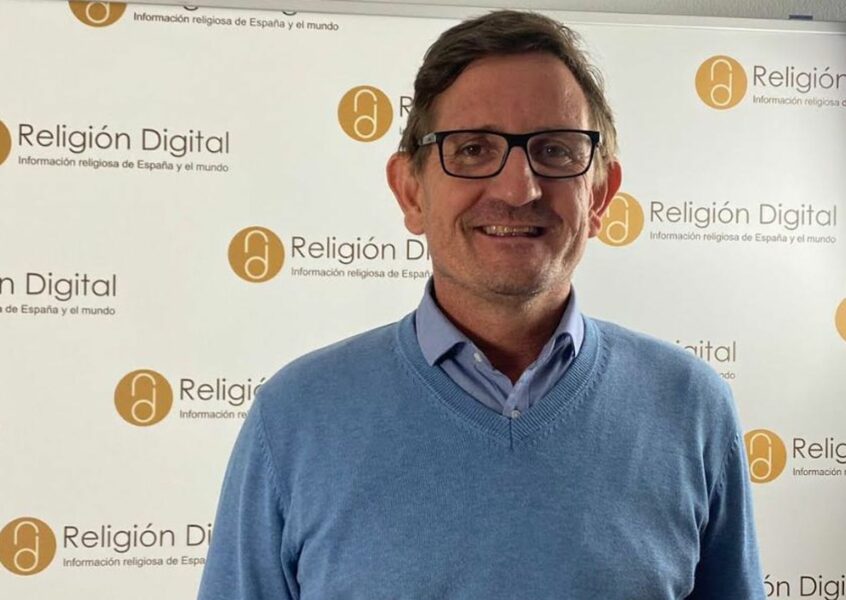
Cardinal José Cobo has appointed priest Luis Miguel Modino as the new “Director of Communicative Development and Contents of the Delegation of Communication Media” of the Archdiocese of Madrid. The appointment, advanced by Religión Confidencial, was not communicated through an official press release, unlike other positions designated on the same day, but rather appeared discreetly in a secondary section of the diocesan website.
The designation reinforces Modino’s weight within the communicative structure promoted by the Archbishop of Madrid and confirms the trust that Cobo places in one of the priests most identified with the synodal agenda and with progressive ecclesial sectors linked to the Amazonian environment.
The new communications manager of the Madrid diocese is a regular collaborator with Religión Digital and Alfa y Omega, and in recent months he has become one of the most visible voices of the so-called “synodal model” promoted from various ecclesial spheres close to the current diocesan government.
A strategic appointment within Cobo’s communication
According to the information published by Religión Confidencial, Modino’s position does not replace any previous manager, but rather adds a new level within the archdiocese’s communication organizational chart. The intention, according to sources cited by that medium, would be to strengthen communicative development and improve Madrid’s media projection.
Luis Miguel Modino has also accompanied Cardinal Cobo on some recent trips to Rome and has consolidated himself as one of the priests closest to the communicative line of the Madrid archbishop. Various reports even place him for some time among the names mentioned for an eventual episcopal promotion.
The choice is not irrelevant, especially because of the ideological and ecclesial profile of the new contents director.
The article on women’s diaconate that generated controversy
On March 8, Alfa y Omega published an article—the official weekly of the Madrid diocese—signed precisely by Luis Miguel Modino, in which he openly raised the possibility of restoring women’s diaconate in the Church.
Read also: The Madrid diocese celebrates 8M by opening up to women’s diaconate
In that text, Modino argued that the issue should continue to be “discerned” within the current synodal process and favorably echoed the theses of Cardinal Leonardo Steiner on a possible diaconal ordination of women. The priest presented the debate as part of an alleged ecclesial development with no turning back and stated that the Church should not abandon that path of reflection.
The publication of the article in an official medium of the Madrid diocese caused unease in ecclesial sectors, given that the issue of women’s diaconate directly affects the doctrine on the sacrament of Holy Orders.
The Church has always taught that the sacred Order constitutes a single sacrament with three inseparable degrees—episcopate, presbyterate, and diaconate—and that sacramental ordination is reserved exclusively to baptized men. The International Theological Commission itself already recalled in 2002 that the ancient “deaconesses” were not sacramentally equivalent to ordained deacons.
A new step within a specific ecclesial line
Modino’s appointment also occurs in continuity with other recent episodes that have arisen in spheres linked to the Madrid diocese. Among them stood out the appearance, in working documents of the so-called Diocesan Convivium, of references to a hypothetical “temporary priesthood,” an idea widely criticized for introducing confusion about the permanent nature of the ministerial priesthood.
Modino’s arrival at the core of the archdiocese’s communications direction marks a communicative line clearly aligned with the most progressive synodal approaches.