


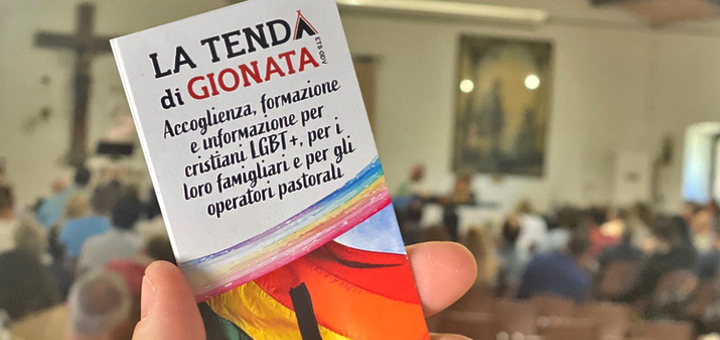
At least twelve Italian bishops will participate this year in vigils organized for the “overcoming of homotransphobia”, a series of events promoted by Christian LGBT groups and supported by numerous dioceses, parishes, and ecclesiastical organizations in Italy.
According to La Nuova Bussola Quotidiana, in the months of May and June, dozens of vigils and celebrations are scheduled in Italy and other European countries. The list, updated by Progetto Gionata, currently includes 47 events, many of them held in churches, parishes, convents, or spaces directly linked to Catholic dioceses.
Twelve bishops involved in the vigils
The most relevant fact is the increase in the number of bishops who will preside over or participate in these vigils. If in 2025 there were five, this year the figure already rises to twelve, more than double.
Among them are the bishop of Parma, Enrico Solmi; the bishop of Cremona, Antonio Napolioni; the archbishop of Florence, Gherardo Gambelli; the bishop of Fano, Andrea Andreozzi; and the archbishop of Pesaro, Sandro Salvucci. Joining them this year are the bishops of Padua, Rimini, Modena, Savona, Verona, Bari, and Forlì.
Episcopal participation is not the only striking element. According to the count by Progetto Gionata, at least 23 dioceses would have some kind of involvement in the organization, support, or sponsorship of these initiatives. Among them are major dioceses such as Milan, Bologna, Bergamo, Como, Catania, Cosenza, Agrigento, and Albano Laziale.
A phenomenon that already extends beyond the local sphere
Progetto Gionata presents these vigils as a path begun in 2007 in Florence, when Christian LGBT groups began to gather to pray against violence and discrimination. Almost twenty years later, these celebrations have spread outside Italy, with events also in Spain, Belgium, Sweden, Malta, Poland, Switzerland, and Ireland.
The motto chosen for 2026 is a quote from Isaiah: “Do not fear, for I have redeemed you, I have called you by name”. For the organizers, this verse expresses recognition, dignity, and identity.
The doctrinal critique: welcome does not mean approval
The Catechism is clear in calling for respect, compassion, and sensitivity toward these people. The problem arises when that pastoral welcome becomes a way to dilute or silence Catholic teaching on chastity, sin, and conversion.
Many of these vigils do not seem oriented toward accompanying people toward Christian life, but rather toward normalizing within the Church categories, language, symbols, and demands proper to the LGBT agenda.
The Italian media outlet also recalls the 1986 letter from the Congregation for the Doctrine of the Faith, signed by the then Cardinal Joseph Ratzinger, in which it already warned about attempts to normalize homosexuality within the Church through pressure groups and ambiguous pastoral programs. The document stated that “no authentic pastoral program can include organizations in which homosexual persons associate with each other, without it being clearly established that homosexual activity is immoral”, and added that “only what is true can ultimately also be pastoral”.
Ratzinger also warned against initiatives that, under the appearance of welcome or accompaniment, ended up diluting Catholic teaching: “Any departure from the teaching of the Church, or silence about it, under the pretext of offering pastoral care, does not constitute a form of genuine attention or valid pastoral care”. For the then prefect of the Congregation for the Doctrine of the Faith, true pastoral charity did not consist in confirming people in an objectively disordered situation, but in accompanying them toward conversion and Christian life.
The Italian synodal drift
The increase in these encounters is also due to the synthesis document of the Italian Synodal Journey, published in October 2025, in which the Italian Episcopal Conference opened the door to supporting with prayer and reflection certain days promoted by civil society against violence and various forms of discrimination, including so-called homophobia and transphobia.
That formulation has been used by some dioceses as backing for LGBT pastoral initiatives. In Como, for example, there is even an “Equipe LGBTQ+” linked to the diocese and to family pastoral care.
The result is a landscape in which the boundary between pastoral accompaniment and assimilation of ideological discourse becomes increasingly blurred. What was previously presented as a marginal sensitivity gains institutional presence, liturgical spaces, and episcopal support.
The rise of these vigils also coincides with the support that various Catholic LGBT groups are showing toward the current synodal process. Progetto Gionata recently disseminated the statement from the Catholic LGBT+ Pastoral Council of Westminster, in which it celebrated that the contributions of European LGBT networks “have left their mark” in the final report of Study Group No. 9 of the Synod on Synodality.
A pastoral increasingly conditioned by the LGBT agenda
The presence of groups like La Tenda di Gionata, Progetto Gionata, Kairos, and other “Christian LGBT” associations shows to what extent these networks have managed to insert themselves into diocesan structures, parishes, movements, and ecclesiastical spaces.
The collaboration of well-known Catholic realities is also noteworthy, such as Catholic Action, Scouts Agesci, the Focolar Movement, and various family pastoral organizations. Therefore, these are not isolated acts organized outside the ecclesiastical sphere, but a growing network of initiatives with internal support.
Christian charity does not consist in confirming each one in their situation, but in leading them to the truth of Christ. And in this area, the Church seems increasingly willing to speak the language of the world rather than that of the Gospel.