


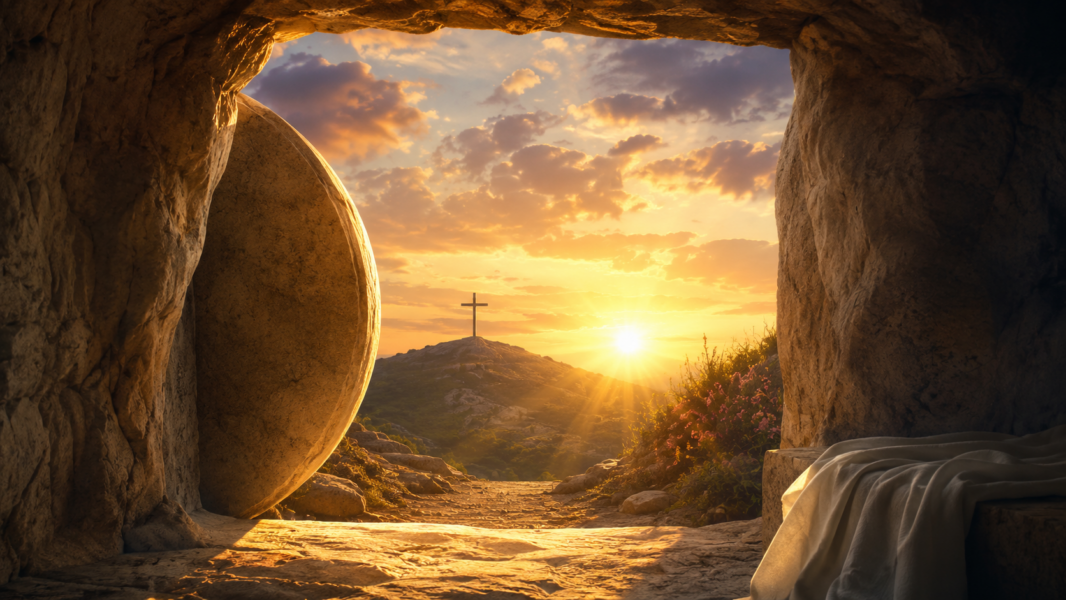
“I am the Alpha and the Omega, the first and the last, the beginning and the end.”
— Revelation 22:13
“This is the day that the Lord has made: let us rejoice and be glad in it.”
— Psalm 118:24
“I am the First and the Last, and the Living One.”
— Revelation 1:17-18
The symbolism of the Sacred Scriptures is unfathomable, because He who inspired them is so great that no definition can contain Him; therefore He reveals Himself in a multitude of images.
There is, at the heart of the Gospels —in Easter time—, an eloquent image of a Day that does not appear on any calendar. Not because it does not exist, but because it overflows everything: it is the eighth day. This is, at once, first and last, origin and consummation; this day cannot be enclosed in the ordinary succession of time. It is the day of the Resurrection, Sunday, in which all things begin anew, are recapitulated.
If read carefully, the Gospel itself hints at this mystery when it narrates that Christ appeared again to His disciples “eight days later” (Jn 20:26). This is not an accidental indication, but a key. This eighth day coincides, with magnificent and superlative meaning, with the first: the day on which the Lord rose. Thus, time no longer simply advances in a straight line, but is recapitulated. It returns, but does not repeat; it comes back, but sanctified.
In Christ, time becomes liturgical. It is no longer mere succession, but a living circle: every Sunday is the first, because everything begins anew; and it is the eighth, because that beginning no longer belongs to the old order. It is a beginning that does not arise from the world, but descends upon it. It is not the restart of the same, but the irruption of the definitive.
Msgr. Juan Straubinger, in commenting on the appearances of the Risen One, emphasizes that the first day of the week points to the beginning of a new reality. It is not simply that something starts up again, but that history is reached by a Life that does not belong to it. The Resurrection does not restore the ancient world: it inaugurates it anew.
For this reason, the Christian tradition —with particular depth in St. Augustine— has seen in this day the symbol of eternal rest. Saturday represented rest after work; Sunday, on the other hand, is the rest that will have no end: the day without sunset.
But in the deepest and abyssal part of this mystery beats a presence; this first and last day is not simply a time: it is Christ Himself. He is the one who, by rising, sanctifies time from within. He does not only inaugurate a new day: He is the Day. As the Apocalypse proclaims, He is the Alpha and the Omega, the beginning and the end. In Him, every beginning finds its source and every end its fulfillment.
In this way, history ceases to be a dispersed flow to become Christocentric: it does not head toward Christ as toward a distant point, but happens already within Him. It is true that there is an end for temporal history: a term toward which everything is directed. But that end is not uncertain nor open to any outcome, because the victory is already Christ’s. In other words, history does not advance toward an unknown resolution, but toward the full manifestation of a victory that has already taken place.
Note: The articles published as Tribuna express the opinion of their authors and do not necessarily represent the editorial line of Infovaticana, which offers this space as a forum for reflection and dialogue.