


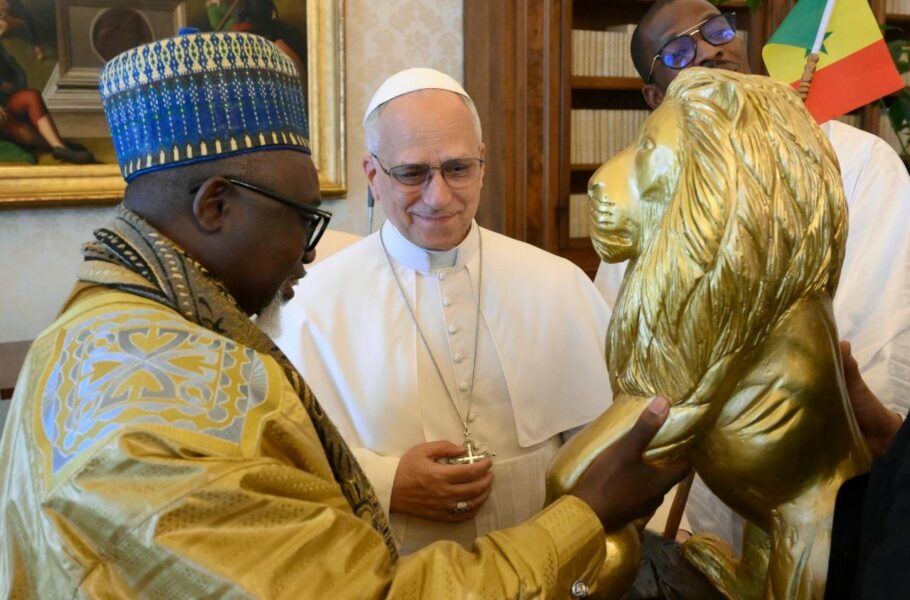
Pope Leo XIV received this Saturday in the Vatican a delegation of leaders and representatives of the Muslim community of Senegal, before whom he defended interreligious dialogue as a fundamental tool to curb extremism, hate speech, and the conflicts currently affecting Africa. During his address, the Pontiff praised the Senegalese model of peaceful coexistence between Christians and Muslims, which he defined as a “treasure of fraternity” that must be preserved.
Below is the speech of Leo XIV:
Excellencies,
dear brothers and sisters:
Peace be with you!
I am pleased to welcome you, who represent the Muslim brotherhoods and communities of Senegal, together with the representatives of the Catholic Church in that same country. This meeting is a significant expression of our friendship and our common commitment to promoting an inclusive, peaceful, and fraternal society.
You come from Senegal, the land of “teranga”—hospitality and solidarity—a land of strong family ties, coexistence, and peaceful cohabitation between Christians, Muslims, and believers of other traditions. This reality constitutes the foundation of dialogue between peoples differentiated by their religious affiliation and ethnic origin. This treasure of fraternity, which must be carefully preserved, is a precious good not only for your nation but for all humanity.
Unfortunately, armed conflicts persist on the African continent, causing serious humanitarian crises and profound inequalities that afflict entire populations daily, not to mention the alarming increase in violent extremism. To this are added the growing flows of migrants and refugees, hate speech that poisons the social fabric, the weakening of family ties, and the erosion of ethical and spiritual values, especially among young people.
In this context, the values inspired by the spirit of “teranga” and interreligious dialogue constitute a valuable means to alleviate tensions and build lasting peace.
«By fostering interreligious dialogue and involving religious leaders in mediation and reconciliation initiatives, politics and diplomacy can rely on moral forces capable of alleviating tensions, preventing radicalizations, and promoting a culture of mutual esteem and respect» (cf. Address to the Authorities, Civil Society, and Diplomatic Corps, Yaundé, April 15, 2026). Today the world greatly needs a diplomacy and religious dialogue founded on peace, justice, and truth.
As Christians and Muslims, we believe together that every human being has been shaped by the hands of God and, therefore, is clothed with a dignity that no human law or power has the right to take away (cf. Gn 1,27). The nations of the world have also proclaimed it: «All human beings are born free and equal in dignity and rights». On this foundation of fraternity, rooted in the origin of humanity and in faith, we together assume our common responsibility: to condemn every form of discrimination and persecution based on race, religion, or origin; to reject every instrumentalization of the name of God for military, economic, or political purposes; to raise our voice in favor of every suffering minority. As I said in Bamenda, Cameroon: «Woe to those who manipulate religions and the very name of God for their own interests […], dragging what is sacred into the darkest and most miserable!» (Speech for Peace, Bamenda, April 16, 2026).
I pray that Almighty God rekindle the desire to understand each other better, to listen to one another, and to live together in respect and fraternity. May He grant us the courage to walk the path of dialogue, to respond to conflicts with gestures of fraternity, and to open our hearts to others without fearing differences. Finally, I pray that your commitment to peace, justice, and fraternity may bear abundant fruits and lead to ever deeper cooperation among all parties for the good of humanity. Thank you!