


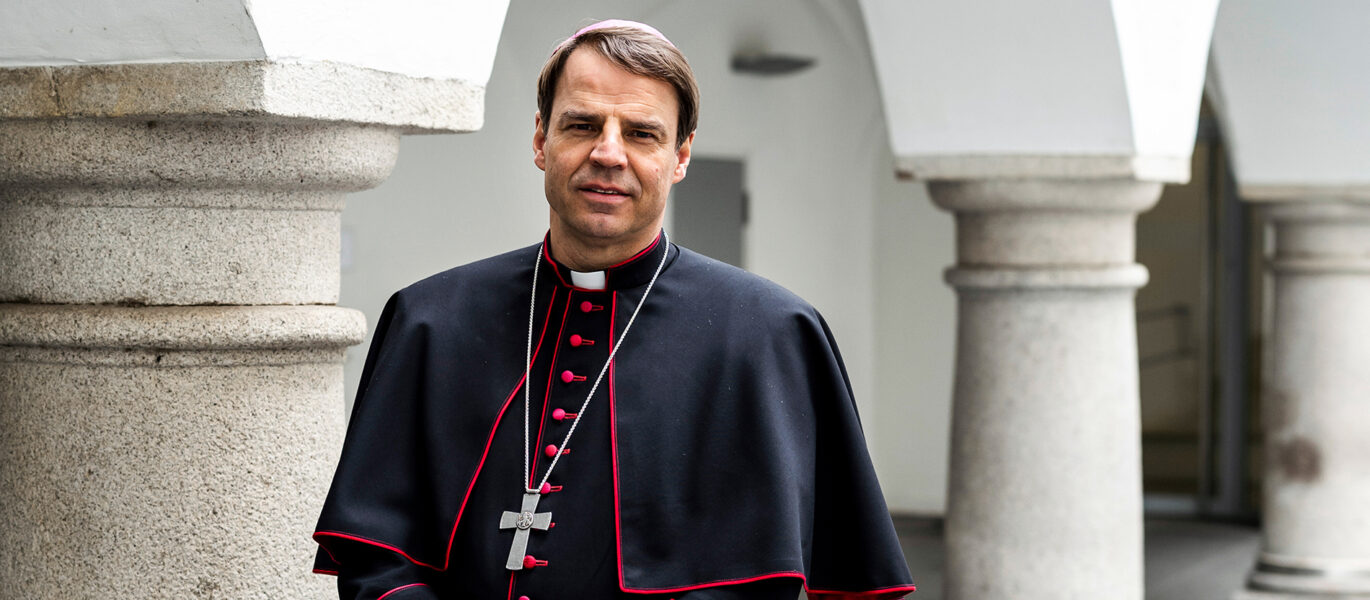
The Bishop of Passau (Germany), Monsignor Stefan Oster, has publicly acknowledged the deep discomfort caused by the assemblies of the German Synodal Way, the controversial reform process promoted by part of the Church in Germany. The prelate assured that he experienced those meetings as an experience of “emotional stress” due to the strong internal divisions and the pressure suffered from maintaining critical positions regarding some of the majority proposals.
According to what he declared in the podcast Frings fragt! from domradio.de and the Central Committee of German Catholics (ZdK), Oster explained that he suffered particularly upon realizing that his stance of conscience contributed to publicly projecting the image of a divided Episcopal Conference.
“I contributed to it because I was part of that minority that said: ‘No, I can’t go that way’,” the bishop confessed.
The prelate also revealed that he personally conveyed to the Pope his concern and suffering over the internal situation of the German episcopate.
“The greatest transformation since the Reformation”
Oster is part of the small group of German bishops who, during the Synodal Way, repeatedly expressed reservations about several of the reforms defended by the majority, especially on issues related to sexual morality, power in the Church, and the priesthood.
The bishop stated that this position brought him strong media and ecclesial pressure.
“The polarizations intensified,” he acknowledged.
Even so, he explained that he also received support from both the faithful and people close to his ecclesial sensitivity.
During the interview, Oster maintained that the Church in Germany is currently undergoing “the greatest transformation since the Protestant Reformation,” shifting from a sociological model of Church to one in which Catholics will have to be able to personally explain what they believe and why they believe it.
Criticism of priestly formation
The Bishop of Passau also spoke about the need for a more serious discernment in the formation of future priests.
As he pointed out, experience has shown that priestly ordination does not automatically correct previous personal or psychological problems.
“Whoever was already strange in the seminary will end up even stranger,” he stated graphically.
Oster insisted on the importance of properly selecting those preparing for the priesthood and accompanying them in a more realistic and mature way.
Transparency regarding abuses
At another point in the conversation, the bishop advocated for greater transparency in the management of sexual abuse cases and in the handling of ecclesial finances.
Even so, he specified that certain delicate processes also require protected spaces to facilitate prudent decisions.
Oster considers that the German Church is currently more advanced than many other episcopal conferences in matters of abuse investigation and prevention, in part thanks to the significant economic resources available.
As an example, he mentioned the recently presented abuse study in Passau, which cost around 750,000 euros.
The bishop also highlighted that the Church has acquired notable experience in this area in Germany, although he warned that many issues remain pending and that attention to victims must not diminish.
Concern over social polarization
Beyond the ecclesial situation, Oster also expressed his concern about the deterioration of public debate and democratic culture in the West.
The bishop defended the idea that Western democracies historically rest on the Judeo-Christian vision of the human person and warned of the risk of losing that foundation.
“We are sawing off the branch we have grown on,” he lamented.
Likewise, he criticized the current media dynamics, marked—according to him—by the constant search for clicks, sensationalism, and polarization, something that also affects Catholic media outlets at times.
“Humiliation is also part of faith”
In a more personal tone, Oster also recalled his experiences as a young athlete practicing judo, where he learned the value of humility through defeat.
The bishop related that experience to the Christian dimension of humiliation and suffering.
“That is part of the very heart of our faith,” he affirmed.
Recalling the Passion of Christ, Oster emphasized that experiences of failure and humiliation are also part of the Christian’s path of human and spiritual maturation.