


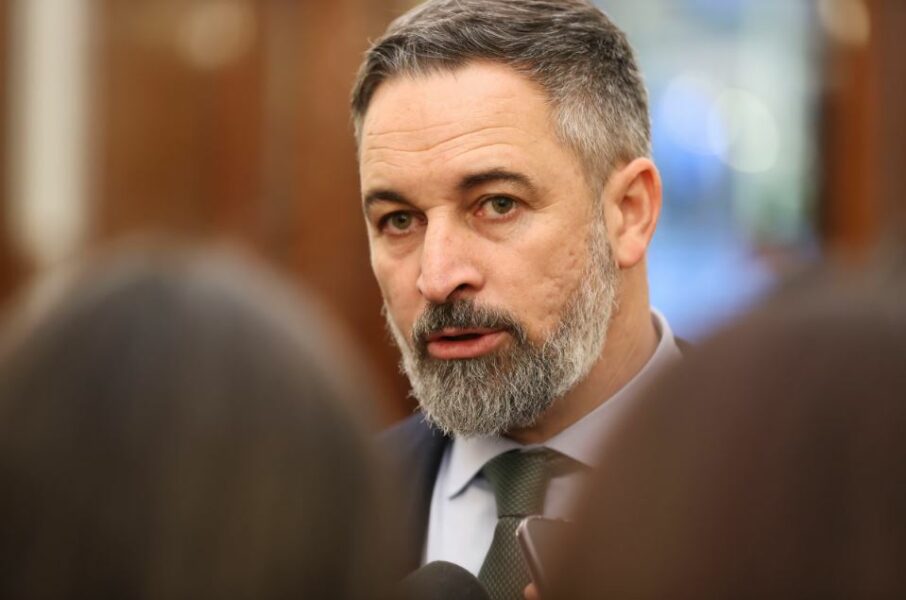
The president of Vox, Santiago Abascal, has denied ignoring a meeting request from the Spanish Episcopal Conference (CEE) and has shown willingness to dialogue with the bishops on immigration, although reiterating his outright rejection of the massive regularization promoted by the Government and supported by various ecclesiastical sectors.
According to what the general secretary of the CEE, Francisco César García Magán, stated this Wednesday, the Spanish bishops proposed about a year ago to hold an informal meeting with Abascal —“to have a coffee or a beer”—, but they never received a response.
Abascal claims he never received the invitation
Hours later, the Vox leader responded publicly through a message on the social network X, where he denied having knowledge of that meeting proposal.
“I have no knowledge of that request. Not long ago I coincided with Mons. Argüello at the presentation of a book and he didn’t say anything to me,” he stated.
Abascal added that his party has no objection to meeting with the Episcopal Conference to explain their stance on immigration and the consequences that, in his opinion, the open borders policy is having.
“Delighted to talk with the Episcopal Conference to explain that massive regularization is a covert invasion,” he wrote.
Vox warns about the pull effect
From Vox, they consider that these measures incentivize the pull effect and worsen the migratory pressure on Spain. In his message, Abascal insisted on the figures of irregular immigrant entries recorded in recent years.
“Two and a half million people have entered in two years. And more will come in the next ones, if we don’t prevent it,” he pointed out.
The Vox leader also maintained that the institutions that support this type of policies “are responsible for the direct harm caused to Spaniards”.
The origin of the controversy
The tension between both parties increased after the Bishop of the Canary Islands, José Mazuelos, publicly defended the need to understand the situation of immigrants arriving on Spanish coasts in cayucos.
Subsequently, García Magán accused Abascal of “slander” for denouncing that some ecclesiastical entities “make business with illegal immigration,” and rejected the “national priority” proposal defended by Vox.
However, from Abascal’s party they insist that a significant part of Spanish Catholics share his concern about the social, economic, and cultural impact of mass immigration.
“There is a large majority of Spaniards, (many of them Catholics and quite a few bishops) who know that we need to change course,” Abascal concluded.