


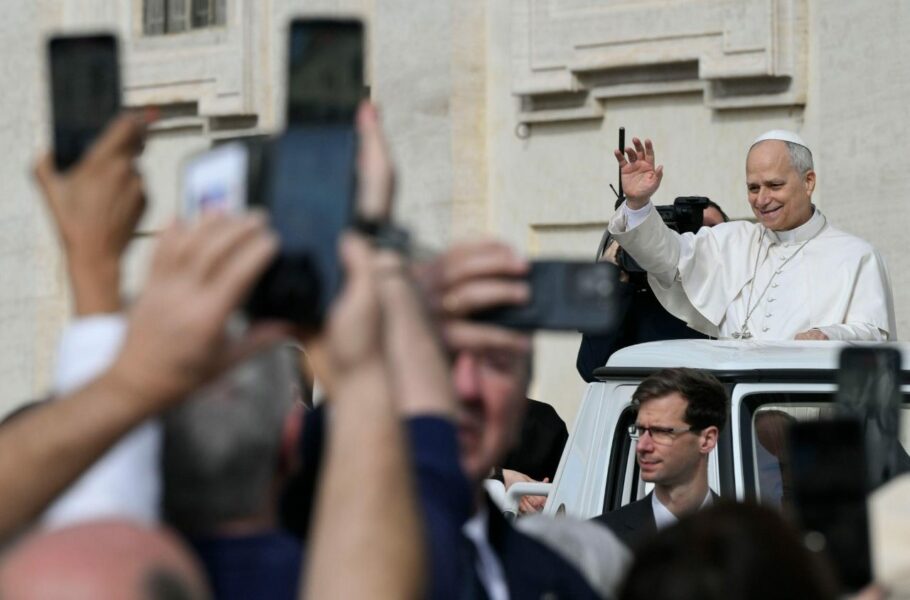
The scene has everything that the contemporary Vatican seems unable to avoid: solemn background, televisual aesthetics, crowd in St. Peter’s Square, popemobile advancing among the faithful and, suddenly, ABBA playing as if the general audience needed a disco soundtrack. The video spread on social media, picked up ironically by Raymond Arroyo, shows the bewilderment: Dancing Queen accompanying a papal encounter in the visible heart of Catholicism.
The audience was no minor act nor an improvised concert in some random courtyard. The official page of the Holy See places the general audience of Leo XIV on Wednesday, May 6, 2026, in St. Peter’s Square, and the catechesis of that day was dedicated to Lumen gentium and to the Church “pilgrim in history toward the heavenly homeland.” The contrast could not be more perfect: while the pontifical text spoke of directing one’s gaze toward the Kingdom of God, someone decided that the appropriate atmosphere called for one of the most recognizable pop anthems of the seventies.
It is not advisable to exaggerate: a general audience is not a Mass. We are not talking about music introduced into the Eucharistic liturgy. But neither is it advisable to pretend that the place does not matter. St. Peter’s Square is not a municipal auditorium, nor a religious theme park, nor a set where everything is neutralized by the label “welcoming.” There, every gesture communicates. Music too. And when Dancing Queen is chosen, the unintentional message ends up being stronger than the intention of whoever pressed the button.
ABBA’s song also has a curiously appropriate history for irony. The group’s own official site recalls that the track was performed publicly before its release at a televised gala in honor of the wedding of King Carl XVI Gustaf of Sweden and Silvia Sommerlath, in June 1976; the single was released later, on August 16 of that year, and ended up becoming a worldwide number one. In other words: it was born with a royal, ceremonial, and slightly excessive scenography as well. Half a century later, the “dancing queen” reappears, not before the Swedish monarchy, but before the oldest spiritual monarchy in the West.
The lyrics, read from St. Peter’s, become almost a pre-written satire. It speaks of loud music, of a scene that attracts gazes, of youth on display, and of someone seeking the place where the right song plays. Placed under Bernini’s colonnade, that scene stops being a disco fantasy and becomes an involuntary parable of the current Vatican: a bimillennial institution trying to seem spontaneous, light, youthful, accessible, as if the problem of evangelization were a lack of rhythm and not a lack of clarity.
There is a particularly ironic point. In his catechesis, Leo XIV recalled that the Church must not announce itself, but refer to Christ. He also spoke of the fragility of ecclesial institutions and their need for conversion and reform. The phrase, applied to the musical episode, works as a diagnosis: when the ecclesiastical apparatus worries too much about producing atmosphere, it ends up becoming the protagonist. The Church stops pointing to the King and looks at itself in the mirror of the scene.
The choice of Dancing Queen is not a heresy. It is something harder to discuss because it seems trivial. And precisely for that reason, it is revealing. Major doctrinal crises are detected in documents, appointments, or silences. Tone crises are detected in these small decisions that no one signs, no one explains, and everyone takes for granted. The question is not whether ABBA can ever play in a Catholic context. The question is why someone thought it was a good idea to play it at a general audience in St. Peter’s Square.
The Vatican usually justifies these decisions under the language of closeness. The problem is that closeness misunderstood degrades what it touches. It does not bring the sacred closer to the people; it lowers the sacred to the code of entertainment. And when everything becomes spectacle, the crowd no longer distinguishes whether it is before a catechesis, an institutional reception, or a public relations event with background music.
The final irony is that Dancing Queen speaks of a figure that captures the scene and to whom everyone looks. In St. Peter’s, that figure should not be the institution, nor the choreography, nor the music, nor the televisual smile of the moment. The Church, according to the catechesis of that day itself, is pilgrim, not protagonist of a dance floor. Its task is not to get the square “into the mood,” but to remember where it is heading. And if to do so it needs ABBA to set the rhythm, perhaps the problem is no longer in the song, but in the idea that some have of the mission.