


On August 10, 1936, in the Sevillian town of Peñaflor, the militiamen who had captured a 21-year-old young requeté made him an offer: shout “¡Viva Rusia!” or “¡Muera la religión!” and he would keep his life. Antonio Molle Lazo did not hesitate. He responded with the only shout he carried inside: “¡Viva Cristo Rey!”. They mutilated him, shot him, and left him on the road with his arms outstretched in the form of a cross.
The monk who refused to bow to the Government
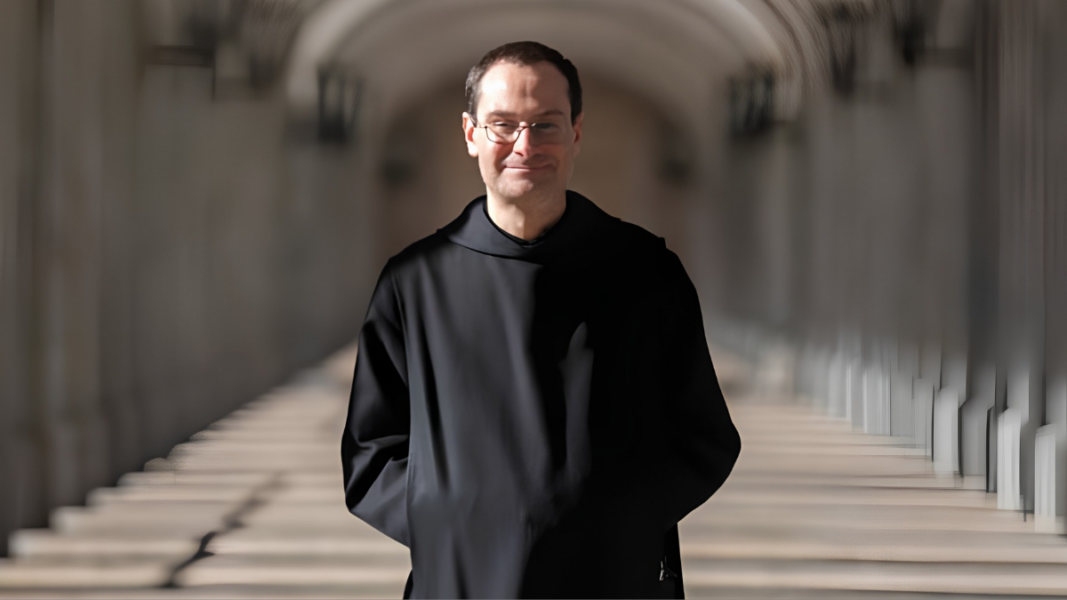
To understand why it matters who signs this biography, one must understand who Santiago Cantera is and what it has cost him to be so.
Cantera was prior of the Benedictine abbey of the Valley of the Fallen from 2014 to 2025. During that period, Pedro Sánchez’s Government made him its main target under the Democratic Memory Law. Minister Félix Bolaños even suggested that the Benedictines could remain in the Valley “as long as the prior disappeared from the scene.” The minister himself celebrated his replacement in March 2025 because, as he said, it was “inconceivable” for “a prior nostalgic for Francoism” to lead the community there. In 2020, Cantera received the Religion in Freedom Award for Audacity in the Face of the World “for his courage, integrity, and serenity in defending the freedom of the Church against undue intrusions by public powers.” Monsignor Munilla said then that Cantera “has given Spain the moral lesson it needed.”
A medieval historian, PhD from the Complutense, who spent eleven years resisting pressures to betray what he considered just: the permanence of his community and the integrity of a sacred space. Someone who said in more than one interview that, since childhood, he had desired the grace of martyrdom.
This man has just published the biography of Antonio Molle Lazo.
“He was twenty-one years old and his arms outstretched in the form of a cross”
Antonio Molle Lazo (1915-1936). Youth, ideals and martyrdom is not a book of political history. It is the biography of a young man from Cádiz, born in Arcos de la Frontera on Good Friday 1915, who grew up in Jerez, was educated by the La Salle Brothers, became a Carlist as an expression of faith—not ideology—and who on August 10, 1936, in Peñaflor, was captured while trying to protect a group of women and the nuns of the Sisters of the Cross.
What happened between the capture and death is documented by the direct testimony of the head of the Peñaflor railroad station, who witnessed it from a few meters away, and by the statements of several militiamen imprisoned in Palma del Río, who acknowledged the facts before Fr. Sarabia in 1939.
The mob offered him his life in exchange for blasphemy. He responded: “¡Viva Cristo Rey!”. They insisted. He responded the same. They mutilated him. He responded the same. When he realized his end was near, he stretched his arms as far as he could in the form of a cross, crossed one leg over the other, and with all the strength he had left, shouted for the last time: “¡Viva Cristo Rey!”. They shot him in that position. It was the hour of none.
What only this man could write
Cantera says it without adornments in the introduction: when recounting Molle’s martyrdom, he had to stop several times because tears prevented him from continuing. “I have felt Antonio’s valor up close and it has moved me to be writing a biography of someone before whom I have felt profoundly unworthy.”
That phrase is worth what it is because it comes from a man who spent a decade being the declared target of a government that wanted to break him. It is not spiritual posturing. It is the acknowledgment of someone who knows the price of not yielding, and who knows that this young man paid an infinitely greater price.
The book covers Molle’s entire life: his childhood, his education, his adherence to Carlism as a natural extension of his faith, his imprisonments during the Second Republic, his last hours in Peñaflor—the Mass in the morning, the communion, the game of dominoes with his companions, the defense of the convent, the capture—. And the death. And the immediate fame of sanctity that followed: the blood that neighbors kissed on the church floor, the body that smelled of incense weeks later in the cemetery, the favors attributed to his intercession that continue to arrive to this day.
His beatification cause, initiated in the 1940s, has been relaunched by the Canonical Association of the Faithful Servants of Christ the King. More than thirty Carlist martyrs from the same era have already been beatified by the Church.
A book for this moment
There is a coincidence that does not seem casual. The man who wrote it has just lived, in his own flesh, what it means to hold a position when the price is too high for most. The man the book is about lived, ninety years ago, the absolute version of that same test.
Antonio Molle was twenty-one years old. A real chance to save his life. And the certainty that shouting a single phrase he did not believe would have been enough to survive. He chose not to do it.
In a time when religious persecution in Spain no longer needs rifles—it suffices with laws, budgets, and institutional pressures—the life of Antonio Molle Lazo is not archaeology. It is a mirror.

Antonio Molle Lazo (1915-1936). Youth, ideals and martyrdom, by Santiago Cantera Montenegro, O.S.B. Homo Legens, 2026. Available in bookstores and at homolegens.com.