


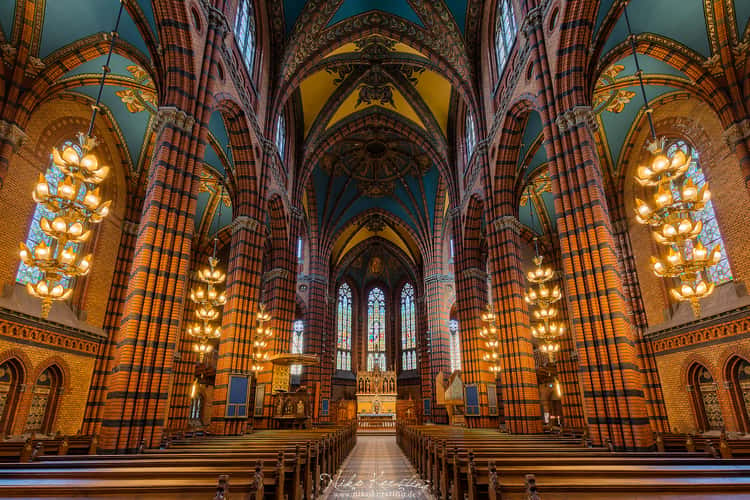
The Catholic Church in Sweden has officially inaugurated the Church of Saint John, S:t Johannes kyrka, in the heart of Stockholm, after the temple passed from the Swedish Lutheran Church to the Catholic Diocese of Stockholm. The ceremony took place on May 1, 2026 and already represents the effective opening for Catholic use of one of the most recognizable temples in the Swedish capital.
A historic temple in the heart of Stockholm
The building is not a minor church. S:t Johannes rises in Norrmalm, at the top of Brunkebergsåsen, an elevated position that makes its tower a visible point in Stockholm’s urban landscape. It was built between 1884 and 1890 and inaugurated on Pentecost Sunday of 1890. The project was the work of the architect Carl Möller, one of the prominent names in Swedish religious architecture at the end of the 19th century.
The church follows the neo-Gothic style, with a structure of great verticality, cathedral-like interiors, and a tower of about 70 meters. Its capacity is around 900 people, which places it among the largest temples in Stockholm.
From Lutheran temple to Catholic reference
Until now, the temple belonged to the Church of Sweden, of Lutheran tradition, but it had been factually linked to the Catholic life of the city for decades. According to the Swedish Christian newspaper Dagen, Catholics have used S:t Johannes for liturgical celebrations since 1978, especially the Polish and Ukrainian communities. That continuity explains why the acquisition has not been a sudden irruption, but the culmination of a pastoral presence already established for nearly half a century.
The sale also responds to a broader religious transformation in Sweden. The Church of Sweden maintains a huge historical and patrimonial presence, but has suffered for decades a sustained decline in members, religious practice, and capacity to maintain its buildings. In many areas, the problem is no longer just spiritual, but material: large, expensive temples that are increasingly underused.
The Catholic Church lives a different situation. It remains a minority in Sweden, but has grown steadily due to immigration from Poland, Ukraine, the Middle East, Africa, Latin America, and other European countries. That growth has generated a very concrete need: more churches, more liturgical spaces, and less dependence on renting Lutheran temples. In that context, the incorporation of S:t Johannes is an operation of enormous pastoral importance.
A key center for Catholicism in Sweden
The Catholic Diocese of Stockholm itself had emphasized that it lacked sufficient premises to serve its faithful and that for years it had had to rent spaces from the Church of Sweden. The acquisition of a temple with capacity for 900 people changes that situation in a central area of the capital and allows consolidating worship in several languages, especially in Polish and Ukrainian.
The temple will not be limited to Sunday Mass. The diocese plans to use it for liturgical celebrations, sacred concerts, diocesan meetings, visits, and activities linked to Church life. It can also host weddings, funerals, and religious acts, although reservations for marriages are restricted to members of the Catholic Church due to the high anticipated demand.
The opening of S:t Johannes as a Catholic church also has an evident symbolic charge: a large 19th-century Lutheran temple passes to serve an expanding Catholic community. It is not a simple real estate transaction, but a visible sign of the religious change in Sweden. Where the old Lutheran majority reduces its effective presence, Catholicism, supported to a large extent by immigrant communities, gains liturgical space, public presence, and institutional stability.
With this inauguration, Stockholm adds a new reference Catholic center in one of its most prominent religious buildings. S:t Johannes ceases to be just a neo-Gothic monument of the city to become a key piece of the Catholic future in Sweden.