


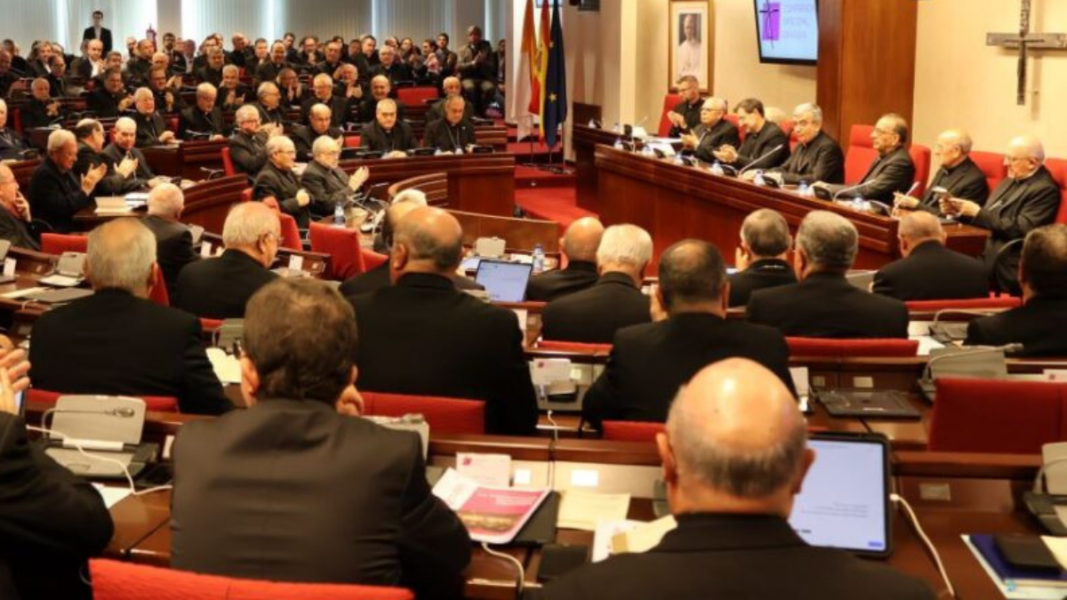
Yesterday, Don José Ignacio Munilla decided, on his Radio María program, to dedicate a good while to one of those alarms that have been circulating through the ecclesiastical hierarchy in recent times with the diligence with which indulgences once circulated: the alarm against polarization. In Munilla’s defense, it must be said that he invents nothing. He quotes Argüello, who quotes Leo XIV, who quotes—with reasonable parsimony—the spirit of the times. The bishop, in this regard, is merely the last link in a devotional chain, and that’s why it’s best not to dwell on him. Let us dwell, therefore, on what he repeats. Which is what deserves the effort.
The argument, stripped of the refined distinctions that Argüello introduces with care, comes down to this: we live polarized; polarization is a modern evil (they don’t clarify whether it’s a substitute for original sin or a backlash from liquid modernity); and consequently, the Christian must safeguard himself from the phenomenon by preserving nuances, avoiding «pigeonholing» himself, and resisting the temptation—typical of social networks—of belonging to a side. Up to this point, everyone nodding in agreement and no one objecting, lest objecting turn one, heavens forbid, into yet another polarizer.
The problem is that, beneath the pious wrapping, what is being sold to us is a fallacy that any high school student—from the days when logic was still taught—would recognize on the first try. It’s called, for Latin enthusiasts, argumentum ad temperantiam; for the rest, the fallacy of the middle term. It consists in assuming that, given two contrary positions, the truth rests with reasonable comfort halfway between them. Aristotle, whom the Church read profitably for fifteen hundred years, placed virtue in the middle between two vices; but he was talking about moral virtues, not facts. The difference is not minor.
Let us illustrate it with the bluntest example. If a gentleman asserts over after-dinner conversation that two and two are eight, and another dares to correct him—after taking a breath, because these things are known to come at a high price nowadays—saying that two and two are four, must we conclude, in the name of a luminous consensus, that two and two are six? Arithmetic, except in some education faculties, does not lend itself to such compromises. The same can be said of astronomy: the distance from Earth to the Sun is not decided halfway between what NASA says and what a flat-earther says. And the same, in short, applies to moral matters in which the suspicious circumstance arises, in these times, that a truth exists. If a legislative current proposes interrupting the life of the unborn up to the eighth month, and another asserts that it should never be interrupted, are we being asked that the second, in order to show himself «non-polarizing,» backtrack to the fourteenth week? And why not the twenty-second? Or the thirtieth, which has a certain numerical charm? The crux of the matter, of course, is not the number. It’s that the number is decided by the truth, not by the average.
There is also a detail that must be placed on the table with the utmost courtesy possible: the complaint against polarization is rarely distributed justly. It almost always goes in one direction. When a society, in five years, goes from not contemplating gender self-determination in minors to contemplating it from age twelve, that—oh surprise—is not called polarization; it is called progress. Polarization, magically, begins when someone utters the word «no.» The one who innovates radically never polarizes. The one who stands firm does. The operation is old and effective: rebrand passivity as virtue and objection as hysteria, and sell the whole package wrapped in words like «dialogue,» «nuance,» and «encounter»—which always look good.
The comic part, at this point, is that the reproach comes from the Catholic Church. The Church, while it was the Church, was polarizing by definition. Its message did not consist in offering a middle ground between Christ and Belial, nor in seeking a reasonable consensus between the commandments and their opposites. The distinction between good and evil, sin and grace, eternal life and damnation—those «polarities» that Argüello himself recalls in his speech, and that Munilla applauds live—are, as far as one can see, extremely polarizing. If polarizing means pointing out, without disguise, differences that exist, the entire catechism polarizes from the first page. That the same catechism now asks us to soften the matter because someone felt offended on social media, well, has its grace.
What happens, I suspect, is that affective polarization—that phenomenon by which one hates the adversary before hearing him, and recognizes oneself in the group before in its arguments—has been confused with polarization plain and simple, which is nothing more than the perfectly healthy fact that on some issues there are correct and incorrect answers, and that affirming one implies denying the other. The former deserves concern; the latter is called, in plain Roman terms, distinguishing. And distinguishing, we forget, is the opposite of indifference.
That a bishop—or several—recommend moderating the tone and not turning the family dinner into a Nuremberg trial seems praiseworthy to me. That from there they slip in, with a very serious air, that all firmness is sectarian, and that the reasonable thing is to yield in any dispute until meeting the adversary at some midpoint along the way, not so much. That is not prudence. It is, in the end, another way of polarizing oneself: that of the one who has settled, very comfortably, in a place he calls the «center» and that conveniently coincides with the only spot where no one is going to challenge him on anything.