


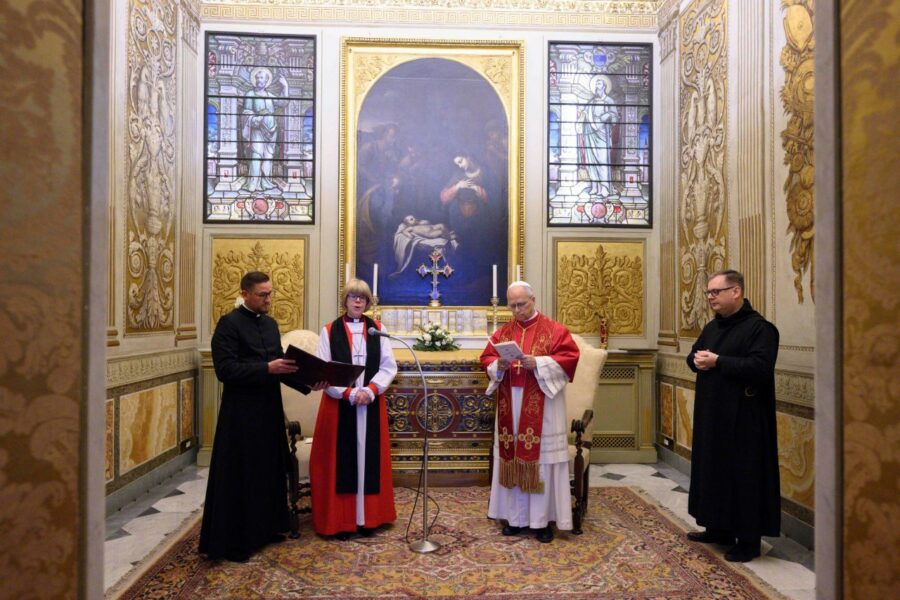
Pope Leo XIV received Sarah Mullally, Archbishop of Canterbury and Primate of the Anglican Communion, in the Vatican this Monday, in a meeting marked by ecumenical dialogue and the doctrinal tensions that continue to separate Catholics and Anglicans. The visit is also preceded by the controversial episode in the Clementine Chapel regarding the presence and public gestures of Mullally in Vatican spheres.
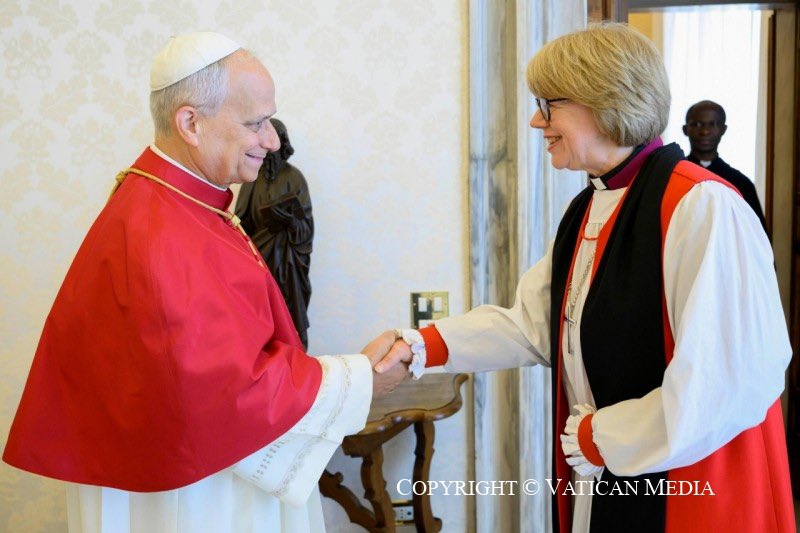
Leo XIV Recognizes Advances and New Difficulties
In the speech delivered during the meeting, disseminated by the Holy See, the Pontiff recalled the long path traveled in ecumenical dialogue since the historic meeting between St. Paul VI and Archbishop Michael Ramsey in 1966. That moment initiated a process of theological dialogue that continues to this day.
Leo XIV acknowledged that advances have been made in issues that for centuries had been a cause of division. However, he warned that in recent decades new problems have arisen that make it more difficult to discern the path toward full communion, an implicit reference to doctrinal and disciplinary debates that also affect the Anglican Communion.
A Context Marked by Doctrinal Tensions
The figure of Sarah Mullally is not unfamiliar with these tensions. Her appointment as the first woman at the head of the Anglican Communion has generated internal divisions, especially in sectors that reject women’s ordination and her positions on issues such as blessings for same-sex couples or the pastoral approach toward the LGBT community.
Read also: Who is Sarah Mullally, the «bishop» received with honors in Rome
These issues, along with other historical differences, form part of the background to which the Pope alluded when speaking of the “new problems” that have arisen in ecumenical dialogue.
Call for Unity Despite the Differences
Despite these difficulties, Leo XIV emphasized that they should not become an obstacle to the common proclamation of the Gospel. The Pope insisted that division among Christians weakens their witness in a world that needs the peace of Christ.
In this sense, he took up words from Pope Francis in 2024, who warned that it would be a scandal if divisions prevented fulfilling the common vocation of making Christ known.
The Pontiff added that it would also be scandalous to abandon the effort to overcome differences, even when they seem difficult to resolve, thereby reaffirming the Holy See’s commitment to ecumenical dialogue.
A Meeting in Continuity with Ecumenical Dialogue
Mullally’s visit to Rome, which takes place from April 25 to 28, is part of a series of meetings aimed at strengthening relations between the Catholic Church and the Anglican Communion.
The meeting in the Vatican also included a moment of joint prayer.
We leave below the full speech of Leo XIV:
Your Grace,
Peace be with you!
In the joy of this Easter season, as we continue to celebrate the resurrection of the Lord Jesus from the dead, I am pleased to welcome you and your delegation to the Vatican.
Your visit brings to mind the memorable meeting between St. Paul VI and Archbishop Michael Ramsey sixty years ago, whose anniversary you commemorated together with Cardinal Koch in Canterbury Cathedral the morning after your enthronement. Since then, the Archbishops of Canterbury and the Bishops of Rome have continued to meet and pray together, and I am glad that today we continue this tradition. Likewise, I am grateful for the ministry of the Anglican Centre in Rome, also established sixty years ago, and I especially greet its director, Bishop Anthony Ball, whom you will commend this afternoon as your representative to the Holy See.
During these days of the Easter season, the first words spoken by the Risen Christ resound throughout the Church: “Peace be with you” (Jn 20:19). This greeting invites us not only to welcome the gift of the Lord’s peace but also to be messengers of his peace. I have often pointed out that the peace of the Risen Jesus is “disarmed.” This is because He always responded to violence and aggression in a disarmed way, inviting us to do the same. Moreover, I believe that Christians must together give prophetic and humble witness to this profound reality (cf. Message for the LIX World Day of Peace, January 1, 2026).
While our suffering world deeply needs the peace of Christ, divisions among Christians weaken our ability to be effective bearers of that peace. If the world is to welcome our proclamation, we must therefore be constant in prayer and in efforts to remove every obstacle that hinders the proclamation of the Gospel. This attention to the need for unity for a more fruitful evangelization has been a constant theme in my ministry; in fact, it is reflected in the motto I chose upon being consecrated a bishop: In Illo uno unum, “In Him who is one—that is, Christ—we are one” (St. Augustine, Enarr. in Ps., 127, 3).
In this sense, when Archbishop Michael Ramsey and St. Paul VI announced the first theological dialogue between Anglicans and Catholics, they spoke of seeking the “restoration of full communion in faith and sacramental life” (Common Declaration, March 24, 1966). Certainly, this ecumenical path has been complex. While important advances have been made in some issues that historically divided us, in recent decades new problems have arisen that make it more difficult to discern the path toward full communion. I know that the Anglican Communion also faces many of these same issues at this time. However, we must not allow these ongoing challenges to prevent us from seizing every possible opportunity to proclaim Christ together to the world. As my dear predecessor, Pope Francis, said to the Primates of the Anglican Communion in 2024, “it would be a scandal if, because of our divisions, we did not fulfill our common vocation of making Christ known” (Address to the Primates of the Anglican Communion, May 2, 2024). For my part, I add that it would also be a scandal if we did not continue working to overcome our differences, no matter how difficult they may seem.
As we continue to walk together in friendship and dialogue, let us pray that the Holy Spirit, whom the Lord breathed upon the disciples on the evening of his resurrection, guide our steps as we seek, with prayer and humility, the unity that is the Lord’s will for all his disciples.
Your Grace, in thanking you for your visit today, I ask that that same Holy Spirit always remain with you, making you fruitful in the service to which you have been called.
May God bless you and your family.