


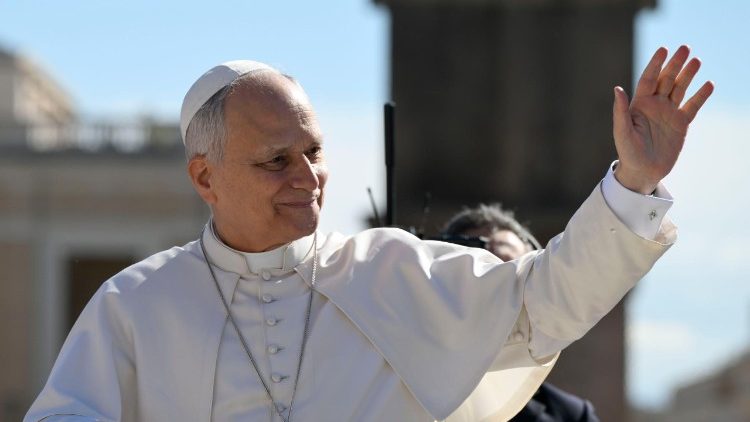
Pope Leo XIV has offered a nuanced and in-depth message on immigration during the press conference on the flight back from Equatorial Guinea to Rome, on the eve of his upcoming trip to Spain in June, where the migration issue—especially in the Canary Islands—is one of the major social and political debates.
A global approach after his time in Africa
After several days in Africa, the Pontiff positioned the migratory phenomenon as a “worldwide phenomenon!”. In this sense, he raised a fundamental question directed at the more developed countries: “What is the North of the world doing to help the South of the world or those countries where young people today cannot find a future and, for that reason, live this dream of wanting to go to the North?”.
Leo XIV emphasized that “everyone wants to go to the North, but often the North has no answers on how to offer them opportunities” and denounced situations of suffering linked to this phenomenon, including “the issue of human trafficking, the ‘trafficking’, which is also part of migration”.
Likewise, he warned about the exploitation of African countries: “Africa is considered by many people as a place where one can go to extract minerals, to take their wealth for the wealth of others, in other countries”. For this reason, he called for greater international involvement: “Perhaps at a global level we should work more to promote greater justice, equality, and the development of these African countries”.
Order at the borders and political realism
The Pope stated: “Personally, I believe that a State has the right to establish rules at its borders”. And he added precisely: “I am not saying that everyone should enter without order, sometimes creating in the places they go to situations that are more unjust than those they left behind”.
These words introduce a criterion of realism amid a debate marked by polarization, recognizing the legitimacy of an orderly management of migratory flows.
Human dignity, an non-negotiable principle
Alongside this recognition, Leo XIV insisted on the moral dimension of the problem. “In any case, they are human beings and we must treat human beings in a human way”, he affirmed emphatically, denouncing that sometimes they are treated “many times worse than animals”.
The Pontiff thus emphasized that beyond specific policies, the dignity of the person cannot be ignored. “When they arrive, they are human beings and deserve the respect that corresponds to every human being for their dignity”.
A message that anticipates his trip to Spain
Leo XIV’s words come at a key moment, just weeks before his trip to Spain, where immigration will occupy a prominent place in the public debate and also within the Catholic world.
Now, after his time in Africa, the Pope has outlined a broader framework that combines political responsibility and moral demand: acting on the root causes of immigration, recognizing the right of States to order their borders, and ensuring, in all cases, respect for the dignity of each person.