


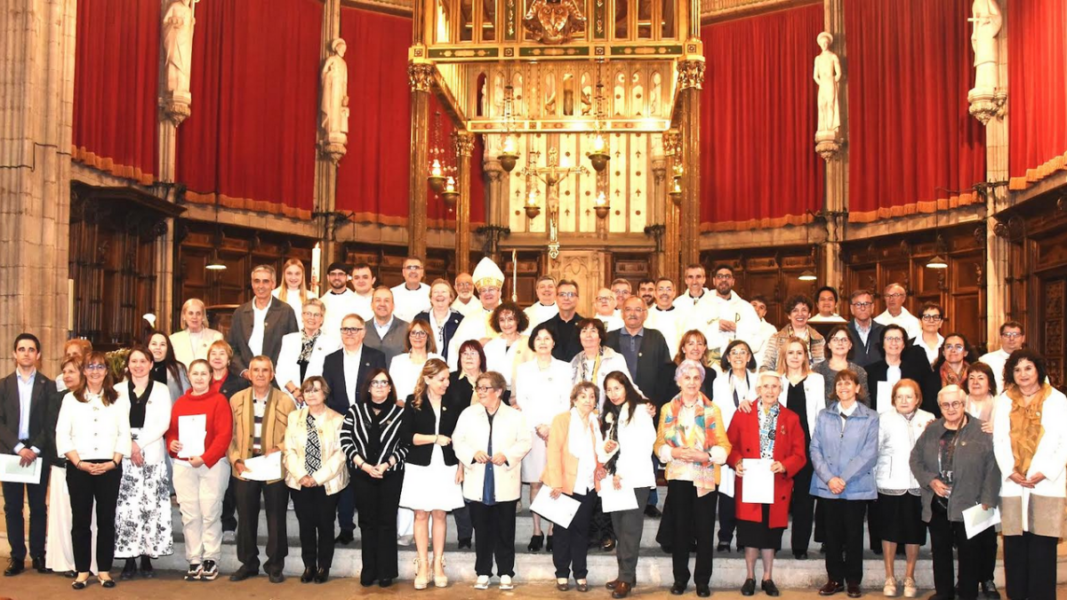
Where is the Church in Solsona heading? This is the first question one might ask when reading with astonishment on its website the news that last Sunday, April 19, in the afternoon, “the cathedral of Solsona hosted, for the first time, a celebration for the institution of extraordinary ministers of the Eucharist. A total of forty-five people from different parishes of the diocese received this ministry”.
Things have changed a lot in this small rural diocese in deep Catalonia, as some will remember: in the fall of 2021, the then-bishop, Xavier Novell, 52 years old, left his post because he had gotten a woman pregnant. Catalan television and the press in general pursued him day and night to capture exclusive images and statements.
However, it was not the first time the bishop made front-page news in the Catalan media; Monsignor, a somewhat eccentric character, had played the role of the devil in “the little shepherds” of a city in his diocese and was radically in favor of Catalan independence, about which he preached from the pulpit. However, alongside these facts, if one observes his eleven years of ministry at the helm of the diocese of Solsona, one gets a very different image.
On the one hand, we could say that Bishop Novell was a conservative who preached sound doctrine and morals. In 2017, the city council of Tárrega, one of the largest cities in his diocese, declared him persona non grata and he even had to leave escorted by the police after being considered homophobic for quoting Pope Francis in a Sunday bulletin linking homosexuality to the absence of a father figure. On the other hand, he warned on another occasion in the cathedral that he would not confirm teenagers who showed up for confirmation with pronounced cleavages or strapless tops, while establishing that only people who attended Mass every Sunday could be Caritas volunteers in the parishes of his diocese. These last two aspects earned him attacks from his own flock. But Novell was a person who made firm decisions and was not intimidated. One of them, taken from the beginning, affected the direction he was going to give to his diocese: he bet everything, as he himself said, on the New Evangelization, hiring laypeople to turn them into “apostolic workers” and organizing with the priests who wanted to collaborate with him the Alpha course in the parishes every year. Moreover, in a diocese with a predominantly elderly and dispersed population in small population centers, he concentrated and grouped Sunday Masses in certain locations, suppressing celebrations in the smallest towns. An unpopular, debatable measure, if you will, but people around there are used to driving to even buy bread, and secondly, the diocese is not exactly overflowing with priests.
After the scandal of Novell’s departure, Francisco Conesa was appointed in his place as the new bishop of Solsona. Conesa was born in Elche in 1961 and came from being bishop in the diocese of Menorca. He was not a “Catalan bishop,” as is so often demanded around here, but his Catalan-ness could be accepted.
And from the very first moment, as could be expected no other way, the new bishop of Solsona seemed to want to distance himself from his predecessor, not only in maintaining a low personal profile, but also in the direction he wanted to give to the diocese, something that, four years after his appointment, from the outside, begins to be seen clearly: as we said at the beginning, he has just instituted in the cathedral with great fanfare 45 extraordinary ministers of the Eucharist. As if that were good news…
Let us stop to consider the implications of such an institution in the particular context of the diocese of Solsona. According to official data from the diocese itself, it is an eminently rural diocese, in which 75% of its 169 parishes do not exceed 300 inhabitants and the largest ones do not reach 20,000. Its population is 140,000 inhabitants. Solsona has 38 priests resident in the diocese, 1 outside the diocese, 2 in mission countries, and four extra-diocesan priests. In total, as can be seen, the number of extraordinary ministers of the Eucharist exceeds that of priests.
The appointment of this massive number of laypeople as extraordinary ministers also leads us to look at Novell’s legacy, whose master plan for evangelization has been definitively deactivated. It seems that the Alpha courses are still being taught, but the rural environment is so different from the urban one and so harsh in its apostasy or religious indifference, due to radical independentist nationalism, that the footprint of Alpha is very faint. Therefore, we could say that, in 15 years since his arrival in Solsona, the physiognomy of the diocese has not been greatly affected, for better or worse, by Alpha. On the other hand, a few days ago a seminarian from the diocese received the diaconate, which currently has a total of four. Not so many years ago, Novell himself was considering establishing a minor seminary in the diocese. And now Conesa has to take the economist to the meeting of Spanish seminarians with the Holy Father so that his delegation looks a bit larger (6 people in total: the bishop, the four seminarians, and the economist).
Of the 140,000 inhabitants of the diocese, nearly 60,000 are concentrated in three cities: Berga, where the far-left CUP is violently dominant, Tárrega, and Mollerussa. Each has around 18,000 inhabitants. They are followed in population by Cervera and the city of Solsona itself, with about 9,000 inhabitants each, and Suria and some other city that rounds to five thousand inhabitants. All the other towns have fewer than 2,000 inhabitants. The majority, as the diocese’s website indicates, do not reach 300 inhabitants, and we are talking about a rural environment with very dispersed population centers.
Sticking to the numbers, what we have is that to the 38 diocesan priests has just been added a regiment that surpasses them: that of the lay extraordinary ministers of the Eucharist. How can such disproportion be explained? With these population numbers and considering the low religious practice in deep and rural Catalonia it is very difficult to think that these ministers are going to have the function of helping to distribute communion to the priests in multitudinous Masses, when it is very difficult for any Sunday Mass to exceed 250 attendees, not even on solemnities, and only in three cities.
So, what is the need for so many extraordinary ministers of the Eucharist? Can we, by logic, think that they will be dedicated to “celebrations in the absence or waiting for a presbyter”?; that is, to paraliturgies: that celebration that looks like a Mass in everything but without consecration, in which the faithful can receive communion from the hands of the extraordinary minister, a minister who cannot hear confessions. Therefore, we insist on something already said on other occasions: while the precept is to attend Mass, on the one hand, and, on the other, one cannot receive communion without being in a state of grace, how is it possible that bishops push the faithful into a situation where they receive communion without the possibility of confessing and cannot fulfill the precept of attending Mass because that celebration is not a Mass?
What is observed is that, in opposition to the concentration of Masses that Novell was carrying out, Conesa seems to have bet on dispersion. If to 38 priests we add the new 45 extraordinary ministers of the Eucharist, we have 83 parishes that could be attended on Sundays. This means half of the parishes in the diocese. Even if only four people attend. And even if, much more gravely, they do not attend a Mass, but a Protestantized liturgical act, celebrated by a layperson invested by the bishop to give communion to the people.
I remember that not long ago in the diocese of Urgell, about fifteen laypeople and acolytes were instituted for those same functions. The number, within the catastrophic, is more reasonable, in two very similar dioceses (except for Andorra), and they were instituted according to the ministry they were going to perform, and not with that vagueness of “extraordinary ministers of the Eucharist,” when they are going to have functions that are not the usual ones that such ministers perform, who help distribute communion to the faithful in multitudinous Masses.
Will Conesa want to collect more from the Spanish Episcopal Conference with the increase in active worship centers? Is there perhaps a directive from the CEE? Because, suspiciously, all rural dioceses are doing the same thing: leaving their parishes in the hands of laypeople. The Fr. Jorge González Guadalix denounced it a couple of years ago on Infocatólica, in one of his memorable articles, titled “The bleak future of rural pastoral care”.
The image that illustrates the text is official from the diocese, the group photo after the Mass of institution of the ministers. I don’t understand how anyone can think that this shows any vitality in that local Church and in what sense it is good news. And I take the opportunity to refute the fallacy, repeated ad nauseam in these contexts, that these extraordinary ministers of the Eucharist are the equivalent of the catechist figure in ad gentes missions. Because in ad gentes missions in third-world countries, the distance between worship centers can be enormous and most of the faithful do not have means of transportation. Even so, they can walk many kilometers to attend Mass. The same as the catechist does, to distribute communion where distances make attendance at Sunday Mass impracticable. The contrast with our landscape could not be more striking: you only need to drive along any road, no matter how secondary, to see the beautiful bell towers rising in the center of each little town. Every town, even if it has a community of less than 50 inhabitants, has a Catholic church. Another thing is that those inhabitants have stopped being Catholic. Because, moreover, those same people travel in vehicles that allow covering great distances in very short times. There is therefore no place for comparison between extraordinary ministers bringing communion to the little towns and catechists in mission territories. It is, simply and diabolically, a masked Protestantization of the Catholic Church.
Because, let’s notice, moreover, that the confusion has already been sown for some time by the hierarchy among the faithful, produced by the substitution of the word Eucharist for the word Mass, which has fallen into total disuse. Obviously, however, they are not the same. The Eucharist is the Sacrament that takes place within the Mass, which is the actualization of the sacrifice of Our Lord Jesus Christ on the cross.
We are reaching the point of having to remind bishops and priests that one can attend Mass without receiving communion if one is not in a state of grace and that attending Mass on certain days is what we are obliged to do, not to receive communion. Therefore, it doesn’t hold that by attending a paraliturgy celebrated by a layperson one is fulfilling the precept.
Not long ago, the priest Antonio María Domènech said that the future of rural parishes is closure. With their Protestantizing practices, the bishops are not only prolonging the agony, but sowing confusion among their faithful when it comes to fulfilling the precepts of Holy Mother Church.