


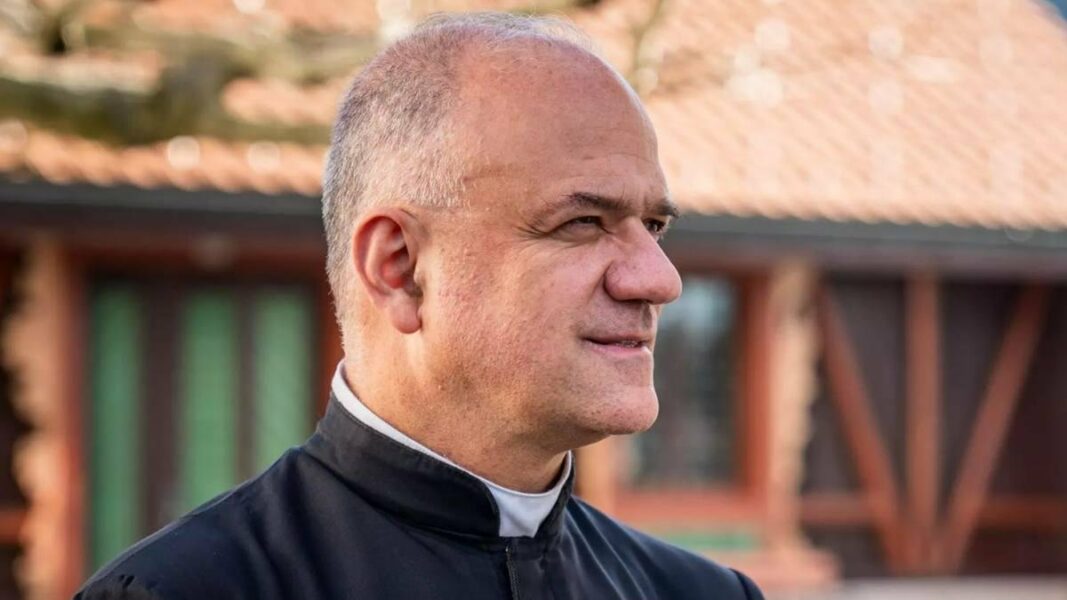
This interview with the Superior General of the Society of Saint Pius X, Don Davide Pagliarani, clearly addresses the reasons that, in the institution’s judgment, justify the upcoming episcopal consecrations, as well as its reading of the doctrinal, liturgical, and disciplinary crisis that the Church is going through. Throughout the conversation, Pagliarani responds to the most frequent objections, expounds the Fraternity’s position on obedience, Tradition, authority, and the risk of schism, and offers his diagnosis of the current ecclesial moment.
We reproduce below the full interview:
FSSPX.News: Reverend Superior General, your announcement of the upcoming episcopal consecrations, on February 2, has elicited a series of particularly intense reactions. What do you think about it?
Don Davide Pagliarani: This is understandable, as it touches on a very sensitive issue in the life of the Church. Moreover, the motives for this decision are objectively grave: what is at stake—the good of souls—is a capital matter. The debate sparked by this announcement therefore logically has great breadth. In the end, no one has remained indifferent. This is objectively positive and, providentially, I believe it corresponds to a very current need.
Indeed, in recent years, the conservative and traditionalist sphere—in the broad sense of the term—has sometimes given the impression of being reduced to a milieu of commentators, where analyses, expectations, and frustrations are expressed, often legitimate, but which do not easily translate into realistic and consistent positions. Among them, there are those who still await a response from the Holy See to the dubia submitted ten years ago by four cardinals—two of whom have since passed away—on Amoris Lætitia, or the eventual publication of a new motu proprio on the Tridentine Mass.
In this context, the decision of the consecrations challenges. It is not just another statement: it is a significant gesture that compels reflection, understanding the real gravity of the current problems, and taking a concrete position. Nothing is more urgent today. Without seeking it, the Priestly Fraternity of Saint Pius X finds itself being the instrument of a salutary shake-up—of which, in the end, only Providence is the author. Providentially, it is granted to contribute to something that the Church needs today more than ever, for its good and its regeneration.
Why do you consider a shake-up of this kind to be particularly necessary today?
When one speaks and discusses ceaselessly, often in a frustrating manner, about extremely grave problems affecting the faith, the very topics of the debate or dialogue end up, in the long term, being perceived as debatable, in the systematic respect for others’ ideas and different sensitivities. Little by little, everything is relativized.
In fact, the scourge of doctrinal pluralism, to which modern man is naturally inclined, ends up contaminating even the healthiest souls, gradually slipping toward indifferentism; a slow and inexorable anesthesia causes the loss of the sense of reality; there is a tendency to settle into a comfort zone, clinging to comforts and privileges, avoiding at all costs compromising them; zeal and the spirit of sacrifice diminish. In a word, the danger is getting used to the crisis and coming to live it as something normal. All this happens progressively, without realizing it. Those who have responsibility for souls have the duty to analyze these mechanisms in depth and try to block them before they become irreversible.
Now, what is at stake today is not an opinion, nor a sensitivity, nor a preferential option, nor a particular nuance in the interpretation of a text: it is the faith and morals that a Catholic must know, profess, and practice to save his soul and go to Heaven.
In other words, in the face of Eternity and the danger of losing Heaven, talks, dissertations, and dialogue must give way to reality.
What is that reality you speak of, and in what sense can the Fraternity’s gesture help to clarify it?
This reality is that today more than ever it is necessary to reaffirm, proclaim, and profess the rights of Christ the King over souls and over nations: it is necessary to have the courage to preach that the Catholic Church is the only ark of salvation for every man, without distinction; it is necessary to believe in the Redemption, in the sacraments, in the destruction of sin; it is necessary to remind humanity that the Church was established to snatch souls from error, from the world, from Satan, and from hell.
It is necessary to stop making those who habitually live in sin, those who even glory in their unnatural vice, believe that God forgives everything, always and in any circumstance, without true conversion, without contrition, without penance, without the demand for a radical change; one must know how to simply recognize that a Pope’s participation in a ritual in honor of Pachamama, in the gardens of the Vatican, is a madness and a scandal without name; finally, and above all, one must stop deceiving souls and humanity by making them believe that all religions worship the same God under different names. In a word: one must stop asking forgiveness from the world for having tried to convert it, Christianize it, and for having condemned error for centuries.
In this tragic context, it is necessary for someone to dare to say: «Enough!» not only with words, but above all with concrete gestures.
«One must stop asking forgiveness from the world for having tried to convert it, Christianize it, and for having condemned error for centuries.»
If, in the present confusion, Providence provides the Society of Saint Pius X with the means to clearly proclaim the eternal rights of Our Lord, it would be a very grave sin on our part to evade this obligation that faith and charity impose on us. Such are the premises that allow understanding why the Society of Saint Pius X exists and why it is proceeding today with these episcopal consecrations.
Without these premises, the Fraternity’s decision, as well as its own discourse, would lack meaning. If it is not recognized that what is at stake is the faith itself, then inevitably the current affairs of the Society of Saint Pius X can only be perceived as a problem of discipline, rebellion, or disobedience. It is the error committed, unfortunately, by those who claim that the Society of Saint Pius X consecrates bishops solely to preserve its own autonomy.
However, that is not the case. The upcoming consecrations are an act of fidelity seeking to preserve the means to save one’s own soul and those of others. The pursuit of selfish autonomy is not the same as safeguarding an indispensable freedom to profess the faith and transmit it to souls.
Among the personalities who have spoken out against the July 1 consecrations are very critical conservative cardinals of Pope Francis, such as Cardinal Gerhard Ludwig Müller or Cardinal Robert Sarah. How do you explain their attitude?
First of all, it must be recognized that a conservative critic of Pope Francis might experience some fear of being identified with the Society of Saint Pius X and demonized along with it. From this can derive the need to clearly manifest that he has nothing to do with us.
However, beyond this aspect, these cardinals or bishops suffer from a deeper, typically modern anxiety: the inability to reconcile the demands of faith with those of canon law. Faith demands that everything possible be done to profess it, preserve it, and transmit it; at the same time, if canon law is interpreted to the letter, abstracting from current circumstances, a consecration of bishops without the Pope’s approval seems impossible. So, what to do? These cardinals, like others, live in a kind of permanent dichotomy that risks nullifying their good intentions: they place these two demands side by side, in a Cartesian manner, and find themselves crushed or overwhelmed by the apparent contradiction.
«The Magisterium exists to teach the faith, and not to invent it; the law exists to preserve it and guarantee the necessary conditions for the Christian life that must derive from it.»
For its part, the Society of Saint Pius X considers that these two postulates must not simply be juxtaposed, but hierarchized, with one subordinated to the other. Indeed, in the Church, the purity and profession of the faith precede every other consideration, for all other elements that make up the life of the Church depend on the faith itself: the Magisterium exists to teach the faith, and not to invent it; the law exists to preserve it and guarantee the necessary conditions for the Christian life that must derive from it[1]. This priority derives from the fact that Our Lord Himself, in incarnating, manifests to the world, first of all, the eternal Truth; and that, as Legislator, He indicates in the Gospel the means to know that same Truth and remain faithful to it. There is a logical priority between the first and second element.
Consequently, divine Providence has not established the Church as a parliamentary set of juxtaposed and independent ministries. On the contrary, it has established a hierarchy of priorities with the specific and primary aim of preserving the deposit of faith, confirming the faithful in this faith, and organizing everything else in function of this priority and fundamental demand. The law, in particular, serves this and not to obstruct or condemn those who want to remain Catholic, that is, those who want to live by the faith.
Why do you consider this attitude as typically modern?
Modern man has difficulty organizing the different elements of the reality in which he lives, and of the knowledge that analyzes them, in a harmonious way. If we use somewhat technical language, we would say that modern man tends to classify the elements of the reality surrounding him in a nominalist way: he places superficial labels on each of them, without striving to go to the bottom of the problems and, therefore, without being able to understand them in all their complexity, implications, or interdependence.
Thus, in the case at hand, the application of the law is completely dissociated from the reality that the law itself is called to protect. It is precisely from this dissociation between the law and reality that ideological approaches, typically modern, are born, both in the religious and civil spheres. This attitude has two distinct and complementary consequences.
In those who suffer this dichotomy and face this dilemma, as can happen in conservative circles, it leads to fatalism and discouragement, for they feel trapped, paralyzed, incapable of acting adequately and in accordance with the objective demands of Truth and Good. He who lives constantly in this existential contradiction ends up being its victim, and confusing fatalism with trust in Divine Providence.
On the other hand, in those who hold authority, this risks leading to irreversible blindness and hardness of heart, inevitable consequences of the ideological approach: «the law is the law,» regardless of circumstances, concrete demands, or good intentions.
It is for this reason that Our Lord condemns this attitude in very strong terms: «Then Jesus said: ‘I have come into this world for judgment: so that those who do not see may see, and those who see may become blind.’ Some of the Pharisees who were with Him heard this and asked Him, ‘Surely we are not also blind, are we?’ Jesus said to them, ‘If you were blind, you would have no sin; but now you are saying, «We see,» so your sin remains'» (Jn 9:39-41).
Do you think that the teaching of the Gospel can, in some way, clarify the present situation?
Our Lord is the perfect example of obedience to the law of Moses: together with the Most Holy Virgin Mary, He fulfills to the letter all legal prescriptions, from the first days of His existence. And He maintains His rigorous observance until the last day of His life: at the Last Supper, Jesus follows to the letter the Jewish ritual of the time.
However, Our Lord performs miracles even on the Sabbath, provoking the legalistic and blind reaction of the Pharisees. Jesus, Legislator greater than Moses himself, is the first to respect the law, and the first to recognize the existence of a higher good that can dispense from observance of the letter of the law. His words, as always, are worth more than a thousand treatises:
«As He went into the house of one of the leaders of the Pharisees on some Sabbath day to eat a meal, they were watching Him closely. And there in front of Him was a man who had dropsy. And Jesus spoke to the scholars of the law and Pharisees by asking, ‘Is it lawful to cure on the sabbath or not?’ But they kept silent. And He took him and healed him, and sent him away. Then He said to them, ‘Which of you shall have an ass or an ox fall into a pit and will not immediately pull him out on the sabbath day?’ But they were not able to make any reply to these things» (Lk 14:1-6).
These divine words need no explanation. The Society of Saint Pius X makes them fully its own. We too must do everything possible to pull souls out of the pit, even if we live as in an endless Sabbath. Our Lord was not a legalist, nor a nominalist, nor a Cartesian: He was the Good Shepherd.
In recent months, even outside the Fraternity, voices of support have arisen. Bishop Athanasius Schneider, in particular, has intervened several times regarding the consecrations. How do you explain his firm stance?
I confess that this support for the Fraternity has deeply moved me. Several diocesan priests have expressed their recognition and encouragement to us, as well as several bishops. I want to thank them all.
Since I cannot name them all here, I would like to particularly thank Bishop Strickland for his message full of strength, clarity, and courage. And, of course, Bishop Schneider: this bishop has given proof of great courage and a freedom of speech that show that he is a man of God, disinterested, truly concerned for the good of souls. I believe that his support, and everything he has said in the course of these recent months, will go down in history. I am convinced that this is not important only for the Fraternity, but even more for all the bishops of the world. It is an objective sign of hope: his word shows that Providence can at all times raise up voices that speak the truth with courage and firmness, without fearing eventual personal consequences.
Before him, Bishop Huonder—who entered eternity two years ago—had already clearly encouraged us to proceed with the consecrations. Both he and Bishop Schneider had been commissioned by the Vatican to dialogue with the Fraternity; and, unlike other interlocutors, they knew how to listen and understand.
Do you still hope to meet the Pope before the consecrations?
Of course, that is my most sincere desire. However, I am surprised that, on the part of the Holy Father, there has been no personal response or reaction so far.
Before declaring schismatic a society that has more than a thousand members, and that constitutes a point of reference for hundreds of thousands of faithful around the world, it would be good to personally know those who are to be judged. The foreseen sanction affects not only an institution—which, moreover, does not exist in the eyes of the Holy See—but persons, and persons deeply united to the Pope and the Church.
I confess that I find it hard to understand this silence, especially when we are so often reminded of the need to listen to the cry of the poor, that of the peripheries, and even that of the Earth…
«We too must do everything possible to pull souls out of the pit, even if we live as in an endless Sabbath.»
Did you have the opportunity to meet Pope Francis? What memories do you keep of him?
The program that Pope Francis imposed on the universal Church is sufficiently known and has been widely commented on by the Society of Saint Pius X. I believe that, unfortunately, the word «disaster» is the most appropriate to summarize the legacy he left.
Despite this, Pope Francis knew how to recognize, in his own way, the good that the Society of Saint Pius X does for souls. From this realization came an apparently equivocal attitude toward us, a form of tolerance that surprised the more superficial observers, and that at times deeply uncomfortable conservative circles.
Many decisions of Pope Francis have caused real sadness in broad sectors of the Church, but it would be unfair to accuse him of having been a rigid or schematic person in his assessment of those in front of him or in the application of the law. His attitude demonstrated this on more than one occasion. Perhaps it is only a detail, but when I asked to meet with him at the Vatican, I obtained an audience in less than twenty-four hours, and he was particularly affable.
In recent years, in the name of a tolerance turned into a principle, the Vatican has shown great openness toward certain complex situations. Do you think that the Society of Saint Pius X can benefit from it?
The application of any law, whether good or bad, ultimately depends on the will of the legislator. It is up to him to determine the way in which he wishes to treat the Society of Saint Pius X.
That said, the openness that the Vatican has shown cannot be desired for its own sake, as it goes so far as to justify the absurd, blessing couples who practice unnatural vice, or solemnly committing not to convert adherents of other religions, to name just two examples. We are faced with an ideological and totalitarian dictatorship of tolerance.
Now, the Tradition of the Church, which the Society of Saint Pius X strives to embody, represents in itself a condemnation of these drifts, unbearable for those who promote such tolerance. If the situation is analyzed well, the sanctions, past or future, that affect the Society of Saint Pius X are opposed not so much to an act of disobedience, as to the living condemnation that it represents with respect to the current ecclesial line.
The role that Providence seems to reserve for the Society of Saint Pius X is the very singular one of being a sign of contradiction: which means, concretely, a thorn in the foot of the reformers. And the particularity of this thorn is that, the more one tries to get rid of it, the deeper it sinks: it is not it that determines this therapeutic effect, but the two thousand years of Tradition that it embodies and represents.
The Society of Saint Pius X can be sanctioned, the Tridentine Mass prohibited… but those two thousand years can never be suppressed. This is the true reason why, despite past condemnations, the Fraternity has never ceased to be a voice that challenges the Church; and here also is why it is not so simple to be tolerant with it.
The day will come when a Pope will decide to remove this thorn from his foot: he will then be able to use it as a docile instrument to contribute—as is our deepest desire—to restore all things in Our Lord Jesus Christ.
It is said that the upcoming consecrations could create a schism. However, some, within the Church, consider the Society of Saint Pius X already schismatic. How to explain this contradiction?
The contradiction is real and highlights a jurisprudence that could be qualified as «fluid» on the part of the Vatican. Let us try to see it more clearly.
Canonically speaking, after being declared schismatic in 1988, the Society of Saint Pius X has never been freed from this censure: in 2009, Pope Benedict XVI lifted the excommunications weighing on its bishops, but without modifying the previous declaration of schism. At the same time, the Society of Saint Pius X has not modified its doctrinal positions and has kept exactly the same justification for episcopal consecrations, past or future. In other words, being consistent with considering the censures that have affected it null, it has never retracted.
For these reasons, «rigorous» canonists still consider it schismatic. In this sense, the explicit statements of Cardinal Raymond Burke, former prefect of the Supreme Tribunal of the Apostolic Signatura, or of Bishop Camille Perl, former secretary of the Ecclesia Dei Commission—suppressed in 2019—must be understood. In this same perspective, the way in which priests who left the Society of Saint Pius X to integrate into official structures were treated must also be understood: their excommunication for schism and suspension were lifted, and they were asked to confess to be absolved also in the internal forum.
«The Tradition of the Church, which the Society of Saint Pius X strives to embody, represents in itself a condemnation of these drifts, unbearable for those who promote such tolerance.»
Opposed to this interpretation is the figure of Cardinal Dario Castrillón Hoyos[2], much more flexible, and above all that of Pope Francis, who never treated the Society of Saint Pius X as schismatic and who explicitly told us that he would never condemn it. In fact, Cardinal Fernández and Pope Leo XIV could also be included in this list: indeed, if they themselves currently seek to avoid a schism, it means that they no longer consider us schismatics. The same goes for the cardinals and bishops who try to dissuade us from the consecrations to avoid a schism.
But then, at this point, a double question arises: first, if that is their fear, it is not understood when, how, or why we would have ceased to be schismatics in their eyes. On the other hand, if the Holy See itself, in practice, does not consider the 1988 declaration of schism valid, what value could a new declaration of schism have, pronounced for reasons and in completely equivalent circumstances?
What is certain is that, in 1988, the Vatican foresaw that the Society of Saint Pius X, after being declared schismatic, would dissolve in the space of a few years. However, not only did it not dissolve, but it has not ceased to grow. And, above all, despite a manifestly unjust declaration of schism, it has never ceased to be a work of the Church and to work for the Church: this reality imposes itself with such force that, despite the 1988 condemnation, the Holy See itself has ended up recognizing it in practice.
A possible cause of these canonical inconsistencies lies in the «fluid» and modernist concept of «imperfect communion,» according to which the same subject can be considered at once Catholic and non-Catholic, member and non-member of the Church. Evidently, if someone is «partially» a son of the Church, the law of the Church can only be applied to him in an equally partial manner, according to arbitrary and variable assessments and criteria…
This shows how an ecclesiological error inevitably leads to juridical errors, or at least to confused, incoherent, and «fluid» judgments.
To support the accusation of schism, it is claimed that an episcopal consecration would always and in any case imply the transmission to the new bishop of jurisdictional power, with the inevitable consequence, in the absence of the Pope’s consent, of the creation of a parallel hierarchy—and therefore of a parallel Church. The Society of Saint Pius X has already responded to this objection[3]. As it is an extremely sensitive point, would you like to add some considerations?
This point is totally central. In reality, the accusation is based on a modernist postulate. I think it is interesting to try to understand why the ecclesiology of the Second Vatican Council teaches that a new bishop always receives, in all circumstances, along with the power of orders, that of jurisdiction.
Let us briefly recall that the power of orders consists in the capacity to administer the sacraments, while jurisdiction designates the power to govern, cum Petro et sub Petro, a part of the flock, usually a diocese. In classical theology, confirmed by traditional canon law and above all by the constant practice of the Church—we can say: according to Tradition—the power to govern is conferred on the bishop directly by the Pope, independently of the consecration. That is why there can be validly consecrated bishops to whom no proper jurisdiction is entrusted, such as auxiliary bishops or those in charge of specific diplomatic missions.
«The Society of Saint Pius X has never ceased to be a work of the Church and to work for the Church: the Holy See itself has ended up recognizing it in practice.»
In the time of the Council, this vision was considered too traditional, too medieval, too Roman: the direct and exclusive intervention of the Vicar of Christ in the attribution of jurisdiction reduced the mandated bishops to simple delegates or representatives of the Pope. On the contrary, the idea that each bishop receives immediately from God, in his consecration, a universal jurisdiction, allowed him, in some way, to be made an equal of the Pope, reducing the place of the Vicar of Christ to that of a simple college president, «first among equals.» This new postulate thus simply underpinned the modernist theory of collegiality[4], foundation of the democratization of the Church.
On the other hand, another consequence is that this redefinition went in the direction of greater ecumenism. Indeed, in order to recognize a certain «ecclesiality» in the Eastern schismatic communities (i.e., those that are truly schismatic) and consider them as «sister Churches,» thus establishing a solid basis for ecumenical dialogue, it was necessary to value their apostolic succession to the point of recognizing them as having real jurisdiction over their faithful—despite their complete separation from Rome and the Pope. Their quality as «Church» would therefore derive from the fact of having bishops who are not only validly consecrated, but also endowed with real authority over the souls that derives from that consecration itself, independently of any intervention by the Pope. This bias allowed conceiving more easily, in these communities, the existence of a true ecclesiastical hierarchy, in the full sense of the term. Without this prior ecclesiological manipulation, it would have been impossible to recognize them as having true «ecclesiality.»
«We cannot limit ourselves to lamenting the effects without going back to their true causes: it is necessary to have the courage to go further and recognize that this crisis has its origin in official teachings, often ambiguous and sometimes clearly in rupture with Tradition.»
It is to this same ecumenical perspective that another ecclesiological manipulation is linked, the elastic concept of «imperfect communion,» mentioned in the previous question: concretely, all Christian «Churches» would form part of a «super-Church»—the Church of Christ, broader than the Catholic Church—and would maintain with it a more or less complete communion, according to the deficiencies of their doctrine. This concept, also modernist, aims to value a supposed emerging unity with the other «Churches.» But it is misleading. Indeed, either one is in communion with the Catholic Church in all aspects, or one is separated from it: there is no intermediate position. Paradoxically, this notion conceived as an instrument at the service of ecumenical dialogue, intended to justify a common path between «Churches» that recognize each other as «sisters,» is also used with respect to the Society of Saint Pius X, which considers it absurd.
What is particularly lamentable in the reproach directed at the Fraternity is that this specific accusation of schism or «imperfect communion,» which is based on modernist, collegial, and ecumenical postulates, is not only formulated by the Vatican, but also by some leaders of the circles and institutes called «Ecclesia Dei»[5]. Paradoxically, they attack the Society of Saint Pius X by citing and defending the ecclesiological errors of the Second Vatican Council… Instead of highlighting these errors in a constructive way—as they could theoretically do—they use them to stone the Society of Saint Pius X. However, they are rubber stones.
Regarding jurisdiction and authority in the Church, how does the Society of Saint Pius X analyze the possibility of appointing religious sisters or laypeople to positions of responsibility?
The question is entirely pertinent, especially if one considers that currently, a Roman dicastery, the one in charge of institutes of consecrated life, instead of having a cardinal and a bishop respectively as prefect and secretary, has been entrusted to two religious sisters.
I do not want to resort to irony, as it would be unkind. I will limit myself to pointing out that the Vatican, in its own way, demonstrates that it remains perfectly capable of distinguishing between the power of orders and the attribution of jurisdictional power: indeed, as I understand it, Sister Simona Brambilla, the current prefect, has never been ordained deacon, priest, or bishop; she has not even received clerical tonsure… The same goes for the sister secretary.
Outside the Society of Saint Pius X, many today sincerely recognize that there is a crisis within the Church, especially in the area of faith. However, some reproach the Society of Saint Pius X for isolating itself in its own line of conduct, without sufficiently taking into account the existence of other diagnoses. Does this criticism seem founded to you?
I think that the Society of Saint Pius X puts its finger on the sore spot at this precise point. We are many who agree that there is a crisis in the Church and that this crisis affects the faith: the Society of Saint Pius X notes and confirms it.
But we cannot limit ourselves to lamenting the effects without going back to their true causes: it is necessary to have the courage to go further and recognize that this crisis has its origin in official teachings, often ambiguous and sometimes clearly in rupture with Tradition. Concretely, one must realize that the current crisis has this specific characteristic: it affects the Church’s hierarchy in the teaching it proposes.
Now, in such a situation, one cannot fail to say what it is: errors must be clearly recognized and denounced by those who are in a position to do so. It is not enough to pretend not to see them or wait for them to disappear over time. Texts like Amoris Lætitia or Fiducia Supplicans, for example, have caused quite significant scandals; then everything calms down, we move on to something else, and almost no one talks about it anymore. But the decisions and errors they contain remain in force: they are not corrected by waiting for them to be forgotten.
The Society of Saint Pius X exists to remind of this, both the faithful and the hierarchy. It considers that to be its duty, not in a spirit of defiance or disobedience, but as a service rendered to the Church. In this sense, it is not fair to say that it isolates itself: it speaks before the whole Church and addresses all perplexed Catholics, without distinction.
For anyone who approaches these issues without ideological prejudice, a realization imposes itself: the rupture does not come from the Society of Saint Pius X, but from the flagrant divergence of official teachings with the Tradition and the constant Magisterium of the Church.
«The Society of Saint Pius X remains in perfect communion with all the Popes of History, without exception, in what they have in common with each other: the deposit of faith, faithfully received, preserved, and transmitted through the centuries.»
How could the official teaching of the Church contain errors?
The question is extremely delicate and complex, and only the Church will one day be able to provide a satisfactory and definitive explanation of what has happened and continues to happen today. What is certain is that an error cannot be taught by the Magisterium of the Church properly so called. Now, the facts are there: we are faced, unfortunately, with the teaching of certain grave errors. But, whether it is the texts of a Council that wanted to be non-dogmatic, or simple pastoral exhortations, homilies, or circumstantial declarations—even dialogues with the world, improvised speeches on the plane, or conversations with journalists—when non-dogmatic elements are presented as such, that cannot correspond to an authentic Magisterium.
To cite an example, an eminent Roman prelate recently explained to me that the Abu Dhabi Declaration should not be considered as belonging to the Magisterium, since it is a simple circumstantial text. I think that one day, with a little flexibility and common sense, a Pope will affirm something equivalent—and publicly—with respect to a whole series of problematic texts that cannot be considered magisterial in the technical sense of the term. The Roman Curia has incomparable experience and finesse to make the necessary distinctions: it only lacks the will to do so.
In any case, a definitive clarification corresponds to the Church itself, and not to the Society of Saint Pius X. Our role is limited to faithfully rejecting everything that is in rupture with Tradition and the constant Magisterium. In doing so, the Society of Saint Pius X remains in perfect communion with all the Popes of History, without exception, in what they have in common with each other: the depositum fidei, faithfully received, preserved, and transmitted through the centuries.
In many areas of the Church’s life, such as the liturgical sphere, it is evident that there are abuses. Why does the Society of Saint Pius X always speak of errors and not of abuses?
It is evident that abuses exist, which exceed the limits of the reforms themselves. The Society of Saint Pius X recognizes this without difficulty.
But the constant rhetoric of abuse, particularly in vogue under the pontificate of Pope Benedict XVI, is not enough to explain the crisis. It even creates a systematic alibi that prevents going to the bottom of the problems. The liturgical reform, for example, presents difficulties that are certainly due to its own principles, independently of possible abuses. Ecumenical and interreligious prayers, to cite another example, are the expression of a theological error, even if one tries to avoid explicit acts of syncretism, so as not to fall into what might seem an abuse.
Above all, speaking constantly of liturgical abuses, or abuses in the interpretation of texts, tends to call into question the people involved—considered responsible for those abuses, or incapable of repressing them—more than the erroneous principles that constitute the origin of the current catastrophe. Now, it is precisely those principles that deserve to be denounced.
«It is not a rebellion, but a response to a cruel necessity.»
I confess that I myself have been surprised in recent years by the bitter and systematic reaction of a somewhat myopic conservative sector, which has attacked the figure of Pope Francis in a very personal way, instead of questioning the Council and the continuity of its doctrinal application to our days. Such an attitude makes it so that, with each election of a new Pope, at least for a few months, a straightening of the crisis is expected—without questioning the new principles—as if everything depended on the personal will of the new pontiff, more or less determined to condemn or repress abuses. It is a superficial rhetoric that no longer convinces an attentive and honest observer.
Doesn’t it seem exaggerated to you, as the Society of Saint Pius X has already pointed out on other occasions, to consider that an authentic Christian life is impossible today in an ordinary parish? Is the state of «necessity» corresponding to this statement so evident? Isn’t it a «useful» concept, developed to justify the consecrations that the institution needs?
The Society of Saint Pius X is fully aware of the tragic and painful character of this statement. It is an extremely grave consideration, which must be well understood.
First of all, it is necessary to recognize that, despite all the problems and deficiencies facing ordinary parishes, good priests and good faithful can, despite this, manage to sanctify themselves and save their souls. Despite deeply unfavorable circumstances, God’s grace can touch souls, and we know of some cases. For many, moreover, the real suffering of their situation becomes a true source of sanctification, which often impels them toward the search for Tradition.
That said, what the Society of Saint Pius X affirms must be understood on an objective plane, and not subjective. To truly appreciate the situation of these parishes, it corresponds to each soul of good will to ask precise questions before God, in prayer, seeking a supernatural answer dictated not by positive or negative impressions, nor by ideological prejudice, but by reason enlightened by faith.
Can the Mass of Paul VI fully express and nourish the Catholic faith? Does it sufficiently transmit the sense of the sacred, of the transcendent, of the supernatural, of the divine? Does this rite allow understanding the true sense of the Catholic priesthood?
In an ordinary parish or pastoral center, that is, where preaching is done in accordance with current doctrinal orientations, is the Catholic faith still taught in all its integrity? Is the catechism given to children still Catholic and capable of forming them for their whole life?
The extremely delicate and very current issues of conjugal morality, or access to the Eucharist in irregular situations, are they still addressed in accordance with the law of the Church? Is the sacrament of penance still administered with a true sense of the Redemption and sin, of its gravity and consequences?
More generally, what fruits have the reforms universally produced in the concrete life of the faithful?
To all these questions—and others like them—the Society of Saint Pius X responds clearly and coherently; and then, from this analysis, because reality imposes itself, it notes the «state of necessity.»
The statement of the Society of Saint Pius X is therefore the fruit of a healthy realism, not of an a priori ideological. The tragic character of this realization is simply commensurate with the tragedy of reality.
Don’t you think that, despite the best intentions, the Society of Saint Pius X risks tearing families apart again, the world of Tradition, and the Church itself?
Perhaps never as today has the Church known division, and no one can rejoice in it.
However, this division is not provoked by fidelity to Tradition, but rather by distancing from it: the crisis of the Magisterium, the ambiguities, the errors, the inculturation, incite interpreting and reinterpreting everything, increase the multiple ways of judging which, in the long run, provoke inevitable divisions. If we use a known image, all this is what tears the tunic of Christ. The Society of Saint Pius X, by its fidelity to Tradition, simply tries to contribute to mending it ceaselessly.
As for the possibility that all traditionalists work and fight together, the Society of Saint Pius X desires it with all its heart. But this must not be done through a kind of miniature ecumenism: it can only be done in full fidelity to the integral Tradition, if we want this open combat to be beneficial for all, even for those who do not agree with us.
«The true unity, lasting and unbreakable, has no other possible foundation than the Tradition of the Church.»
Finally, with regard to possible divisions within the same family, it is necessary to recall with courage these words of Our Lord, without being scandalized, without falling into bitterness, supporting those who suffer:
«Do not think that I have come to bring peace upon the earth. I have come not to bring peace but a sword. For I have come to set a man ‘against his father, a daughter against her mother, and a daughter-in-law against her mother-in-law; and one’s enemies will be those of his household.’ Whoever loves father or mother more than me is not worthy of me, and whoever loves son or daughter more than me is not worthy of me» (Mt 10:34-37).
A retrospective question. The particular moment that the Society of Saint Pius X is going through today rekindles, among the elders, memories and emotions of 1988. That date undoubtedly marks a decisive turning point in the work of Bishop Lefebvre. What statement by the founder of the Society of Saint Pius X is the first that comes to mind?
During a private conversation, Bishop Lefebvre said that he would have preferred to die rather than confront the Vatican. This shows with what spirit he prepared the 1988 consecrations. At that time, as today, it was not a rebellion, but a response to a cruel necessity: a necessary and inevitable decision, but taken against his will.
On another occasion, Bishop Lefebvre affirmed with serenity and in a deeply supernatural way, that if the Society of Saint Pius X was not a work of God, it would not continue nor survive him. It is not for us to give an answer to this question. But History has already begun to speak.
In your opinion, when and how can the crisis of the Church end, and with it that feeling of general disintegration, both within and outside the Church itself?
Only Providence possesses the precise answer to this question. For my part, I suppose that, after having sought in vain and desperately peace and unity in collegiality, the synod, ecumenism, dialogue, listening, inclusion, shared ecological concern, human fraternity, the incessant proclamation of human rights, etc., the authorities will end up realizing—too late—that the true unity, lasting and unbreakable, has no other possible foundation than the Tradition of the Church.
Thus, when the crisis has manifested all its consequences, when apostasy is even more widespread and the churches are empty, those authorities will finally understand that there was nothing to invent: it was simply necessary to be faithful to Christ the King and proclaim, after the example of the first martyrs, His intangible rights in the face of a neo-pagan world.
One thing is certain: to the extent that the self-demolition of the Church has come from Rome, only from Rome and through Rome will this terrible crisis end. However, the seeds of this reconstruction of the Church are already at work: they bear fruit humbly in the souls vivified by the spirit of Our Lord, and where the advent of those who, one day, will restore in splendor the kingship of Jesus Christ is silently prepared.
«Only from Rome and through Rome will this terrible crisis end.»
Certainly, the crisis lasts longer than one could imagine. This is due, in my humble opinion, to the intrinsic difficulty that the Church finds today in reacting. A healthy body manages to react quite easily to the pathogenic agents that attack it; but the more weakened a body is, the more work it costs it. In the same way, the crisis we are living has been determined by the attack of pernicious principles on already weakened minds—weakening that had begun long before the reforms.
However, as in every trial, it is necessary to see Providence at work and arm oneself with patience. The longer the crisis, the more Satan unleashes, the more resplendent will be the triumph of Tradition and, above all, the more it will be manifested to the world that the Church is indefectible and divine.
Never as today does the promise of Our Lord fill us with joy and hope: «the gates of Hell shall not prevail against it» (Mt 16:18).
And, moreover, the certainty of this triumph is assured first of all by her who crushes all heresies: «In the end, my Immaculate Heart will triumph.»
Interview granted in Menzingen on April 19, 2026, Good Shepherd Sunday, originally published on fsppx.org
- [1] This order, founded on the transmission of the faith, is a classic notion of canon law. Let us cite one author among others: «Ut patet fundamentum vitæ supernaturalis Ecclesiæ curæ et potestati concreditæ est fides; it is clear that the faith is the foundation of the supernatural life entrusted to the care and authority of the Church.» The law must therefore determine in an organic way everything concerning the faith: «quæ respiciunt fidei prædicationem, explicationem, susceptionem, exercitium, professionem externam, defensionem et vindicationem; everything concerning the preaching of the faith, its explanation, its reception, its exercise, its external profession, its defense and the refutation of errors,» in Gommarus Michiels OFM Cap., Normæ generales juris canonici, Paris, 1949, vol. 1, p. 258.
- [2] Cardinal Castrillón Hoyos stated on several occasions, in the 2000s, that the Society of Saint Pius X «is not in schism,» but is in an «irregular canonical situation,» which must be regularized within the Church.
- [3] Letter from Father Davide Pagliarani to Cardinal Víctor Manuel Fernández, February 18, 2026, annex 2.
- [4] This doctrine considers the episcopal college as such as a second subject of supreme authority in the Church, alongside the Pope: consequently, it tends to transform the Church into a kind of permanent council, justifying the omnipotence of episcopal conferences and the ongoing synodal reform.
- [5] The studies of Father Josef Bisig, founder of the Priestly Fraternity of Saint Peter, and of Father Louis-Marie de Blignières, founder of the Fraternity of Saint Vincent Ferrer, are particularly noteworthy.