


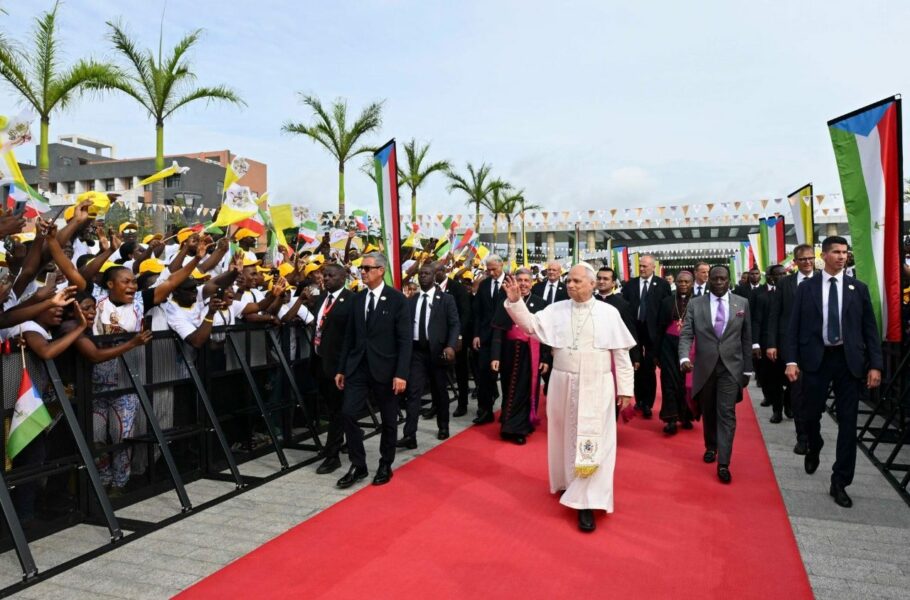
The visit of Leon XIV to Equatorial Guinea, which ends today, leaves on the table a reality that Vatican diplomacy knows well: no papal trip is purely pastoral. Every gesture of the Pope has an inevitable public projection and, in certain contexts, can be used by political power as an element of legitimation. It is not a hypothesis nor an interested suspicion, but a necessary warning when the evangelical message is projected onto scenarios marked by crisis, inequality, or lack of freedoms.
The trip, held between April 21 and 23, was preceded by clear warnings about the country’s internal situation. The Equatoguinean media Diario Rombe already described a scenario of economic deterioration, with delays in the payment of public salaries, growing social tensions, and persistent denunciations of repression; while the State mobilized resources to ensure the logistics and coverage of Leon XIV’s visit.
A contrast that reflects the distance between the image that power seeks to project outward and the reality that the country lives.
A country in crisis that projects normality
Equatorial Guinea is going through a phase of strong economic tension after the fall in oil revenues, the main support of the State. The same media pointed out that a large part of the national budget would have been mobilized to finance the visit, while thousands of public workers continue without receiving their salaries and numerous companies depend on payments that do not arrive, which has generated a blockade situation that directly affects the daily life of the population. To this scenario are added denunciations about the deterioration of public freedoms, with references to summary trials, increase in the prison population, and accusations of torture.
In that context, the Pope’s arrival inevitably enters a political-social dimension that crosses his visit and marks his words.
From John Paul II to Leon XIV
In 1982, John Paul II visited Equatorial Guinea shortly after Teodoro Obiang came to power—after the coup d’état against Francisco Macías Nguema—. At that time, the Pope did not avoid the context in which he found himself. He recognized that the people had gone through “serious difficulties” and explicitly asked for the “effective respect for the rights of each citizen”, encouraging the building of a “serene, prosperous, and just” society.
More than four decades later, Leon XIV has resumed that same tone in his speech before the authorities in Malabo. He has recalled that the aspirations of a people pass through “a social climate of authentic freedom, of justice, and of respect for rights”, expressly citing John Paul II and underscoring the validity of those words.
The Pontiff has maintained a clear line on social issues, denouncing inequality, the exploitation of resources, and the logic of an economy that excludes. He has also warned against the “thirst for power and worldly glory” and “unjust wealth”, insisting on the responsibility of politics in the common good.
But the development of the trip has also shown moments of tension before social realities. During his passage through Cameroon, the issue of polygamy was raised publicly in the middle of the cathedral. The Pope remained silent, while a good part of the faithful reacted with rejection to the intervention that raised it.
From Equatorial Guinea to Spain: a necessary warning
In light of this scenario, the upcoming visit of Leon XIV to Spain in June has a perspective that cannot be ignored. The country is going through a moment of strong political and social tension, with open debates on fundamental issues—among them abortion or immigration—and a climate of growing polarization.
It is not about questioning the trip, but about understanding its scope. Experience shows that, when the context is unstable, the challenge is not only to avoid instrumentalization, but to have the necessary clarity and firmness so that the message does not dilute. Because precisely in these scenarios is where a word that is not ambiguous, that does not withdraw, and that illuminates reality without fear is most needed.