


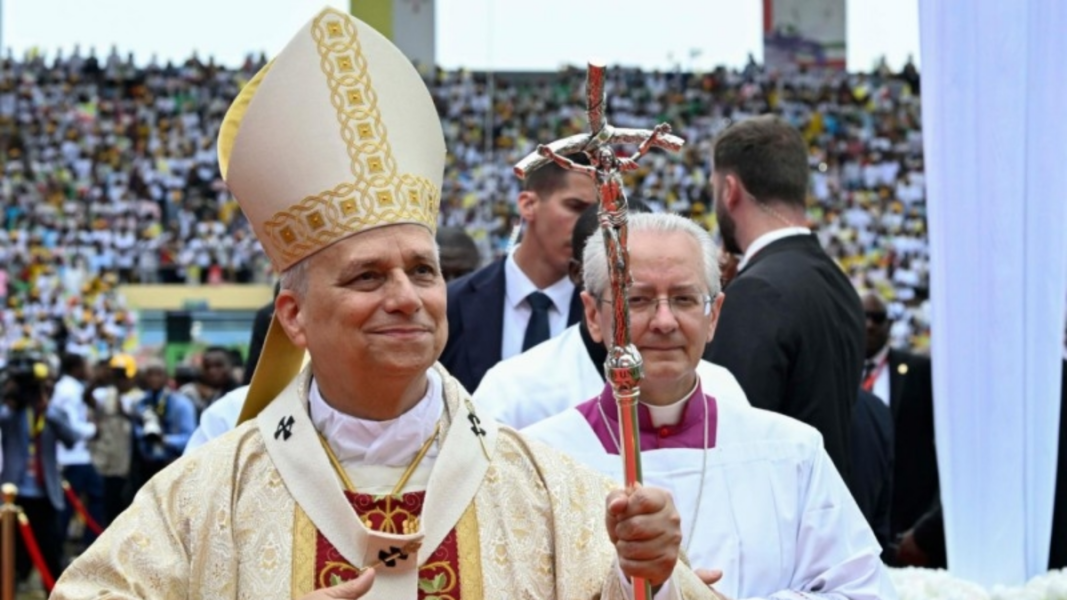
Pope Leo XIV celebrated Holy Mass in the Malabo stadium, at the conclusion of his apostolic journey to Africa, with a homily centered on the transformative power of the Gospel and the centrality of the Eucharist in Christian life.
The Pontiff emphasized that faith allows us to understand our own life in the light of the Word of God, recalled that in Christ the “bread of eternal life” is offered, and encouraged the faithful to live their faith as a concrete witness of service, justice, and hope. Likewise, he exhorted the local Church to continue its evangelizing mission with fidelity and joy.
Homily of the Holy Father
Dear brothers and sisters:
I want to begin by greeting with affection this particular Church of Malabo with its pastor and, at the same time, express my deepest condolences to the entire archdiocesan community, to the brother priests, and to the family members for the death, a few days ago, of their Vicar General, Monsignor Fortunato Nsue Esono, whom we remember in this Eucharist.
I invite you to live this moment of pain with a spirit of faith and I trust that, without being carried away by comments or hasty conclusions, full light will be shed on the circumstances of his death.
The Scriptures we have just heard challenge us, asking each one of us “if we know” and “how” we read the biblical pages that we share today. It is an invitation as serious as it is providential, because it prepares us to read together the book of history, that is, the pages of our life, which God continues to inspire with his wisdom.
Sharing the journey of a traveler who, from Jerusalem, returns precisely to Africa, the deacon Philip asks him: “Do you understand what you are reading?” (Acts 8:30). That pilgrim, an eunuch of the queen of Ethiopia, immediately responds with humble sagacity: “How can I understand, unless someone explains it to me?” (v. 31). His question thus becomes not only an appeal to the truth, but also an expression of curiosity. Let us observe carefully who is speaking: he is a rich man, like his land, but a slave. All the treasures he administers are not his own; his are the labors, which benefit others. This man has intelligence and culture, and he demonstrates it both in work and in prayer, but he is not fully free. This condition is painfully engraved in his body; indeed, he is an eunuch. He cannot generate life, all his energies are at the service of a power that controls and dominates him.
Precisely as he returns to his homeland, Africa, which has become a place of servitude for him, the proclamation of the Gospel liberates him. The Word of God, which he holds in his hands, produces a surprising fruit in his life: when he meets Philip, witness to the crucified and risen Christ, the eunuch becomes not only a reader of the Bible, that is, a spectator, but a protagonist of a narrative that involves him, because it refers precisely to him. The sacred text speaks to him and arouses his question about the truth. Thus this African delves into the Scripture, which is hospitable to every reader who wishes to understand the Word of God. He enters the history of salvation, which is hospitable to every man and woman, especially to the oppressed, the marginalized, and the least. To the written text now corresponds the lived gesture; upon receiving Baptism, he is no longer a stranger, but becomes a son of God, our brother in the faith. Slave and without descendants, this man is reborn to a new and free life in the name of the Lord Jesus. We continue to speak of his redemption, precisely as we read the Scriptures.
Like him, we too have been made Christians by Baptism, inheriting the same light, that is, the same faith, to read the Word of God. To reflect on the prophecies, to pray the psalms, to study the Law and proclaim the Gospel with our life. All biblical texts, in fact, reveal their true meaning in faith, because they were written and transmitted to us in faith; therefore, their reading is always a personal and also ecclesial act, not a solitary or merely technical exercise.
We read Scripture together as a common good of the Church, with the Holy Spirit as our guide, who inspired its composition, and the apostolic Tradition, which has guarded and spread it throughout the earth. As the eunuch asks, we too can understand the Word of God thanks to a guide who accompanies us on the journey of faith, as the deacon Philip did, who “took the word and, beginning from this Scripture, proclaimed to him the Good News of Jesus” (v. 35). The African traveler was reading a prophecy that was fulfilled for him at that time, as it is fulfilled today for us: the suffering servant spoken of by the prophet Isaiah (cf. Is 53:7-8) is Jesus, the one who, through his passion, death, and resurrection, redeems us from sin and death. He is the Word made flesh, in whom every word of God finds fulfillment: he reveals its original intention, its full meaning, and its ultimate end.
As Christ affirms, “only the one who comes from God has seen the Father” (Jn 6:46). In the Son, the Father himself shows his glory: God becomes visible, audible, and tangible. Through the gestures of Jesus, the Redeemer, He gives fullness to what He has always done, that is, to give life. He creates the world, saves it, and loves it forever. Jesus reminds those who listen to him of a sign of this constant providence: “Their ancestors in the desert ate the manna and died” (v. 49). He thus refers to the experience of the exodus; a path of liberation from slavery that, however, became an exhausting wandering for forty years, because the people did not believe in the Lord’s promise, even longing for Egypt (cf. Ex 16:3). Under Pharaoh’s yoke, the people ate the fruits of the earth; God, on the other hand, leads them into the desert, where bread can only come from his providence. The manna is therefore a test, a blessing, and a promise that Jesus comes to fulfill. To that ancient sign now succeeds the sacrament of the new and eternal Covenant: the Eucharist, bread consecrated by the one who has descended from heaven to become our food. If those who ate the manna “died” (Jn 6:49), “the one who eats of this bread will live forever” (v. 51), because Christ is alive. He is the Risen One and continues to give his life for us!
Through the definitive exodus that is Jesus’ Passover, every people is liberated from the slavery of evil. As we celebrate this event of salvation, the Lord calls us to a decisive choice: “The one who believes has eternal life” (v. 47). In Jesus, we are given a surprising possibility: God gives himself for us. Do I trust that his love is stronger than my death? By deciding to believe him, each one of us chooses between certain despair and a hope that God makes possible. Then our hunger for life and justice finds relief in the words of Jesus: “The bread that I will give is my flesh for the life of the world” (v. 51).
Thank you, Lord! We praise and bless you, because you have willed to make yourself Eucharist for us, bread of eternal life, so that we may live forever. Precisely now, dear friends, as we celebrate this sacrament of salvation, we can exclaim with joy: “Christ is everything for us!” In him we find fullness of life and meaning: “If you are oppressed by injustice, he is justice; if you need help, he is strength; if you fear death, he is life; if you desire heaven, he is the way; if you are in darkness, he is the light” (S. Ambrose, De Virginitate, 16:99). With the Lord’s companionship, our problems do not disappear, but they are illuminated: just as every cross finds redemption in Jesus, so in the Gospel the story of our life finds meaning. Therefore, today each one of us can say: “Blessed be God, who did not reject my prayer, nor withhold his mercy from me” (Ps 66:20). He always loves us first; his word is Gospel for us, and we have nothing better to proclaim to the world. This evangelization involves us all, starting from Baptism, which is the sacrament of fraternity, bath of forgiveness, and source of hope. Through our witness, the proclamation of salvation becomes gesture, becomes service, becomes forgiveness; in a word, it becomes Church.
As Pope Francis taught, truly “the joy of the Gospel fills the heart and the entire life of those who encounter Jesus” (Apost. Exhort. Evangelii Gaudium, 1). At the same time, when we share this joy, we perceive even better the risk of “an individualistic sadness that arises from a comfortable and avaricious heart, from the sickly search for superficial pleasures, from an isolated conscience. When the interior life closes in on one’s own interests, there is no longer space for others, the poor no longer enter, the voice of God is no longer heard, the sweet joy of his love is no longer enjoyed” (Ibid., 2). In the face of such closure, it is precisely the Lord’s love that sustains our commitment, especially in the service of justice and solidarity.
For this reason, I encourage all of you, Church on pilgrimage in Equatorial Guinea, to continue with joy the mission of the first disciples of Jesus. By reading the Gospel together, may you be passionate proclaimers, as the deacon Philip was. By celebrating the Eucharist together, may you bear witness with your lives to the faith that saves, so that the Word of God may become good bread for all.
Greeting and Thanksgiving of the Holy Father
Dear brothers and sisters:
The time has come to bid you farewell, to Equatorial Guinea and also to Africa, at the end of the apostolic journey that God has granted me to make during these ten days.
I thank the Archbishop, Monsignor Juan, and the other bishops, the priests, and all of you, the people of God on pilgrimage in this land; Christ is the light of Equatorial Guinea and you are the salt of the earth and the light of the world.
My gratitude goes to the civil authorities of the country and to all those who, in various ways, have contributed to the success of my visit.
I leave Africa carrying with me an inestimable treasure of faith, hope, and charity; it is a great treasure: made of stories, faces, testimonies, joyful and suffering, that abundantly enrich my life and my ministry as successor of Peter.
As in the first centuries of the Church, today Africa is called to contribute significantly to the holiness and missionary character of the Christian people. I entrust this intention to the intercession of the Virgin Mary, to whom I commend with all my heart, as well as your families, your communities, your nation, and all the African peoples.