


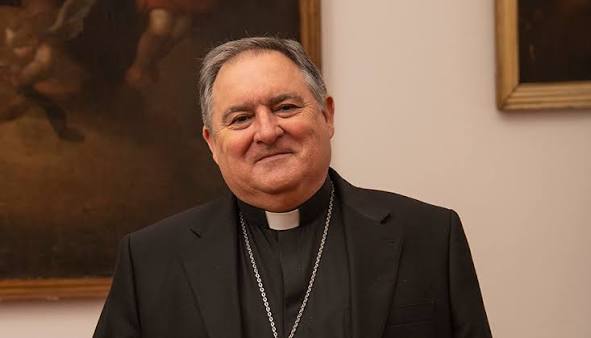
The Bishop of the Canary Islands, José Mazuelos, uttered yesterday at the CEE headquarters a phrase destined to go viral: «Many people should be put in a cayuco for five days, morning and afternoon, without eating, to see what we do when they arrive.» He said it during the briefing prior to León XIV’s trip to the archipelago, flanked by the Bishop of Tenerife, Eloy de Santiago, and the head of Cáritas Canarias, Caya Suárez Ortega.
The context is the usual one. Santiago described the Canary Islands as «Europe’s southern border» and recalled the case of El Hierro, where an island of nine thousand inhabitants received more than twenty-five thousand migrants last year at the La Restinga dock. Mazuelos spoke of the Atlantic route as «deadly,» called for fighting the mafias, asked for «formulas so that migrants can come in another way to work,» and acknowledged the «difficult balance between welcome and the common good,» with one premise: «The cayuco has already arrived, and the people who arrive must be treated with the dignity they haven’t had.» Suárez, from Cáritas, defended the recently initiated regularization process and argued that without migrants, neither hospitality nor elderly care would function in the Canary Islands. Testimonies from migrants are expected at the meeting with León XIV.
That’s what was said up to here. Now the game.
Let’s accept the gauntlet, Monsignor. Let’s accept it fully. Five days in a cayuco without eating to have an opinion on migration. Agreed. But then let’s establish the principle with all its consequences, because a principle that only applies in one direction isn’t a principle: it’s an excuse.
If to have an opinion on those who arrive one must have spent five days without eating in the Atlantic, then to have an opinion on those who are already here, on those who pay taxes, on those who rent apartments, on those who raise children and contribute and make ends meet by juggling numbers, one must have done some things before. Very few. Minor, ordinary things, without epic. Namely.
One must have taken the commuter train at seven-thirty in the morning on a February Tuesday, squeezed against a door, with a wet coat, to get to a job where neither the schedule, nor the boss, nor the salary is chosen. One must have waited twenty-five minutes for the bus in the rain because the previous one passed full. One must have checked the account balance on the twenty-second and done the math on whether it will last or not.
One must have paid a mortgage. A rent in Madrid or Barcelona or any provincial capital where the average salary doesn’t cover even a decent room. One must have seen the electricity bill go up without changing the contract. One must have given up on having a second child, or a third, not out of selfishness but out of arithmetic.
One must have accompanied a fourteen-year-old daughter to the metro at eleven at night because she comes back from English class and the route home crosses a neighborhood where you no longer recognize anyone. One must have learned to glance sideways. One must have heard your wife say «today I’d better take a taxi» and done the mental calculation of whether it’s possible or not.
One must have gone to a health center and waited four hours. One must have taken an elderly parent to the emergency room and slept in a chair. One must have looked for a subsidized school and not found a spot. One must have paid for private insurance because the system you fund with your taxes doesn’t attend to you.
One must have worked without an official car, without a driver, without a provided residence, without a guaranteed salary until death, without the certainty that someone will make your food, iron your cassock, and take you to the airport when you travel to Rome. One must have looked in the eyes of a supervisor who tells you that the company is «restructuring» and you have two months left.
Because all that, Monsignor, is also a journey. It’s not deadly like the Atlantic one. No one drowns. But it’s the real life of Spaniards to whom, from the pulpit, from the episcopal palace, or from the CEE press room, it’s explained that they have to welcome, integrate, regularize, understand, accompany, and shut up. It’s the life of those who pay for the party without being invited to the table.
The Spanish clergy talks about migration as one talks about the rain from a window with double glazing. With compassion, with lyricism, with perfectly stitched evangelical quotes. And then they go back to the car, to the office, to lunch at one-thirty, to a nap without neighbor noise, to assured retirement, to concerted healthcare, to a paid burial. Charity is very cheap when the bill is passed to someone else.
It’s not about denying the drama of the cayuco. It exists. It’s real. The dead of the Atlantic are real dead, and their blood cries out. But the question that the Bishop of the Canary Islands doesn’t ask himself, because from his position he has no reason to, is who materially sustains the welcome that he proclaims rhetorically. And the answer is always the same: the Spanish working class. Not the Episcopal Conference. Not the dioceses. Not the subsidized schools. Not the convents. The people who take the commuter train.
That people, by the way, don’t have a palace. Don’t have a driver. Don’t have a secretary. Don’t have a dicastery to call. They have a paycheck, a two-bedroom apartment, and a daughter who comes home alone on the metro. And to that people, for years, from the ambo, they’ve been told that their concern is selfishness, that their fear is xenophobia, that their tiredness is a lack of faith.
Five days in a cayuco, says Mazuelos. Fine. But first, five days on the Atocha platform at seven in the morning. Five days shopping with forty euros. Five days waiting in emergencies with a child with fever. Five days checking the mailbox in case the tax letter arrives. Five days, Monsignor, being one more, without a cassock, without an escort, without privilege, without the certainty that someone, somewhere, will take care of you no matter what.
Then we talk.