


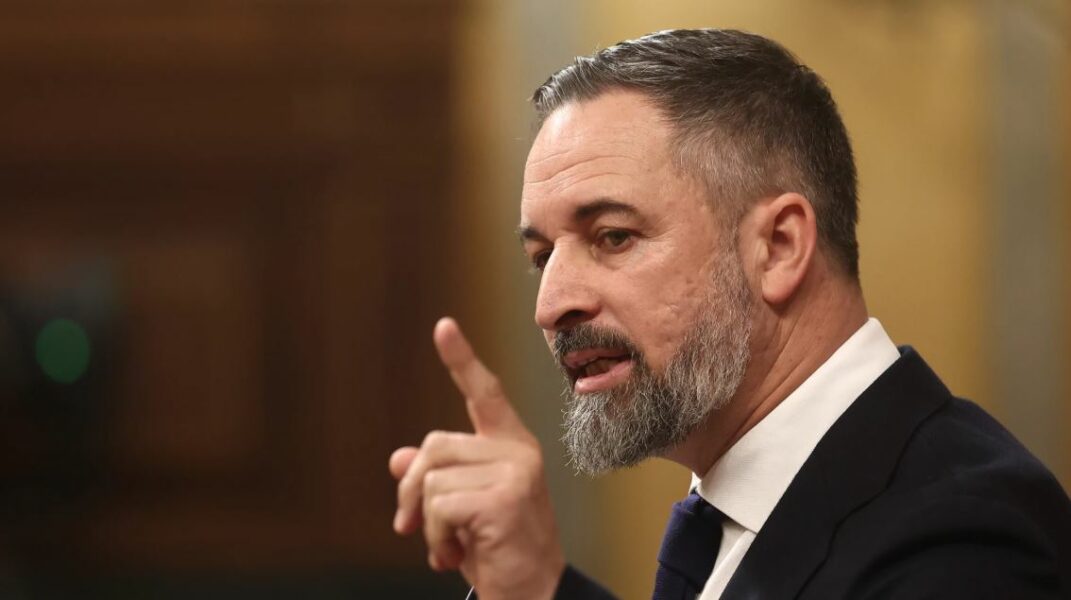
The president of Vox, Santiago Abascal, has reacted to the statements of the Bishop of the Canary Islands on immigration, after the prelate stated that “many people should be put in a cayuco for five days without eating” to understand the situation of migrants.
Abascal lashes out at the discourse on immigration
In a message posted on the social network X, Abascal stated that “some who make a business out of illegal immigration should leave the palace and go down to see the consequences it has for Spaniards,” pointing to areas such as healthcare, security, wages, and taxes.
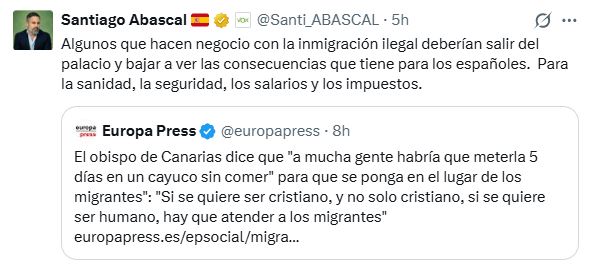
The Vox leader thus introduces a direct criticism of the discourse that, in his view, ignores the impact of irregular immigration on the daily lives of citizens.
The bishop’s statements and the migratory context
The Bishop of the Canary Islands, José Mazuelos, made these statements in a meeting with the media, in which he defended the need to foster empathy toward those who arrive by cayuco on Spanish coasts, a route he described as particularly harsh and dangerous.
In that context, the prelate insisted that, from a Christian and human perspective, it is necessary to attend to migrants, emphasizing the suffering they endure during the journey.
In contrast to that approach, Abascal’s reaction emphasizes the social and economic consequences of irregular immigration, an approach that contrasts with the discourse centered on welcoming that is maintained, for the most part, by ecclesiastical sectors.
Accepting the appeal to empathy that the bishop raises would require, in coherence, extending it also to the everyday reality of those who sustain with their work, their taxes, and their sacrifices the system that makes that welcome possible. Because the drama of the cayuco is undeniable, but it does not exhaust the complexity of the migratory phenomenon: alongside it coexists the concrete life of millions of Spaniards who face real difficulties and on whom, ultimately, the consequences of political decisions fall.
To this is added an element that does not go unnoticed: these calls are usually made from comfortable institutional positions—episcopal palaces, stable structures, assured assistance and coverage—that, precisely because of their distance from ordinary life, hinder a full understanding of those realities. Ignoring that dimension or reducing it to a lack of sensitivity does not contribute to a serious debate, but rather impoverishes it.