


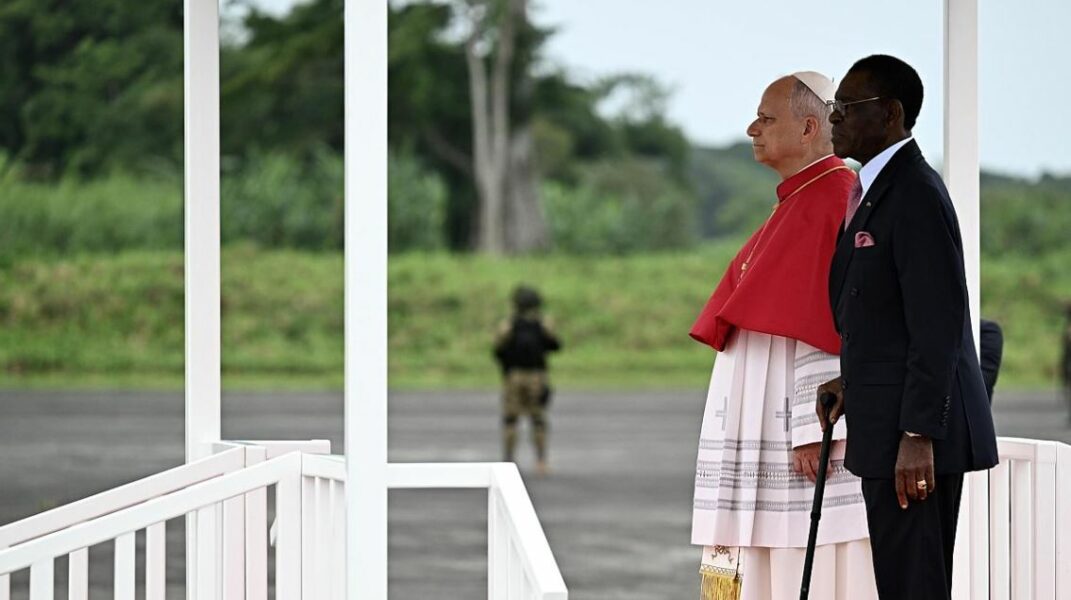
Pope Leo XIV arrived in Equatorial Guinea this Tuesday, the final leg of his African trip, and he did so with a direct speech before President Teodoro Obiang Nguema—in power since 1979—in which he denounced the abuse of power, inequality, and the instrumentalization of religion to justify violence.
From the memory of Francis to the arrival in Malabo
During the flight between Luanda and Malabo, Leo XIV recalled the first anniversary of Francis’s death, evoking his legacy of closeness to the poorest and his insistence on mercy. “He has left so much in the Church with his witness and his word,” he affirmed, in a tone still marked by the memory of the previous pontificate.
Upon arriving on Equatoguinean soil, the Pope was received with honors at the Malabo airport by President Teodoro Obiang Nguema, who has governed the country for more than four decades. After the official ceremony and a brief private meeting, both proceeded to the Presidential Palace.
An uncomfortable speech before a consolidated power
Before political authorities, diplomats, and representatives of civil society, Leo XIV delivered the most significant speech of the day.
Without directly mentioning the regime, he placed the focus on the moral responsibility of political power. He recovered words from St. John Paul II in 1982—when Obiang was already in power—on the need to guarantee rights and dignified living conditions, and emphasized their current relevance: “These are words that remain relevant today and that challenge anyone who holds public office.”
Leo XIV warned of the risks of a politics dominated by ambition and self-interest, evoking St. Augustine’s contrast between the “City of God” and the “earthly city.” He also warned that, “The name of God cannot be profaned by the will to dominate, arrogance, and discrimination.” And he added that it should never be invoked “to justify decisions and actions that cause death.”
The message, delivered before one of the world’s longest-standing governments, marked the political core of the day.
Inequality, resources, and conflicts: a global critique
The Pope broadened his gaze to the international context, denouncing an economic model that leaves out the majority.
“Exclusion is the new face of social injustice,” he affirmed, pointing to the growing imbalance between a privileged minority and the rest of the population.
In the same vein, he directly linked armed conflicts to the exploitation of resources: “One of the main reasons for the proliferation of wars is the colonization of oil and mining deposits, without respect for international law or the self-determination of peoples.”
The university: truth versus domination
After the institutional event, the Pontiff moved to the academic sphere. At the university campus that bears his name, Leo XIV offered a reflection on the meaning of education.
“The inauguration of a university is an act of trust in the human being,” he affirmed.
However, he warned of the risk of an intelligence detached from truth: when knowledge becomes an instrument of domination, it ceases to be a search and turns into imposition. Against this, he defended a formation that teaches discernment and service.
The hospital: the true criterion of a society
The day concluded at the Jean-Pierre Olie psychiatric hospital, in an environment radically different from that of the Presidential Palace.
There, before patients and healthcare staff, Leo XIV spoke of suffering and fragility, but also of the value of care. “A truly great society is not one that hides its weaknesses, but one that surrounds them with love,” he affirmed.
“God loves us as we are, but not to leave us as we are, but to heal us,” he added, before blessing those present.