


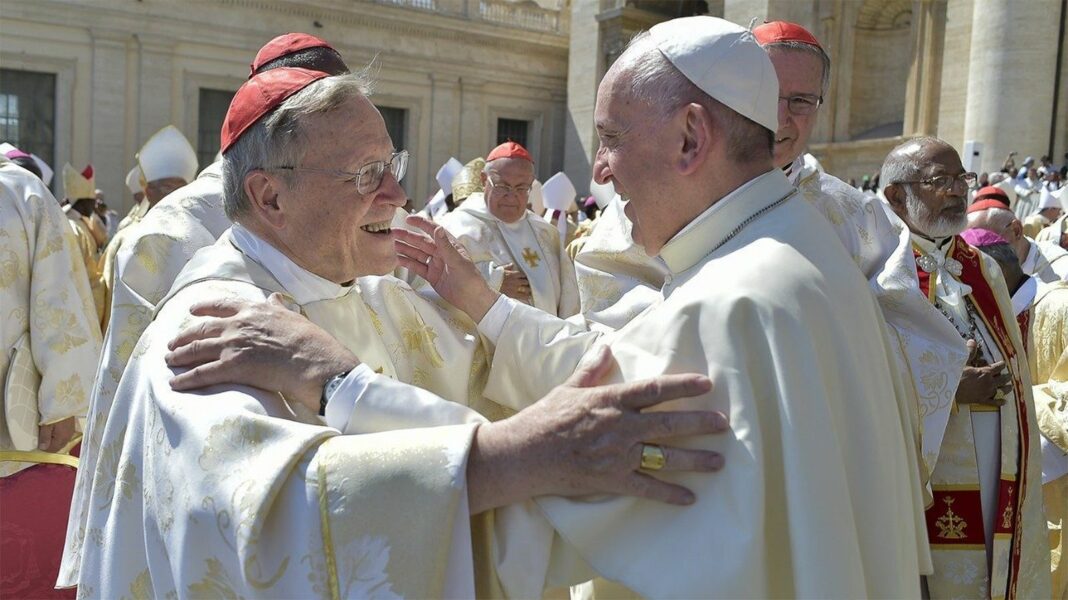
One year after the death of Pope Francis, his figure and his pontificate continue to generate contrasting interpretations within the Church. An article by Cardinal Walter Kasper published in Communio offers a markedly positive reading of those twelve years, although it also hints at some of the tensions that accompanied his governance.
Francis passed away on April 21, 2025, just one day after having imparted the urbi et orbi blessing. His death caused a strong commotion among the faithful who, for days, flocked massively to say goodbye in St. Peter’s Basilica.
A pontificate that sought to mark a turning point
From the beginning, Jorge Mario Bergoglio made it clear that his pontificate would not follow the usual schemes. His first appearance—with a simple “good evening”—and his way of presenting himself as someone “from the end of the world” set the tone for a stage that sought to distance itself from certain traditional codes.
Kasper interprets those gestures as part of a conscious choice: a Church less centered on itself and more oriented toward the peripheries. A line that, however, was not received unanimously within the Catholic world.
Reform and evangelization, between impetus and controversy
The axis of that pontificate was, according to the German cardinal, evangelization understood as a process of renewal. It was not only about transmitting the faith, but about promoting changes in the life of the Church.
That insistence on “initiating processes”—one of Francis’s habitual expressions—marked much of his action. But it also opened a scenario of uncertainty in some areas, where the concrete scope of those reforms was not always clear.
Amoris Laetitia and the moral debate
One of the most significant moments came with Amoris Laetitia —an exhortation of which Kasper himself has been a staunch defender—, the document that addressed complex issues related to marriage and family.
For the cardinal, this text represented a relevant contribution by placing conscience at the center of discernment, within a broader understanding of mercy. In his view, Francis did not limit himself to resolving a specific case, but opened a deeper perspective on the relationship between morality and pastoral care, framed within the horizon of love and personal accompaniment.
Synodality, an open path
Another of the pillars of the pontificate was the impetus for synodality, which Kasper considers one of Francis’s most important legacies. The Pope promoted a more participatory Church, in which the entire People of God—laity, religious, and pastors—is called to engage in the life and mission of the Church.
The synodal process, initiated in 2021, is presented by the cardinal as a response to the challenges of the present time and as a concretization of the Second Vatican Council. In his judgment, it is not about modifying the structure of the Church, but about developing more fully the communion among its members, understood as unity in the diversity of gifts and vocations. In this sense, he recognizes that synodality is a path in development, which requires both theological and practical deepening, but values it as a decisive orientation for the Church of the future.
Between personal charisma and fundamental doubts
The German cardinal does not ignore that Francis’s pontificate was accompanied by criticisms. Some pointed to his style of governance, perceived as spontaneous, and to decisions that, at certain moments, generated uncertainty in various areas.
Doubts were also raised about the scope of some of his initiatives and their long-term implications. However, Kasper frames these tensions in the context of a time of profound change, which necessarily entails difficulties and conflicts.
A legacy that remains under discussion
The balance proposed by the German cardinal is that of a Pope who wanted to open paths and place the Church in dialogue with the contemporary world. A legacy that, one year after his death, continues to be the object of interpretation and development within the Church.
He finally concludes by pointing out that the pontificate of Leo XIV now assumes the task of continuing that path. Francis’s heritage, according to Kasper, is “in good hands”.