


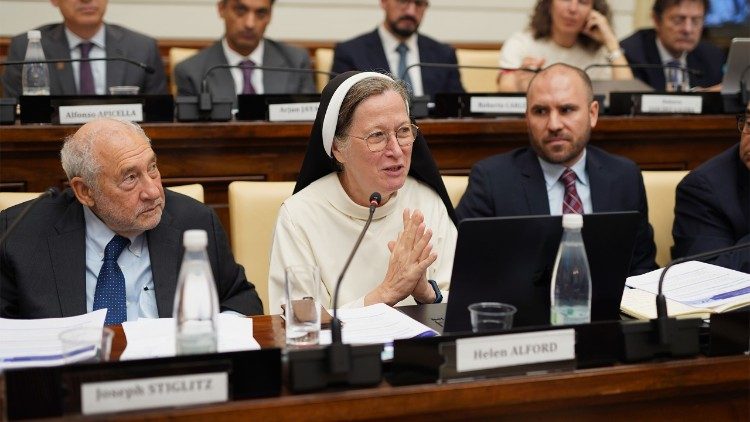
The Pontifical Academy of Social Sciences held a plenary session from April 14 to 16 dedicated to the analysis of political power, legitimacy, and the reconfiguration of the international order, in a meeting marked by the presence of speakers and approaches clearly aligned with contemporary academic currents of a progressive profile.
A Meeting with a Recognizable Ideological Profile
Under the title “The Uses of Power: Legitimacy, Democracy and the Rewriting of the International Order”, the session has brought together academics and international experts to reflect on the crisis of liberal democracies and the evolution of the global order.
However, the program’s own profile shows a defined ideological stance. Among the participants are names such as the economist Jeffrey Sachs, linked to international organizations and the sustainable development agenda; the Nobel Prize winner Joseph Stiglitz, known for his criticisms of the liberal economic model; or the former Argentine minister Martín Guzmán, representative of interventionist economic policies.
They are joined by academics and ecclesiastical figures related to issues such as migration, global governance, climate justice, or the 2030 Agenda, areas common in debates promoted from progressive positions.
Themes Reflecting a Specific Agenda
The content of the presentations reinforces that orientation. The program includes interventions dedicated to issues such as mass immigration and its impact on the international order, the Sustainable Development Goals from critical perspectives inspired by Foucault, or the need to reconfigure the global order in terms of climate justice.
Likewise, concepts such as global governance, the role of international organizations, or the reformulation of the international system that emerged after the Second World War are addressed, in line with approaches widely disseminated in academic and political environments of a progressive bent.
A Theoretical Framework Coherent with That Approach
The introductory document of the meeting is situated in that same framework, starting from the crisis of liberal democracy and questioning its capacity to sustain itself as a universal model. In this context, a review of its foundations and of the current international order is proposed.
Particularly significant is the recourse to Hegel’s critique of the Kantian ideal of an international order based on norms and cooperation, opting for a more skeptical reading centered on the balance of power among States.
Contrast with Pontifical Magisterium
The meeting has taken place in parallel to the call by Pope Leo XIV in favor of peace, the common good, and the moral responsibility of nations, emphasizing the ethical dimension of political life.
In contrast, the meeting’s approach is situated mainly on an academic and structural plane, focused on the analysis of power and the revision of contemporary political categories.
A Consolidated Trend
The session confirms a line already visible in other initiatives of the Pontifical Academy of Social Sciences: the adoption of analytical frameworks that, while presenting themselves as interdisciplinary reflection, rely to a large extent on contemporary currents of thought linked to progressive and global approaches.