


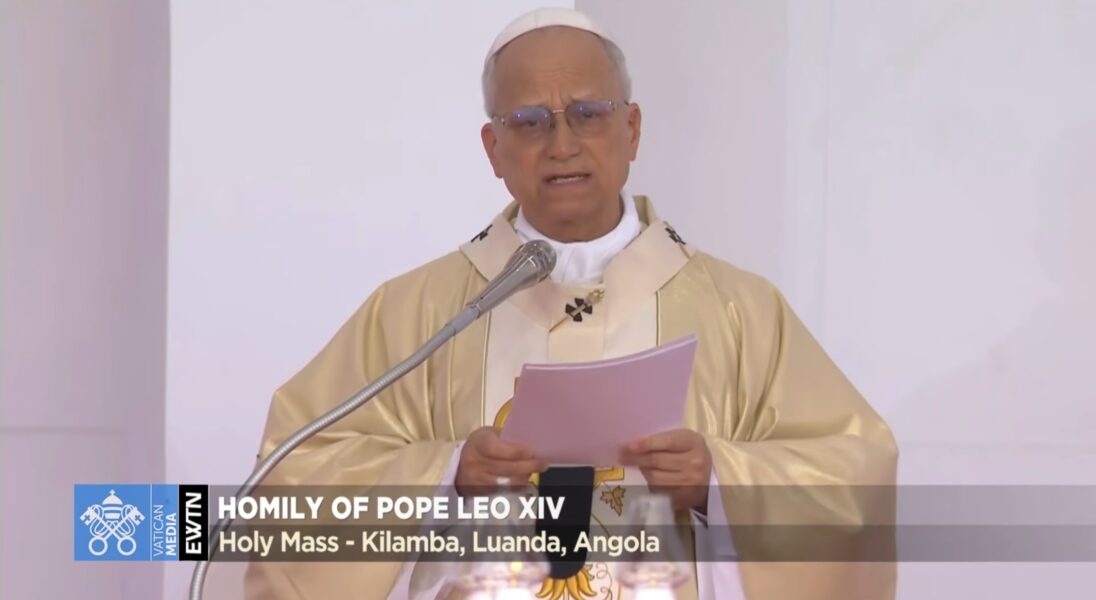
On the esplanade of Kilamba, during the Mass celebrated this April 19 in the context of his apostolic journey to Africa, Pope Leo XIV delivered a homily deeply marked by Christian hope amid the historical suffering of peoples. Drawing from the Gospel passage of the disciples of Emmaus, the Pontiff offered a meditation directly linked to the reality of Angola, appealing to reconciliation, fidelity to the Church, and the moral and spiritual reconstruction of the nation. Below, we reproduce the full homily in English.
Dear brothers and sisters:
With a heart full of gratitude, I celebrate the Eucharist in your midst. I give thanks to God for this gift and I thank you for your festive welcome.
On this Third Sunday of Easter, the Lord has spoken to us through the Gospel of the disciples of Emmaus (cf. Lk 24:13-35). Let us allow ourselves to be enlightened by this Word of life.
Two disciples of the Lord, with wounded and sad hearts, leave Jerusalem to return to their village of Emmaus. They have seen that Jesus, in whom they had trusted and whom they had followed, die, and now, disappointed and defeated, they return to their homes. Along the way, “they talked together about all that had happened” (v. 14). They need to talk about it, to recount again what they have seen, to share what they have experienced, but with the risk of remaining prisoners of pain, closed to hope.
Brothers and sisters, in this initial scene of the Gospel, I see reflected the history of Angola, of this beautiful and wounded country, which hungers and thirsts for hope, for peace, and for fraternity. Indeed, the conversation on the road of the two disciples, who recall with dismay what happened to their Master, brings to mind the pain that has marked your country: a long civil war with its aftermath of enmities and divisions, of wasted resources and poverty.
When one remains immersed for a long time in a history so marked by pain, there is the risk of what happened to the two disciples of Emmaus: losing hope and being paralyzed by discouragement. They walk, yet they remain stuck on the events that occurred three days earlier, when they saw Jesus die; they converse with each other, but without expecting a way out; they keep talking about what happened, with the fatigue of those who do not know how to start over, nor even if that is possible.
Dear brothers, the Good News of the Lord, even today for us, is precisely this: He is alive, He has risen and walks at our side as we journey along the path of suffering and bitterness, opening our eyes so that we may recognize His work and granting us the grace to start over and rebuild the future.
The Lord draws near to the two disappointed and hopeless disciples and, becoming their companion on the way, helps them to recompose the fragments of that history, to look beyond the pain, to discover that they are not alone on the road and that a future inhabited by the God of love awaits them. And when He stops to dine with them, sits at the table and breaks the bread, then “their eyes were opened and they recognized Him” (v. 31).
Here is traced also for us, for you, dear Angolan brothers and sisters, the path to start anew: on the one hand, the certainty that the Lord accompanies us and has compassion for us; on the other, the commitment that He asks of us.
We experience the Lord’s companionship above all in our relationship with Him, in prayer, in listening to His Word, which sets our hearts burning as it did for the two disciples, and above all in the celebration of the Eucharist. It is here that we encounter God. For this reason, it is necessary to always watch over those forms of traditional religiosity that, certainly, belong to the roots of your culture, but that at the same time run the risk of confusing and mixing in magical and superstitious elements that do not help on the spiritual path. Remain faithful to what the Church teaches, trust in your pastors, and keep your gaze fixed on Jesus, who reveals Himself in a special way in the Word and in the Eucharist. In both, we experience that the Risen Lord walks with us and, united to Him, we too overcome the deaths that besiege us and live as risen ones.
To this certainty of not being alone on the road is added also a generous commitment that can heal the wounds and rekindle hope. Indeed, if the two of Emmaus recognize Jesus when He breaks the bread for them, that means that we too must recognize Him in this way: not only in the Eucharist, but wherever a life becomes bread broken, wherever someone becomes a gift of compassion like Him.
The history of your country, the still difficult consequences you bear, the social and economic problems, and the various forms of poverty demand the presence of a Church that knows how to stand by on the road and gather the cry of its children. A Church that, with the light of the Word and the nourishment of the Eucharist, knows how to revive lost hope. A Church made up of people like you, who give themselves in the same way that Jesus breaks the bread for the two disciples of Emmaus. Angola needs bishops, priests, missionaries, religious sisters and brothers, laywomen and laymen who have in their hearts the desire to break their own lives and give them to one another, to commit to mutual love and forgiveness, to build spaces of fraternity and peace, to perform acts of compassion and solidarity toward those who need them most.
With the grace of the Risen Christ, we can become this broken bread that transforms reality. And just as the Eucharist reminds us that we are one body and one spirit, united to the one Lord, so too we can and want to build a country in which the old divisions are overcome forever, in which hatred and violence disappear, in which the wound of corruption is healed by a new culture of justice and sharing. Only in this way will a future of hope be possible, especially for so many young people who have lost it.
Brothers and sisters, today it is necessary to look to the future with hope and to build the hope of the future. Do not be afraid to do so. The Risen Jesus, who walks the road with you and for you breaks Himself as bread, encourages you to be witnesses of His resurrection and protagonists of a new humanity and a new society.
On this journey, dear brothers, you can count on the closeness and prayer of the Pope. But I too know that I can count on you, and I thank you for it. I entrust you to the protection and intercession of the Virgin Mary, Our Lady of Muxima, that she may always sustain you in faith, hope, and charity.