


On the anniversary of the election of Joseph Ratzinger as Benedict XVI, which was 21 years ago on April 19, we republish the following article (31.08.2025) from a Former Perplexed Catholic.
Ratzinger was an uncomfortable person for almost everyone in the Church. As Benedict XVI, he was the pope who did the most after the Second Vatican Council to remove restrictions on the Traditional Mass, and despite his evident personal evolution from progressivism in the times of the Second Vatican Council, there were several commentators who still asked for more from him: that he had celebrated the traditional Mass as the Supreme Pontiff of the Catholic Church.
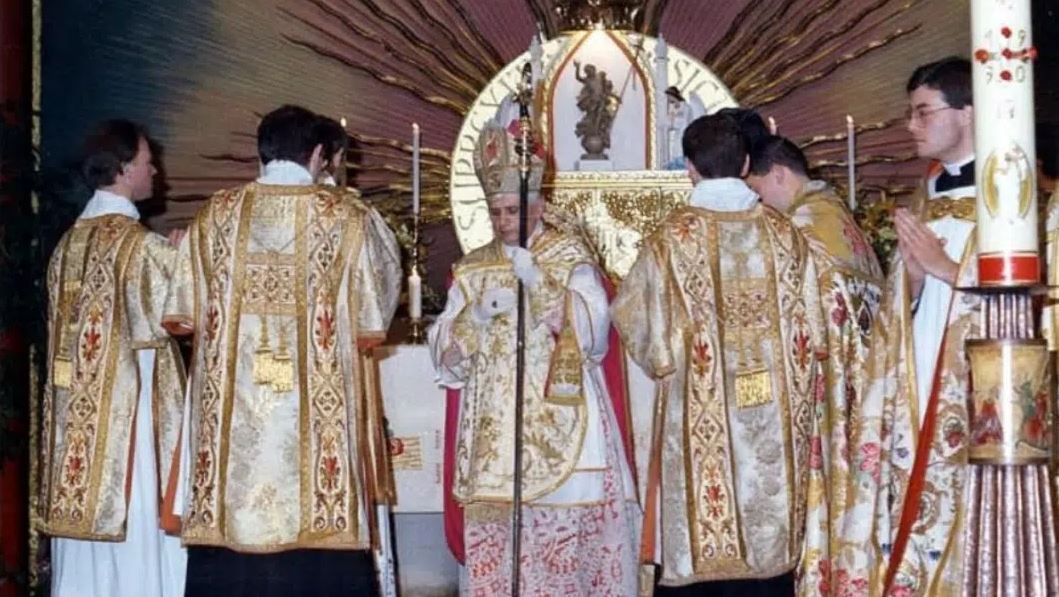
Regarding this, I would like to point out two issues: the first, that as a cardinal he celebrated the Traditional Mass on various occasions. The magazine “The Latin Mass”, in its issue 4 from 1995, reported on the visit in September of that year by Cardinal Ratzinger to the Abbey of Saint Mary Magdalene of Barroux, where on Sunday the 24th he celebrated a Pontifical Mass according to the traditional rite. The day before, Saturday September 23, he had visited the neighboring women’s abbey, Our Lady of the Annunciation, where he had also celebrated the traditional Mass. Previously, in 1990, invited by the Priestly Fraternity of Saint Peter, Cardinal Ratzinger had celebrated the Traditional Mass at the Wigratzbad seminary (in the image). The second issue is that he celebrated those Masses as Prefect of the Congregation for the Doctrine of the Faith. For example, it is well known that cardinals like Gerhard Mueller and Raymond L. Burke celebrate the vetus ordo; but neither of them holds a position like that of prefect of the CDF. Mueller was, but no longer is.
It is true that Ratzinger did not go so far as to celebrate a traditional Mass – at least publicly – as pope, and that perhaps that would have been the great turning point for a more widespread celebration. But if we take into account that when Bishop Schneider – as he himself explained in an interview published in 2023 – begged him not to distribute Communion in the hand anymore, and to do so only kneeling and on the tongue, Benedict responded that he would consider it, but that he already knew how difficult that could be taking into account the pressure groups that existed in the Curia and throughout the Church. However, enduring this pressure, he ended up giving Communion kneeling and on the tongue in the Vatican. But if that was the situation with Communion, can we imagine what it was like with regard to the Pope having celebrated the Traditional Mass publicly in the Vatican? I say this only to expose the difficulty of the context.
After the review we carried out on the previous occasion following only the “Report on the Faith”, we are going to review other statements by Cardinal Ratzinger / Benedict XVI on the liturgy and, especially, the Mass, in which I believe his thinking on the matter is clearly observed; the sense of the evolution of his stance from progressivism toward conservatism (due to the lack of control in the decomposition of the celebration) and his liberalization of the celebration of the vetus ordo with the motu proprio Summorum Pontificum, which is explained, as we will see in Ratzinger’s own words, by his positive understanding of the variety of rites and, above all, by his idea of the uninterrupted continuity of the Church and the Mass in history. And also by his explicit consideration that the Mass is the center of Catholic life, which has been given to us, and which cannot be fabricated. From the following readings, it emerges that the decisions Ratzinger made had the objective of seeking unity in the Church and liturgical peace.
In his autobiography “Milestones”, published in 1997, Ratzinger recalled from the years of the Second Vatican Council that “the liturgy and its reform had become, since the end of the First World War, a pressing issue in France and Germany, from the point of view of a restoration as pure as possible of the ancient Roman liturgy; to this was also added the demand for active participation of the people in the liturgical event (…). It would not have occurred to any of the fathers to see in this text ‘a revolution’ that would have meant the ‘end of the Middle Ages’, as some theologians at the time believed they had to interpret. It was seen as a continuation of the reforms made by Pius X and which Pius XII carried forward with prudence, but with resolution. The general norms were understood in full continuity with that development which had always taken place and which with the supreme pontiffs Pius X and Pius XII had been configured as a rediscovery of the classical Roman traditions. (…). In that context, it is not surprising that the ‘normative Mass’ that was to enter – and did enter – in place of the previous Ordo Missae was rejected by most of the fathers convened in a special synod in 1967”.
In the preface to the work of the liturgist Klaus Gamber, “The Reform of the Roman Liturgy”, published in 1996, Ratzinger stated the following: “The liturgical reform, in its concrete realization, has strayed too far from its original purpose. The result has not been a revitalization but a devastation. On one side, there is a liturgy that has degenerated into a show, where an attractive religion has been attempted to be shown with the help of fashionable nonsense and enticing moral principles, with momentary successes in the group of liturgical creators and a more pronounced attitude of rejection in those who seek in the Liturgy not so much the spiritual ‘showmaster’, but the encounter with the living God, before whom every ‘action’ is insignificant (…). Jungmann had defined in his time the liturgy, as it was understood in the West, as a ‘liturgy fruit of a development (…). What has happened after the Council is something completely different: instead of a liturgy fruit of continuous development, a fabricated liturgy has been introduced. We have gone from a process of growth and becoming to another of fabrication. We did not want to continue the becoming and organic maturation of what has existed for centuries; it has been replaced, as if it were industrial production, by a fabrication that is a banal product of the moment”.
As a cardinal and theologian, he wrote in 1987: “As for its content (except for some criticisms), I am very grateful for the new Missal, for how it has enriched the treasure of prayers and prefaces (…). But I consider it unfortunate that the idea of a new book has been presented to us instead of that of continuity within a single liturgical history. In my opinion, a new edition must make it quite clear that the so-called Missal of Paul VI is nothing more than a renewed form of the same Missal to which Pius X, Urban VIII, Pius V and their predecessors contributed, from the earliest history of the Church. It is of the very essence of the Church to be aware of its uninterrupted continuity throughout the history of the faith, expressed in an always present unity of prayer”.
In 2007 Benedict XVI published the Motu Proprio Summorum Pontificum. This document granted much more freedom for the celebration of the Mass according to the 1962 Roman Missal, which under this new legislation became known as the “extraordinary form”. “It is not appropriate to speak of these two versions of the Roman Missal as if they were ‘two rites’ – the pope said in the letter Con grande fiducia, which accompanied the motu proprio-; rather, it is a double use of the same rite”.
One of Ratzinger’s great concerns was unity, which he distinguished from uniformity: “I am not in favor of rigid uniformity, but of course we should oppose chaos, the fragmentation of the liturgy and, in that sense, we should also be in favor of observing unity in the use of the Missal of Paul VI. It seems to me that this is a problem that must be addressed with priority: how can we return to a common rite, reformed (if desired) but not fragmented or left to the arbitrariness of local congregations or some commissions or groups of experts? (…). The ‘reform of the reform’ is something that concerns the Missal of Paul VI, always with this objective of achieving reconciliation within the Church, since at the moment there is instead a painful opposition, and we are still very far from reconciliation”. In Salt of the Earth (1997), Cardinal Ratzinger stated: “I am of the opinion, without a doubt, that the old rite should be granted with much more generosity to all those who desire it. A community is calling its own existence into question when it suddenly declares that what until now was its most sacred and highest possession is strictly prohibited and when it makes the longing for it seem absolutely indecent”. In God and the World (2000) he said that “to foster a true liturgical consciousness, it is also important that the prohibition of the form of liturgy in valid use until 1970 [the old Latin Mass] be lifted. Whoever today advocates for the continuous existence of this liturgy or participates in it is treated like a leper; here all tolerance ends. There has never been anything like it in history; with this we despise and proscribe the entire past of the Church. How can we trust it today if things are like this?”
In his well-known book “The Spirit of the Liturgy” (2000 edition), it reads: “Vatican I had in no way defined the Pope as an absolute monarch. On the contrary, it presented him as the guarantor of obedience to the revealed Word. The authority of the Pope is bound to the Tradition of the faith, and this also applies to the liturgy. It is not ‘fabricated’ by the authorities. Even the Pope can only be a humble servant of its legitimate development and of its permanent integrity and identity (…). The authority of the Pope is not unlimited; it is at the service of the Sacred Tradition. The Pope is not an absolute monarch whose will is law, but the guardian of authentic Tradition and, therefore, the first guarantor of obedience. His rule is not that of arbitrary power, but that of obedience in faith. Therefore, with regard to the liturgy, he has the task of a gardener, not that of a technician who builds new machines and throws the old ones onto the scrap heap”.
In the letter to the bishops Con Grande Fiducia, which accompanies Summorum Pontificum (2007), the pope said: “As for the use of the 1962 Missal as the Extraordinary Form of the liturgy of the Mass, I would like to draw attention to the fact that this Missal was never juridically abrogated and, consequently, in principle, it has always been permitted (…). I now come to the positive reason that motivated my decision to issue this Motu Proprio which updates that of 1988. It is a matter of arriving at an interior reconciliation in the heart of the Church (…). In the history of the liturgy there is growth and progress, but no rupture. What previous generations considered sacred remains sacred and great for us too, and it cannot be suddenly totally prohibited or even considered harmful. It is our task to preserve the riches that have developed in the faith and prayer of the Church, and to give them the place they deserve”.
I have preferred not to order the texts chronologically because it seemed to me that what was important was to see the key ideas, highlighted at the beginning. From everything read, it emerges what we pointed out last week, that Ratzinger bases continuity on the subject “Church”, as Fr. Gabriel Calvo Zarraute very aptly indicates. Through this, Benedict XVI seeks to incorporate all the changes of the 20th century into the tradition of the Church, but being unable to resolve the rupture of the principle of non-contradiction. Because, doctrinally, there are some statements in the texts of the Second Vatican Council and the 1992 Catechism that previous popes and councils condemned.
Regarding the liturgy, attending the novus ordo Mass and the vetus ordo Mass, having read about the intentions of the reform and reading these texts by Benedict XVI, I cannot help but be in total disagreement with his assertion of continuity as two forms of celebrating the same rite. The same Klaus Gamber stated that they are two distinct rites. And with the new rite, a new liturgical theology has been elaborated, which obscures the fact that the Mass is the actualization of the holy sacrifice of Calvary, that the priest is acting in persona Christi and that it shifts the focus from God to man; and from there derives a whole different Christian anthropology. Certainly it is the Church, the same one founded by Jesus Christ, but the errors remain and it is not possible to clarify them as long as this issue of the “hermeneutic of continuity” as affirmed by Benedict XVI is not resolved.
To conclude, I would like to comment that, personally, and giving thanks to God for everything that Ratzinger contributed as a cardinal and as Pope to the liberalization of the public celebration of the Traditional Mass, I am disconcerted to see that Benedict XVI placed the so-called traditionalists (especially the Lefebvrists) and the modernists (or progressives) on equal terms, as integrists and as groups that claimed for themselves the ownership of the “authentic faith”. I do not believe that those who tried to save from destruction the liturgical heritage that Ratzinger himself loved so much can be considered the same as those who precisely sought its destruction.