


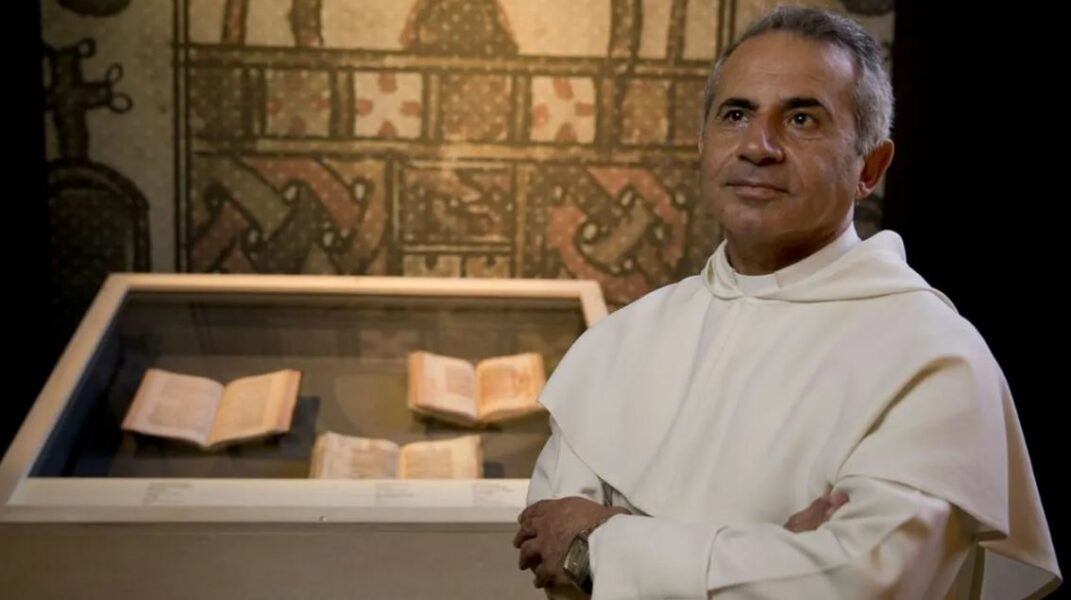
In the midst of the devastation caused by the Islamic State in Iraq, the figure of the Dominican Najeeb Michaeel emerges as one of those rare examples in which the defense of the faith and the custody of Christian memory merge into a single mission. According to The Aramaic Wire, this priest risked his life for years to save the world’s largest collection of Aramaic manuscripts, a documentary treasure spanning centuries of religious and cultural history in the Nineveh Plain.
He did it, moreover, practically alone. Long before the final irruption of the Islamic State in Mosul, Michaeel had already received death threats. In 2007, letters began arriving at the Dominican monastery in the city; inside each envelope was a broken cross and a bullet. His name was on a blacklist. But far from fleeing, he decided to begin a silent operation to save the manuscripts.
A clandestine evacuation before dawn
Every morning, before the sun rose, Father Najeeb dressed in civilian clothes and drove his old car to Mosul to transport boxes of manuscripts about 30 kilometers away. It was a long, discreet, and risky job, carried out box by box over months.
The collection he was trying to rescue was no small feat. It included Aramaic manuscripts dating back to the 9th century, as well as other Christian, Muslim, Jewish, and Yazidi texts. It was not just about preserving ancient documents, but about saving an essential part of the memory of the Middle East, threatened by fanaticism and barbarity.
The definitive rescue when ISIS was at the gates
The threat became extreme in August 2014, when the Islamic State was just days away from taking Mosul. Then, Michaeel repeated the salvage operation. He loaded two vehicles with manuscripts and 16th-century books and set off eastward during the night.
On board traveled centuries of history. Christian, Muslim, Jewish, and Yazidi manuscripts that bore witness to a plural civilization in the Nineveh Plain. At one of the checkpoints along the way, a girl pointed to the horizon. When they managed to pass the last post, the priest attributed their salvation to the protection of the Virgin: he was convinced that they had not arrived there only by their own strength.
The return to a desecrated monastery
After the liberation of Mosul, Michaeel returned to the Dominican monastery and found a devastating scene. The building had been turned into an arms depot. The library had been destroyed. The historic clock tower, donated in 1876 by the Empress of France and considered Iraq’s first clock, had been looted.
The most eloquent part of the disaster was perhaps the transformation of the temple itself: where there had once been an altar, the terrorists had erected a gallows. The place of prayer had been turned into a symbol of humiliation and death.
From custodian of manuscripts to Archbishop of Mosul
In 2019, the Church appointed Najeeb Michaeel Archbishop of Mosul, thus recognizing a trajectory marked by fidelity, courage, and the defense of Eastern Christian heritage. Today, he oversees more than 8,000 digitized manuscripts from 105 collections distributed across Iraq, Turkey, and Iran.
His story speaks not only of cultural preservation. It also speaks of Christian resistance in a land punished by persecution. While others destroyed centuries of faith and civilization, this priest understood that saving the manuscripts was also about saving the memory of a people and the continuity of a tradition that terror sought to erase.