


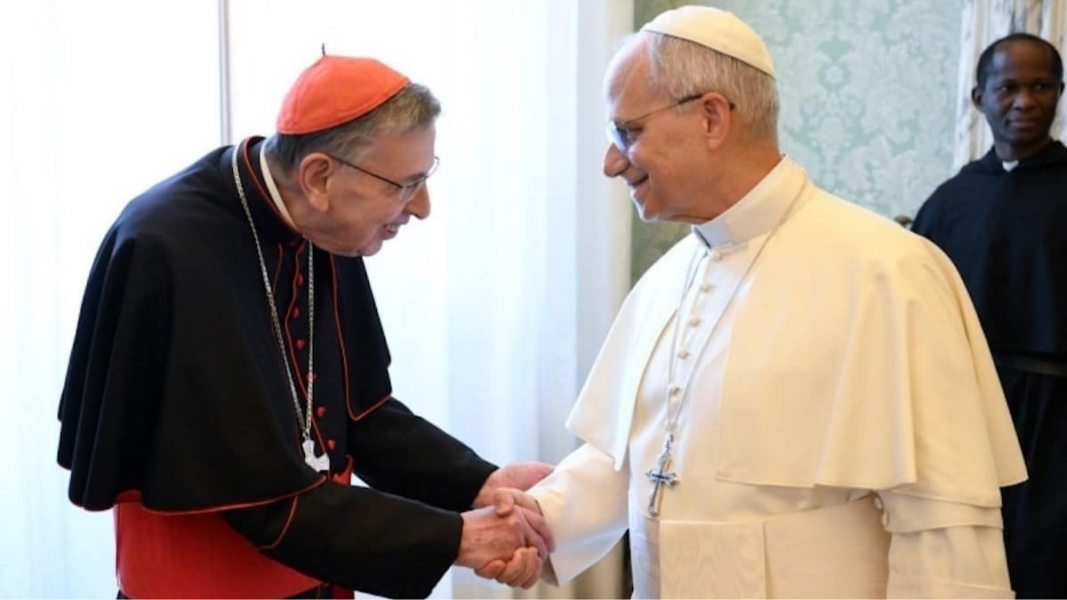
With little time left to mark one year since the election of Leo XIV, the underlying lines of his pontificate are beginning to take shape with greater clarity. It is not yet a closed balance, but rather a clear orientation. This is what Cardinal Kurt Koch, one of the Pope’s main collaborators, explains in an interview granted to France Catholique.
Far from offering a superficial analysis, the prefect of the Dicastery for Promoting Christian Unity synthesizes the current moment of the Church in three axes that, in his judgment, define the direction set by Leo XIV: Christ at the center, ecclesial unity, and the search for peace.
Christ at the Center of the Church
The first feature highlighted by Koch is the deeply Christocentric character of the pontificate. Leo XIV —he affirms— “is absolutely convinced that it is necessary to place Christ at the center of the Church,” not as a spiritual slogan, but as a condition for everything else.
Only from that centrality is it possible to address the second great challenge: unity. At a time when the Church is experiencing internal tensions and a plurality of currents, the Pope insists that communion cannot be built on human balances, but on a common reference: Christ.
Unity as an Internal Challenge
Koch does not evade reality. He recognizes that there are “many tendencies” in the Church and also “tensions,” which makes unity an urgent task. The issue is not only internal: a fragmented Church loses credibility when proposing reconciliation in the world.
“If the Church is a divided community, how could it help recover unity among Christians? How could it help recover peace in the world?”, the cardinal asks.
The model that inspires the Pope is not uniformity, but unity in diversity, in the image of the Trinity: distinct persons, but deeply united.
A Pontificate with Augustinian Roots
Another distinctive feature is the influence of St. Augustine, constant in Leo XIV’s speeches and homilies. Koch especially emphasizes the bond between Church and Eucharist, reprising a classic idea: “The Church makes the Eucharist and the Eucharist makes the Church”.
Also in this line is understood the Pope’s episcopal motto, In illo uno unum (“In Him who is One, let us be one”), which summarizes his vision: a diverse Church, but united in Christ.
Europe, a Background Concern
Within this general framework, a concrete concern emerges: Europe. Koch reveals that Leo XIV follows the spiritual situation of the continent with concern, where faith no longer holds a central place.
The cardinal expresses it with prudence, but without hiding the gravity of the diagnosis: faith in Europe “is in great danger of being forgotten”.
This loss is not only religious. It affects the very identity of the continent, which —he warns— runs the risk of emptying itself of content if it limits itself to sharing material interests without a common spiritual base.
A Shift in the Foundations of Society
The crisis manifests itself with special clarity in the area of human life. Koch points out a profound change in the conception of rights: “Before, the foundation of human rights was the right to life. But now it is said that it is the right to give death. It is the complete opposite”.
The reference points to current debates such as euthanasia, which the cardinal considers a symptom of the loss of fundamental references.
A Pontificate Under Construction
Almost one year after his election, Leo XIV thus appears, according to Cardinal Koch, as a pontiff with a defined profile: centered on Christ, oriented toward unity, and attentive to the challenges that threaten faith, especially in Europe. In a context of internal tensions and loss of references in the West, the Vatican prefect hints that the priority is none other than to recover that which sustains everything else: faith itself, without which —as emerges from his diagnosis— the Church loses its capacity to be a sign and Europe runs the risk of emptying itself of its own identity.