


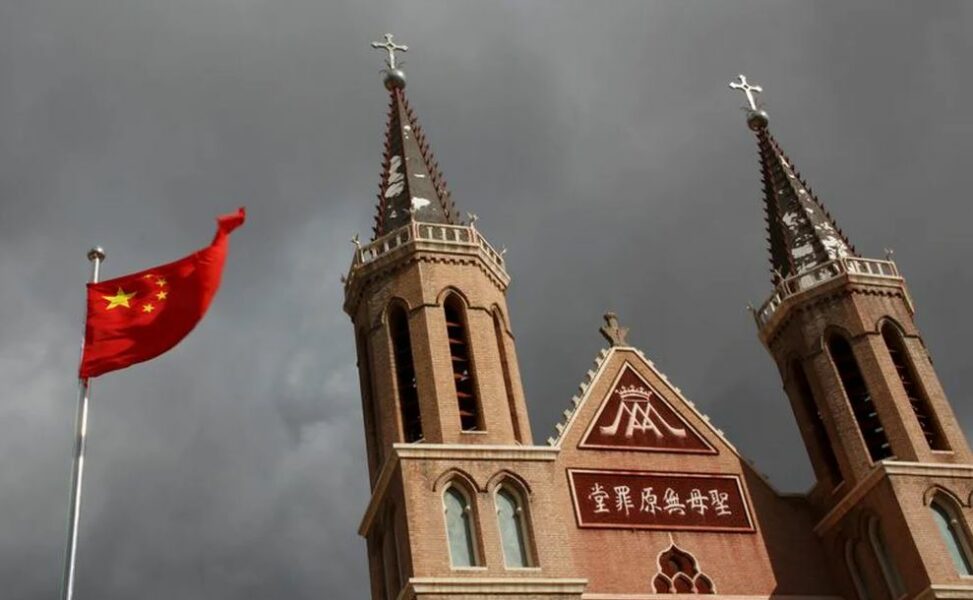
The agreement between the Holy See and China signed in 2018 is once again called into question following a new report from Human Rights Watch, which denounces an increase in pressure on Catholics in the country, especially those who remain outside the official state-controlled church.
Far from having improved the situation, the organization maintains that in these years a context of greater surveillance, ideological control, and restrictions on religious freedom has been consolidated, affecting the nearly 12 million faithful in China.
An Agreement Under Suspicion
At the center of the criticisms is the agreement itself on the appointment of bishops, whose content has still not been made public. According to Human Rights Watch, this framework has in practice facilitated the forced integration of underground communities into the Chinese Catholic Patriotic Association, dependent on the Communist Party.
Since its signing, there have been successive arbitrary detentions, disappearances, and house arrests of bishops and priests who resist submitting to state control, in a dynamic that questions the real effects of the pact.
The appointment mechanism has also not managed to contain the tensions. Although the Pope formally retains the possibility of veto, it has not been exercised, and the current Pontiff, Leo XIV, has approved candidates proposed by Beijing even after previous breaches by the regime.
The Underground Church, Increasingly Cornered
On the ground, the consequences are visible. The report collects testimonies that describe a progressive weakening of the underground communities, historically faithful to Rome and reluctant to integrate into the official structure.
In several cases, the pressure has translated into the demolition of temples, the removal of religious symbols, or the detention of faithful, to the point of leaving these communities without real margin for resistance. Some testimonies point out that the agreement has in fact served as an instrument to accelerate this process.
It is not only a matter of external control. Among part of the Catholics, a feeling of helplessness is also spreading, at a time when their fidelity faces growing difficulties.
The “Sinicization” and Total Control of Ecclesial Life
This hardening is inscribed in the “Sinicization” policy promoted by Xi Jinping, which seeks to subordinate religious life to the ideology of the Communist Party.
The control is not limited to underground communities. Official churches are also subjected to strict supervision: mandatory ideological training for the clergy, censorship of content, restrictions on pastoral activity, and limitations on religious education, especially for minors.
Even the movements of the clergy are subject to state authorization, in a system that extends political control to all areas of ecclesial life.
A Tension That Does Not Disappear
In this context, the situation of Catholics in China once again highlights an underlying tension that remains unresolved: the coexistence between a diplomatic agreement with the regime and the effective defense of religious freedom.
On April 7th, the organization forwarded the results of the report to both the Chinese government and the Holy See. To date, neither has responded to the request for comments.