


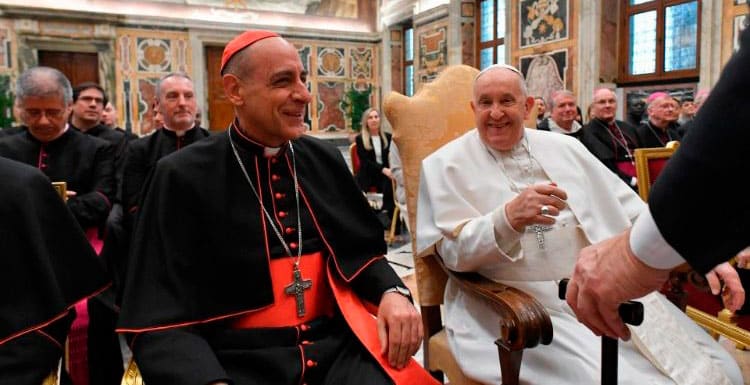
At the gates of the first anniversary of the death of Pope Francis, the prefect of the Dicastery for the Doctrine of the Faith, Cardinal Víctor Manuel Fernández, has come out to firmly defend the continuity of his legacy against those who point to a change of course with Leo XIV. In an interview granted to Il Giornale, the cardinal has stated without nuances that “to say that Pope Leo wants to cancel what was done in Francis’s pontificate is dishonest”.
The Argentine cardinal, a key figure in the last pontificate and not without controversy in doctrinal spheres, insists that the current Pope not only does not distance himself from his predecessor, but actively promotes its reception.
Leo XIV asks to reread Francis
Tucho maintains that Leo XIV has given concrete indications in that line. “To us cardinals, before the consistory, he asked us to reread Evangelii gaudium and then invited us to reflect again on its application,” he explains. Likewise, he points out that the Pope has convened the presidents of the episcopal conferences “to resume the reception of Amoris laetitia”.
In his view, these gestures demonstrate that “Francis is not underground,” a striking expression with which he intends to underscore the validity of his magisterium. However, he introduces a criticism of those who did not assume it: “For those who rejected each of his teachings or for those who received them only in appearance, his pontificate will have been only a bad interlude”.
“Humble yourself and trust”: the personal memory of Francis
In evoking his last encounters with the Argentine Pope, Fernández offers a testimony of markedly personal tone. “In one of the last audiences I had with him, when he could hardly speak anymore, he looked at me, smiled, and repeated a phrase to me: ‘Humble yourself and trust’,” he recounts.
As he explains, the meaning of those words was clear: “To renounce every form of pride and to have gestures of humility, because in that way God can do a great work through one’s own person”.
Continuity or tension: the background of the debate
The prefect insists that there is no break between pontificates, but complementarity: “Between Leo and Francis there are many points in common; more than opposition, one should see complementarity”.
However, his own words reflect that the debate remains open within the Church, especially on sensitive issues of the recent magisterium. Fernández claims, for example, “his insistence on speaking with the heart of the Gospel, as an announcement of infinite love,” as well as the application of the so-called hierarchy of truths to all preaching.
He also defends the condemnation of the death penalty promoted by Francis, noting that “even today, unfortunately, the most traditionalist groups resist”.
No new assignments from Leo XIV to the Dicastery
One of the most striking points of the interview is the reference to the current functioning of the Dicastery for the Doctrine of the Faith. Tucho assures that the Pope has not imposed new specific tasks: “The requests that come from the bishops and from other dicasteries are so many that the Holy Father tries not to add more commitments”.
This statement contrasts with what happened in the previous pontificate. Under Francis, the dicastery received concrete assignments to prepare doctrinal documents, some of which are still pending publication. Among them, a text on the transmission of the faith, previously mentioned by officials of the organization itself, but on which the prefect now offers no update.
The silence on this pending document is significant, especially at a time when Fernández himself recognizes that “today many do not reject the faith, but consider it unnecessary”.
Parish life: a community of charisms and experiences
In addressing how faith should be lived today in the concrete sphere of parishes, Fernández proposes a model that emphasizes the diversity of experiences. “A community full of charisms, where everyone experiences freedom and appreciation from others to make those gifts flourish with joy and hope,” he describes.
According to the prefect, this type of community would allow generating “a communion full of richness, colors, and fascination,” in which each faithful finds their place. At the same time, he insists on the need to offer “diverse spaces for personal encounter with Christ,” emphasizing “diverse” because “sensitivities are different”.
A crisis of faith marked by superficiality
On the pastoral level, the prefect describes a worrying underlying situation: “We live in enormous distraction, an excess of noise from social networks and the world in general.” In his view, this dynamic leads to a superficial faith, more weakened by indifference than by frontal opposition.
As a response, he proposes starting from human experience: “The experience that everyone has of dissatisfaction, emptiness, lack of meaning in life,” along with the desire for fraternity and openness to a personal relationship with Christ.
However, his approach insists on a line that is already habitual: avoiding both immobility and rigid positions. “The effort must be made by all, conservatives and progressives, because in everyone there is the temptation to enclose themselves in their own schemes,” he concludes.