


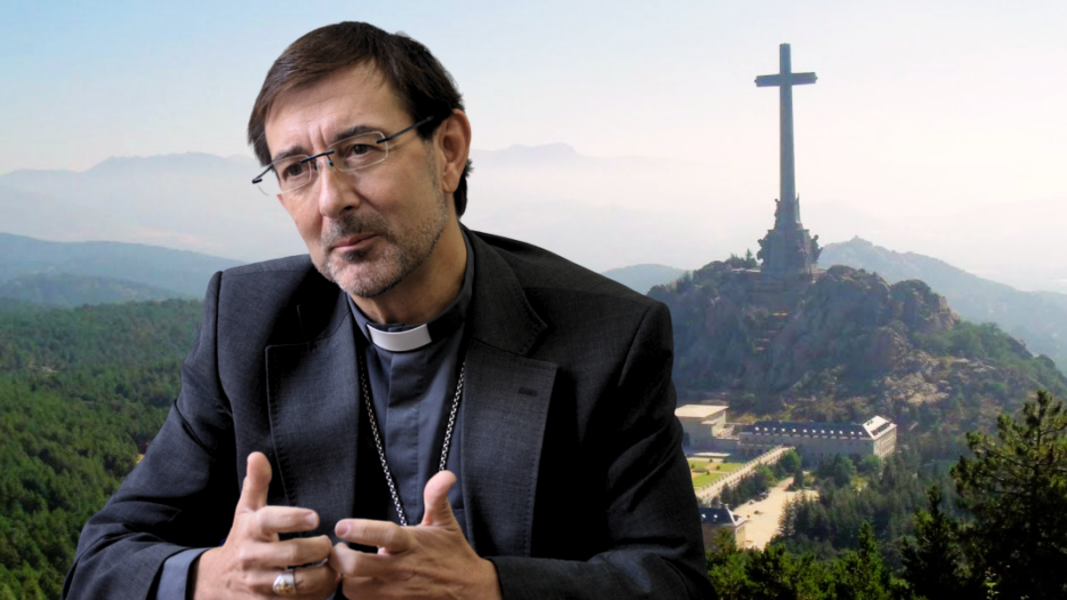
A surprising message from Cardinal José Cobo Cano is circulating these days among no few priests and some bishops, leaving both perplexed, as well as a considerable number of the faithful, especially those of the Archdiocese of Madrid, who are the most directly affected. The message would justify the signing of the agreement with the Government subscribed to by the Archbishop of Madrid, Cardinal Cobo. Thanks to the archbishop’s intervention, the «sacrality of the basilica» would have been «saved» and greater evils avoided, including the eventual expulsion of the monastic community.
As this same digital outlet said on April 22, «the agreement is wet paper.» Cardinal Cobo’s intervention neither ‘dries’ nor gives any validity to the paper, given that this agreement «would affect the sacred nature of the Pontifical Basilica of the Holy Cross of the Valley of the Fallen, which, being pontifical, requires express intervention from the Holy See.» This hardly disputable argument is the one that supports the complaint that, in February 2026, the Abogados Cristianos Foundation presented before the National Court. Therefore, it is reasonable to think that Cardinal Cobo’s lack of competence, as the signer of that paper, allows us to expect that there are good legal reasons to believe that the agreement will not produce the destructive effects it intended for the Valley, but it may have destroyed the credibility and trust in the Archbishop of Madrid and could erode, if something forceful is not done, the bond of Spanish faithful with their bishops. The consequences for the solidity of the Spanish Church’s structure would be terrible.
To the readers of this medium, the cardinal’s insistence on boasting about the agreement in such a strange way will not seem novel, since this tiresome refrain was spread around these same dates last year, in the days prior to the episcopal Plenary, and is relaunched now, on the eve of the next Plenary Assembly and the Pope’s visit. The explanation, then as now, seems to have come from the cardinal and his entourage, as they now say, and it does not withstand, then or now, the slightest analysis.
What sacrality has exactly been saved when the secret agreement signed by Cardinal Cobo, at the Government’s behest, as we were told, on that ill-fated March 4, 2025, drastically and categorically reduces the worship space to the altar and some adjacent pews, leaving the rest of the basilica—including the nave, the dome over the altar, and the access—at the disposal of a process of political and ideological resignification of a civil-warist character? Can it seriously be sustained that the sacred is preserved when the fragmentation of a consecrated temple and the alteration of its essential unity are accepted in writing?
Where would the faithful who have packed the basilica, including the central nave, in the liturgical acts of this recent Holy Week, have been placed if the project backed by the archbishop had already been in effect and the worship space reduced to a small number of pews? These days, the Valley has been filled with families doing the Way of the Cross and attending the offices of Holy Thursday and Good Friday. The spiritual fruits of times like these are immense, and I imagine they will be to the liking of the Spanish bishops, some of whom I know have been impressed by such promising attendance of the faithful. Would the bishops think that something had been saved with the agreement? Something holy, I mean.
Nor does the second part of the explanation given by Cardinal Cobo offer greater consistency. Where is there documented in the document an effective guarantee on the part of the Government that it will refrain from attempting the expulsion of the monks? In what clause is that supposed commitment recorded?
It is evident that the faithful have demonstrated through facts that the Valley of the Fallen matters to them, and a lot. This same Holy Week, and all Holy Weeks, as well as in all liturgical celebrations over the years, and every time they are summoned. From those campaign Masses, when the complete closure of the nave in 2010, to the recent convocations of these years, which have collapsed the entrances. The Archbishop of Madrid himself acknowledges that on every visit to Madrid’s parishes he is asked about this issue: people want to continue going to the Valley and finding an unprofaned church, and they view with concern that anything affecting such a beloved basilica could be agreed upon with the Government. There is nothing good to expect from a government that boasts of knocking down crosses.
Furthermore, it is that same government, surrounded by numerous indications of irregularities, whose actions are continually exposed in the newspapers as suspicious of such shameful conduct that, today itself, have led very relevant figures from its entourage to sit before the Supreme Court. It is with this type of «interlocutors,» and no others, that Cardinal Cobo signed an agreement of which he boasts, and for which, moreover, he lacked competence. Do the Spanish bishops think that the faithful of their dioceses will easily believe that their own bishop knew nothing of the agreement signed by Cardinal Cobo? And, if he was not informed, why has nothing been said? It will end up happening. It is already happening.
Every Good Friday, in Valladolid, a multitude gathers around its bishop and the preacher of each year, who comments on each of the Seven Words that Our Lord said from the Cross. The chosen one for this occasion was the Archbishop of Oviedo, Monsignor Jesús Sanz Montes, accompanied by the Bishop of Valladolid, Don Luis Javier Argüello. A special affection toward the visiting bishop was perceived. His sermon was brilliant and well-directed to a society «that asks for a little thirst, because it is dying of water.» The thirst of the Spanish faithful appears in springs like the Valley of the Fallen, and their thirst for truth cannot be quenched with stagnant water.