


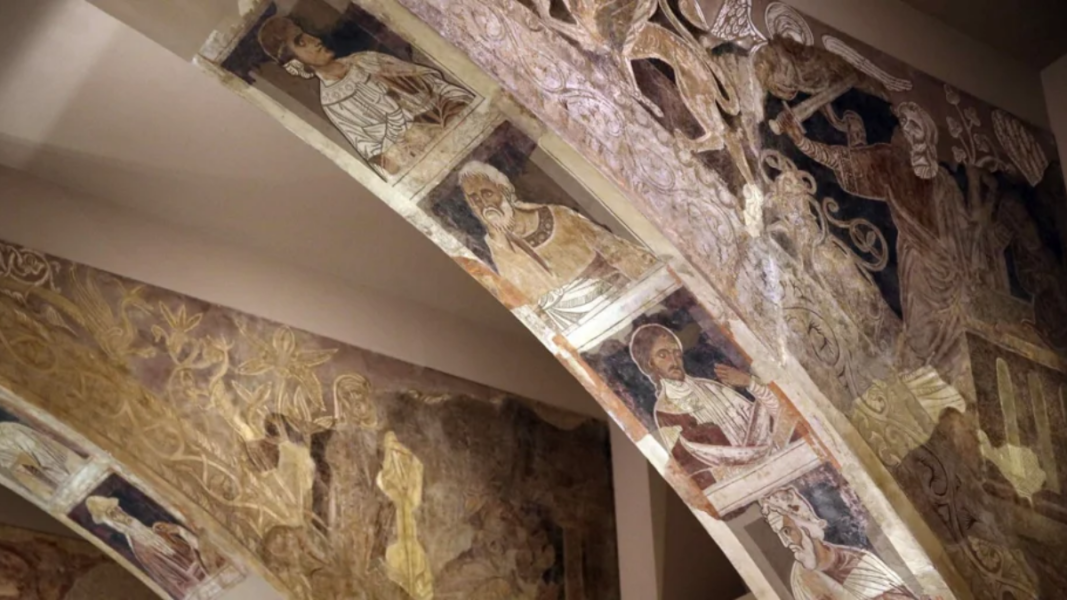
The murals of the Real Monasterio de Santa María de Sijena must return to Aragón within a maximum period of 56 weeks, after the judge in charge of executing the Supreme Court ruling has set the calendar for their return. However, the transfer continues to be wrapped in resistances and appeals from the Catalan institutional environment, which prolongs a conflict that has been dragging on for decades.
According to El Mundo, the restitution of this set, linked from its origin to the religious life of the monastery, continues to not materialize in practice, despite the firm judicial resolutions.
From its liturgical origin to the start in the Civil War
The paintings, made in the 13th century, were part of the Chapter House of the Sijena monastery, integrated into a space designed for prayer, contemplation, and the teaching of the faith.
In 1936, after the fire at the convent during the Civil War, the works were removed using the strappo technique by a team led by Josep Gudiol. They were subsequently transferred to Barcelona, where they have remained since 1940 in the MNAC.
That transfer, carried out in a context of urgency, also meant the separation of the paintings from their original location and from the spiritual function for which they were conceived.
From the Supreme Court ruling to judicial execution
The litigation took a decisive step in May 2025, when the Supreme Court confirmed the obligation to return the murals to Sijena, putting an end to the judicial process regarding their ownership.
On April 13, the judge in Huesca in charge of executing the sentence has set a maximum period of 56 weeks to complete the transfer, as detailed by El País. The resolution establishes that the process must be carried out with all technical guarantees, but makes it clear that the return must be executed.
For its part, the MNAC has announced its intention to appeal, although the resolution itself warns that the execution is not suspended for that reason.
Technical arguments and opposition to the transfer
The Catalan museum argues that the paintings present extreme fragility due to the damage suffered in the 1936 fire, which altered their structure and caused cracks and detachments.
According to its managers, any transfer entails risks to the integrity of the works. However, the judicial resolution reminds that the expert reports have not concluded that the transfer is unfeasible, provided it is carried out with the appropriate means.
From Aragón, it is insisted that there are sufficient technical conditions and that the Chapter House, already restored, is prepared to receive the paintings again.
A dispute that goes beyond the technical
The case has incorporated elements of political tension. According to El Debate, Junts per Catalunya has asked to halt the transfer of the paintings, linking it to other debates on cultural heritage, such as that of Guernica.
However, sources cited by El Debate maintain that the comparisons are not equivalent. The Sijena paintings remained in their original location for more than seven centuries, forming part of a specific religious ensemble, before their transfer in the context of the Civil War.
The meaning of their restitution
In Sijena, the Chapter House has been conditioned to once again house the paintings, with systems for controlling light, temperature, and humidity.
The works were not created as independent pieces, but as part of a specific religious space, linked to monastic life and the transmission of the faith. Their return does not mean merely a material transfer, but the recovery of that bond.
More than ninety years after their departure, the paintings remain outside the place for which they were conceived, while a judicial process advances that has already set deadlines for their return, but whose execution continues to be conditioned by technical objections and resistances that have so far prevented their effective return to the Real Monasterio de Santa María de Sijena.