


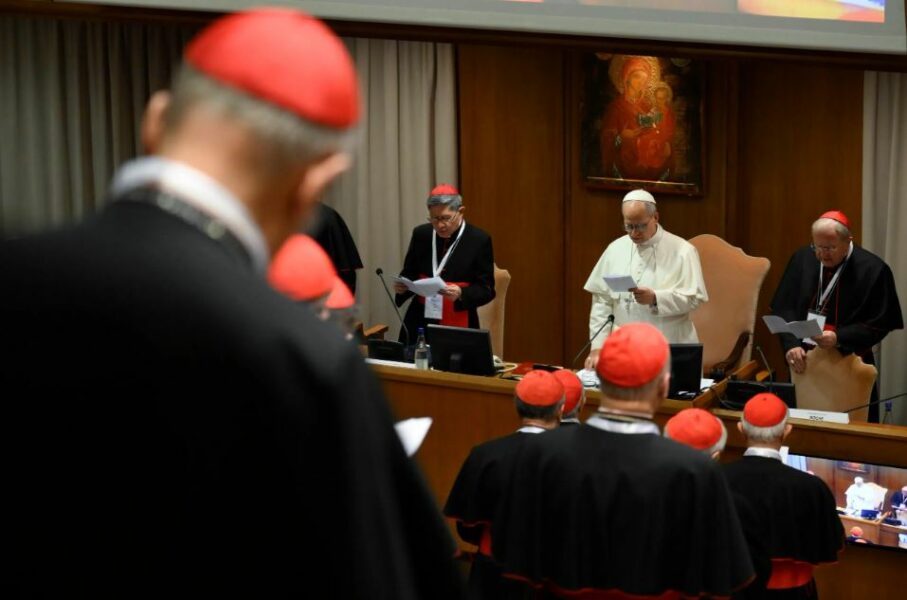
Pope Leo XIV has sent a letter to the cardinals, dated April 12 and released on this April 14, in which he proposes to refocus the life of the Church on the proclamation of Christ and the transmission of faith. In the text, the Pontiff takes up the conclusions of the consistory held in January and emphasizes the role of the exhortation Evangelii gaudium as a reference for the ecclesial mission.
The letter, published by the Holy See, is framed in the Easter season and has as background the preparation for the next consistory scheduled for the end of June.
Evangelii gaudium as a point of reference
Leo XIV highlights that the apostolic exhortation Evangelii gaudium remains a key document for understanding the Church’s mission. As he explains, it is not so much about introducing novelties as about recovering the core of the Christian message.
In the Pope’s words, this text “recenters everything on the kerygma as the heart of Christian and ecclesial identity” and has been recognized as a “true new breath,” capable of driving processes of pastoral and missionary conversion.
From a received faith to a lived faith
The Pontiff emphasizes that this call affects all levels of ecclesial life. At the personal level, he invites every baptized person to renew their encounter with Christ, moving from a merely inherited faith to a lived faith.
In this context, he insists on the importance of spiritual life, the primacy of prayer, and the coherence between faith and life, as well as the value of witness, which “precedes words.”
A Church with missionary impetus
At the community level, Leo XIV raises the need to overcome a “pastoral of conservation” to make way for a missionary pastoral. The communities, he notes, must become active subjects of proclamation, characterized by welcome, closeness, and the capacity for accompaniment.
Also at the diocesan level, the Pope emphasizes the responsibility of pastors, called to sustain missionary boldness without letting it be “suffocated by organizational excesses.”
A mission centered on Christ and free from proselytism
The letter presents a vision of the mission as a unitary reality, centered on Christ and on the essential proclamation of faith. It is, he states, a mission that “spreads by attraction rather than by conquest” and that integrates proclamation, witness, commitment, and dialogue.
The Pope also warns against two risks: proselytism and a purely institutional logic. Even in minority contexts, he adds, the Church is called to live “without complexes,” as a “small flock bearing hope.”
Call to review the transmission of faith
Among the concrete indications, Leo XIV proposes to relaunch the reception of Evangelii gaudium to evaluate which aspects have really been assumed and which remain pending.
Likewise, he points out the need to review the processes of Christian initiation, improve ecclesial communication in a missionary key, and make use of pastoral visits as occasions for the proclamation of the Gospel.
Preparation for the next consistory
The letter concludes with thanks to the cardinals for their participation in the January consistory and with the announcement of a forthcoming more detailed communication to prepare for the meeting on June 26 and 27.
We leave the full letter below:
Most Reverend Eminence:
In the holy time of Easter, I wish to extend my cordial and fraternal greeting to you, so that the peace of the Risen Lord may sustain and renew our suffering world.
I gladly take this opportunity to renew my gratitude for your participation in the Consistory of last January. I greatly appreciated the work done in the groups, which allowed for a free, concrete, and spiritually fruitful exchange, as well as the quality of the interventions in the assembly. The contributions gathered constitute a precious heritage, which I wish to continue safeguarding and maturing in ecclesial discernment.
In the closing discourse of that meeting, I already pointed out some elements emerging from the groups dedicated to synodality. I now wish to dwell in particular on what has matured in the groups in relation to Evangelii gaudium, especially regarding the mission and the transmission of faith.
From your contributions, it clearly appears how this Exhortation continues to represent a decisive point of reference: it does not simply introduce new contents, but recenters everything on the kerygma as the heart of Christian and ecclesial identity. It has been recognized as a true “new breath,” capable of initiating processes of pastoral and missionary conversion, rather than producing immediate structural reforms, thus orienting the Church’s path in depth.
They have emphasized how this perspective challenges the Church at all levels. At the personal level, it calls each baptized person to renew the encounter with Christ, moving from a faith simply received to a faith truly lived and experienced; in this path, the very quality of spiritual life is also involved, in the primacy of prayer, in the witness that precedes words, and in the coherence between faith and life. At the community level, it drives the shift from a pastoral of conservation to a missionary pastoral, in which communities are living subjects of proclamation: welcoming communities, capable of comprehensible languages, attentive to the quality of relationships, and able to offer spaces for listening, accompaniment, and healing. At the diocesan level, the responsibility of Pastors emerges clearly to decisively sustain missionary boldness, watching so that it is not weighed down or suffocated by organizational excesses, and favoring a discernment that helps recognize the essential.
From all this emerges a deeply unitary understanding of the mission: a Christocentric and kerygmatic mission, born of an encounter with Christ capable of transforming life and that spreads by attraction rather than by conquest. It is an integral mission, which keeps together the explicit proclamation, witness, commitment, and dialogue, without yielding to the temptation of proselytism or to a logic of mere conservation or institutional expansion. Even when recognized as a minority, the Church is called to live without complexes, as a small flock bearing hope for all, remembering that the end of the mission is not its own survival, but the communication of the love with which God loves the world.
Among the specific indications that have emerged, some deserve to be welcomed and further meditated: the need to relaunch Evangelii gaudium to honestly verify what, over the years, has really been assumed and what, on the other hand, remains still unknown or not applied; in particular, attention must be paid to the necessary reform of the paths of Christian initiation; the convenience of also valuing apostolic and pastoral visits as authentic kerygmatic occasions and for growth in the quality of relationships; as well as the demand to reconsider the effectiveness of ecclesial communication, also at the level of the Holy See, in a more clearly missionary key.
With a grateful spirit, I renew my recognition for your service and for the contribution offered to the life of the Church. With a view to the next Consistory, which will take place on June 26 and 27, a more detailed communication will follow to adequately accompany its preparation.
In the Risen Lord, source of our hope, may my most cordial Easter greetings reach you.
With fraternal esteem, in Christ.
From the Vatican, April 12, 2026
LEÓN PP. XIV