


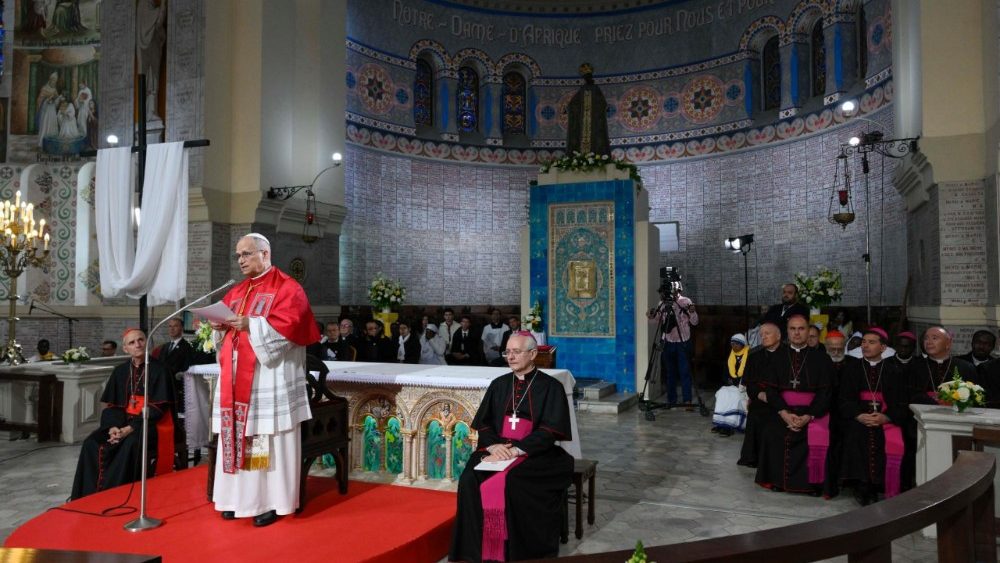
No, there is no “communion” between Christians and Muslims
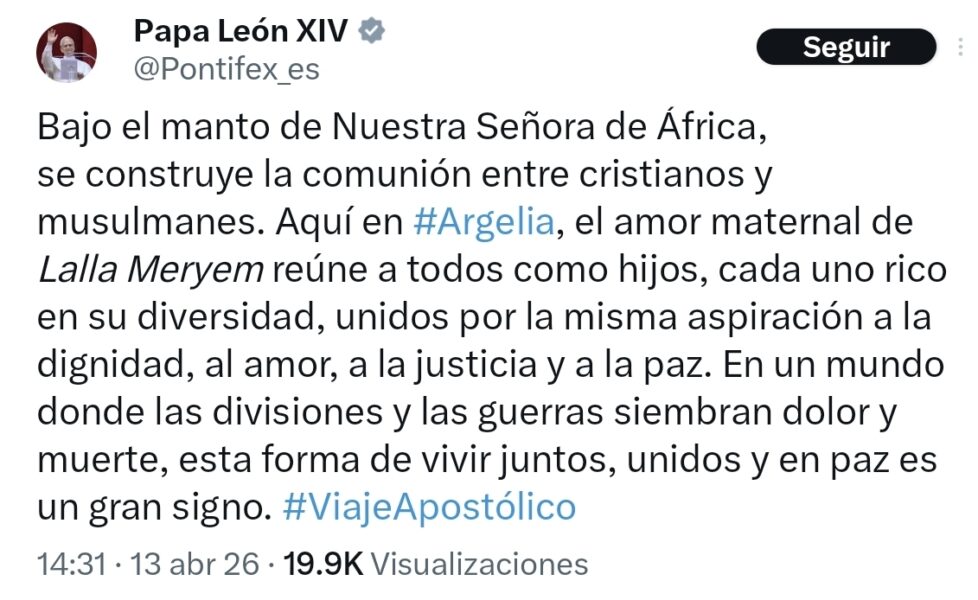
There are words in politics that serve to embellish a speech, but in the mouth of a pope or a pontifical account, they cannot be used as if they were putty. “Communion” is one of them. The Spanish tweet from @Pontifex_es about Algeria does not limit itself to praising coexistence, social peace, or cooperation between people of different religions. It goes quite a bit further. It states that “under the mantle of Our Lady of Africa, communion is built between Christians and Muslims.” And that is exactly where the problem lies. Not in courtesy toward Muslims. Not in the desire for peace. Not in the possibility of civil collaboration. The problem is in calling “communion” something that, in the Catholic sense, it is not.
In the language of the Church, communion is not a kindly emotion nor a feel-good metaphor to designate that people get along reasonably well. Communion has an objective doctrinal content. The Catechism explains that the unity of the Church is ensured by “visible bonds of communion”: the profession of the same faith received from the Apostles, the common celebration of divine worship and the sacraments, and apostolic succession through the sacrament of holy orders. That does not describe mutual sympathy. It describes effective belonging to the same supernatural reality founded by Christ. If there is no same faith, if there are no same sacraments, if there is no ecclesial communion, speaking of “communion” ceases to be Catholic precision and becomes terminological confusion.
Catholic doctrine itself distinguishes quite clearly between non-Catholic Christians and the faithful of non-Christian religions. Regarding separated Christians, the Catechism speaks of a “certain communion, though not perfect,” founded on valid baptism and faith in Christ. That formulation already shows that the word “communion” is not distributed indiscriminately. It is applied, though imperfectly, where there is baptismal incorporation into Christ and a real, though wounded, bond with the Church. That logic cannot be transferred as is to Islam, because Islam does not baptize in Christ, does not confess Jesus Christ as Son of God, does not recognize the Trinity nor participate in the sacramental order of the Church. Between Catholics and Orthodox, one can speak of imperfect communion. Between Christians and Muslims, no.
It is appropriate here to anticipate the usual reply. Lumen gentium 16 or Nostra aetate 3 will be cited immediately, where the Council states that Muslims “with us adore the one, merciful God” and that the Church regards them with esteem, recognizing in them elements of religious truth, a serious moral life, and the practice of prayer, almsgiving, and fasting. All that is true. And precisely because it is true, it is advisable to read it in full and not mutilate it. The Council does not say that there is ecclesial communion with Islam. It says something very different: that there is a reference to the Creator, that partial goods and truths exist, and that this justifies respect, dialogue, and collaboration. Moreover, Nostra aetate recalls at the same time that the Church “announces and has the obligation to announce constantly Christ,” in whom men find the fullness of religious life. In other words, respect yes; indifferentism, no. Dialogue, yes; doctrinal liquefaction, no.
The problem with the tweet is not, therefore, that it is too kind to Muslims. The problem is that it erases a conceptual boundary that the magisterium itself preserves. One thing is to recognize that a Muslim, as a rational creature, can sincerely seek God, live with moral rectitude, and participate in certain goods that grace does not cease to sow in the world. A very different thing is to present that situation as “communion.” Because communion, for the Church, arises from Christ and leads to Christ. It does not simply spring from the common aspiration to dignity, love, justice, and peace. Those aspirations are human and noble, but they do not constitute the supernatural communion of the Church in themselves. Reducing communion to an ethical consensus is to empty it of its specifically Christian content.
The key is not to confuse levels. There can be social coexistence without communion of faith. There can be cooperation for justice without religious unity. There can be mutual esteem without sharing the Christian revelation. It can even be affirmed, with the Council, that Muslims worship the one Creator God, in the sense that their religious intention is not directed toward a plurality of pagan gods, and at the same time maintain without wavering that they reject essential truths of the Christian faith: the Trinity, the divine filiation of Christ, the Incarnation, and the Redemption as confessed by the Church. As soon as that is forgotten, the difference between full truth and partial truth disappears under a sentimental fog. And that fog always favors error.
In fact, the Catechism expressly states that the Christian faith cannot accept “revelations” that claim to surpass or correct the definitive Revelation given in Christ, and adds that this is the case with certain non-Christian religions. The phrase has a direct scope for Islam, which historically presents itself as a subsequent revelation that corrects central elements of Christianity. That does not prevent respect toward Muslims as persons, but it does prevent diluting the doctrinal difference under ambiguous expressions. If Christ is the full and definitive revelation of the Father, then one cannot speak lightly of religious communion where that fullness is denied.
Dominus Iesus was also published precisely to cut off these drifts. The document recalls that interreligious dialogue is part of the evangelizing mission, but “does not substitute” the missio ad gentes. And it warns against relativism that disfigures the definitive character of the revelation of Jesus Christ, the uniqueness of the Christian faith, and the unique salvific nature of Christ and the Church. Even more: it affirms that men cannot enter into communion with God except through Christ and under the action of the Spirit. That affirmation is enough to measure the lightness of the tweet. Because when the magisterium speaks of communion in a strong sense, it links it to Christ, to the Church, and to the economy of salvation, not to an interreligious atmosphere of shared cordiality.
It will be said that it is pastoral language, not a dogmatic definition. But precisely there lies the danger. Most of the faithful do not read conciliar documents or declarations from the Congregation for the Doctrine of the Faith. They read headlines, phrases, tweets, and slogans. And if technically incorrect vocabulary is used from official channels, the practical result is deformed catechesis. The average faithful ends up concluding that all religions are, in the end, variants of the same experience of God; that the mission no longer consists in announcing Christ, but in accompanying diverse spiritualities; and that the Church must renounce doctrinal precision to be welcoming. That is not pastoral. That is intellectual disarmament.
There is still another significant detail. The tweet places that supposed “communion” under the mantle of Our Lady of Africa and speaks of the maternal love of Lalla Meryem that gathers all as children. The image may sound poetic, but there too a serious ambiguity slips in. Mary occupies in Christianity a place inseparable from the Incarnation of the Word. She is Mother of God because the Son born of her is true God and true man. In Islam, on the other hand, Mary is venerated, yes, but within a radically downgraded Christology, where Jesus is not the incarnate Word nor the crucified and risen Redeemer. Invoking Mary as a common mantle without recalling the Christological truth that defines her is another way of using Catholic symbols for vaguely conciliatory purposes, but doctrinally deactivated. Nostra aetate recognizes that Muslims honor Mary, but in the same passage recalls that they do not recognize Jesus as God. That precision is not secondary. It is the central issue.
The Church does not need hostility toward Muslims. It needs exactitude. It does not need verbal aggressiveness. It needs conceptual clarity. No one disputes that Christians and Muslims can live together, collaborate for the common good, reject violence, and defend human dignity. The Council expressly recommends it. What cannot be done is to call “communion” what, according to Catholic doctrine itself, is at most coexistence, dialogue, cooperation, or a relationship of respect. Changing the name of things does not improve reality. It only makes it more confusing.
The underlying issue is more serious than it seems. When ecclesial language ceases to be precise, the faith becomes blurred. And when the faith becomes blurred, the mission is paralyzed. If communion no longer requires the same faith, the same baptism, and the same incorporation into Christ, then there are no longer reasons to evangelize. It will suffice to celebrate differences, praise ethical convergences, and produce well-intentioned texts. But that is not Catholic logic. The Church exists to announce Jesus Christ, not to dissolve him into a universal spirituality of diplomatic tone. Lumen gentium opens precisely by affirming that Christ is the light of the nations and that the Church desires to announce the Gospel to every creature. And the Catechism insists that the missionary effort begins with the announcement of the Gospel to the peoples who still do not believe in Christ. If that remains true, then one should not speak as if communion were already built where the essential is still lacking.
In sum, the tweet does not scandalize because of excess courtesy, but because of a defect in theology. With a single word misused, it blurs the difference between human relationship and supernatural communion, between respect and unity of faith, between dialogue and ecclesial belonging. And when a pontifical account normalizes that confusion, it is not building religious peace, but weakening the Catholic intelligence of those who read it. There are terms that a journalist can use lightly. A pope cannot. And “communion,” certainly, is one of them.